
Cloudy pool water is almost always caused by one of four things: low free chlorine, pH or alkalinity out of range, a filter that is not doing its job, or fine particles suspended in the water that the filter cannot grab on its own. Test your water first – that single step tells you which fix to start with. Most cloudy pools clear up within 24 to 48 hours once you correct the root cause and run the filter continuously.
Why Does Pool Water Turn Cloudy in the First Place?
Cloudiness happens when something is floating in your water that does not belong there – dead algae cells, body oils, sunscreen residue, calcium particles, or microscopic debris. Clear water is water where those particles are either absent or have been trapped by your filter. When your sanitizer drops, particles multiply faster than the filter can remove them. When your pH climbs above 7.8, calcium starts coming out of solution and gives the water a white, milky haze. When your filter is clogged or undersized, particles just keep circulating.
Heavy bather load is one of the most underrated causes. A pool that had a party on Saturday will often look hazy by Sunday morning – the chlorine got consumed by sunscreen, sweat, and body oils faster than it could keep up. Rain is another common culprit: it dilutes chlorine, drops the pH, and washes organic debris into the water all at once.
How Do You Diagnose Cloudy Pool Water?
Start with a test before you add anything. You need to know your free chlorine level, pH, total alkalinity, and cyanuric acid (CYA) level. Here is what to look for:
- Free chlorine below 2 ppm: This is the most common cause of cloudy water. Low sanitizer lets bacteria and organic matter accumulate fast.
- pH above 7.8: High pH causes calcium carbonate to precipitate out of the water, creating a white haze. It also makes chlorine much less effective – at pH 8.0, roughly 80% of your chlorine is in an inactive form.
- Total alkalinity above 120 ppm: High alkalinity pushes pH up and contributes to cloudiness, especially in pools with hard fill water.
- CYA above 80 ppm: High stabilizer locks up chlorine, meaning your test strip might show adequate chlorine but almost none of it is actually working.
- Chemistry looks fine but water is still hazy: The problem is almost certainly your filter – it is either dirty, damaged, or not running long enough to turn over the full volume of water.
If you are unsure how often you should be testing, How Often Should You Really Test Your Pool Water? lays out a practical schedule based on how heavily your pool is being used.
What Is the Fastest Way to Clear a Cloudy Pool?
The fastest fix depends on your diagnosis, but here is the sequence that clears most cloudy pools quickly:
- Test the water. Do not skip this step. Adding shock to a pool with a pH of 8.2 is mostly wasted effort.
- Adjust pH to 7.4 to 7.6. Use muriatic acid or dry acid to bring pH down if it is above 7.8. This step makes everything else work better.
- Shock the pool. Add 1 lb of calcium hypochlorite shock (68% or higher) per 10,000 gallons of water. If the water is milky or you suspect combined chlorine, double the dose. Shock at dusk so UV does not burn it off before it can work.
- Run the filter continuously. Do not give it a break. Run pump and filter 24 hours a day until the water clears. This is the step most people skip, and it is why their pool stays cloudy for days.
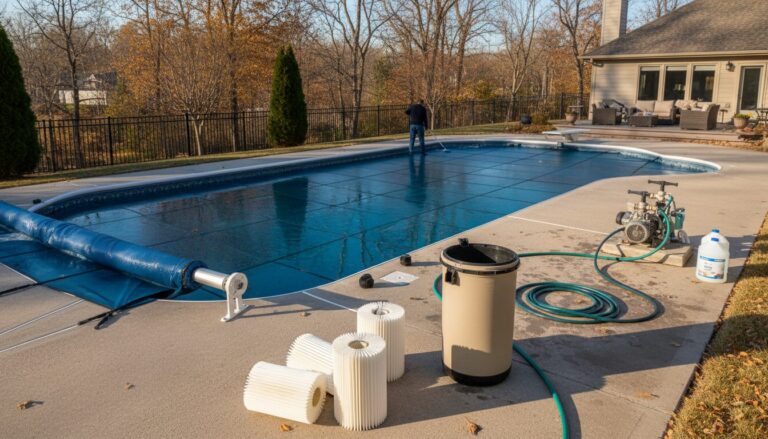
- Clean or backwash your filter. A dirty filter cannot clear cloudy water – it will just recirculate particles. Backwash your sand or DE filter, or rinse your cartridge. If pressure is more than 8 to 10 psi above baseline, clean the filter before you do anything else.
- Add a clarifier if needed. If chemistry is balanced and the filter is clean but the water is still dull after 24 hours, a clarifier helps by clumping fine particles so the filter can catch them. AquaDoc makes a pool clarifier that pool owners use specifically for this kind of lingering haze after chemistry has already been corrected. Follow the label dosing – more is not better with clarifiers, and overdosing can actually make the water worse.
When Should You Use a Flocculant Instead of a Clarifier?
A clarifier keeps particles in suspension long enough for your filter to grab them – the process takes 24 to 48 hours. A flocculant works differently: it causes particles to clump and sink to the bottom, where you vacuum them out manually. Flocculant is the right choice when your pool is severely cloudy (you cannot see the bottom) and you need it clear fast – for an event, for example. The trade-off is that you have to vacuum to waste, not back through the filter, and the pool will need to rest with the pump off for several hours while the particles settle.
For most everyday cloudiness – the kind that follows a busy weekend or a rainstorm – a clarifier plus good filter run time is the better and easier path.
Common Mistakes That Keep a Pool Cloudy Longer
Running the pump only 8 hours a day while trying to clear a cloudy pool is the single biggest mistake pool owners make. Your filter cannot clean what it does not process, and if your pool’s volume is not turning over fast enough, you are fighting the problem with one hand tied. Run the pump continuously until the water is clear, then drop back to your normal schedule.
Adding more and more chemicals without testing is another trap. Pouring in clarifier, then shock, then algaecide, then more shock without understanding the root cause often makes water worse, not better. One bad test result showing pH at 8.0 explains 80% of chronic cloudiness problems. Fix that first.
Neglecting the filter after you shock is also a frequent misstep. Shocking kills and dislodges a huge amount of organic material. All of it ends up in your filter. If you do not clean or backwash the filter 12 to 24 hours after a heavy shock treatment, the filter clogs and the water stalls out.
How Do You Keep a Pool From Getting Cloudy Again?
Consistent chlorine is the best long-term prevention. Keep free chlorine between 2 and 4 ppm and test at least twice a week during swim season – more often after parties, heavy rain, or a heat wave. Keep pH between 7.4 and 7.6, where chlorine works at peak efficiency. And stay on top of filter maintenance: a cartridge filter should be rinsed every two to four weeks, and a sand or DE filter should be backwashed when pressure rises 8 to 10 psi above its clean baseline.
Frequently Asked Questions
How long does it take to clear a cloudy pool?
A mildly cloudy pool can clear in 12 to 24 hours after you correct the chemistry and run the filter continuously. A heavily cloudy or white pool may take 2 to 4 days of sustained filtration, shocking, and possibly a clarifier or flocculant.
Can I swim in a cloudy pool?
You should not swim in a cloudy pool. Cloudiness usually means low sanitizer, which means bacteria can survive. It also obscures the pool floor, which is a safety hazard.
Why is my pool cloudy after I shocked it?
Shocking can temporarily cloud the water as dead algae, combined chlorine byproducts, and other particles get released into suspension. Run the filter continuously and it should clear within 24 to 48 hours.
What causes a pool to turn cloudy overnight?
The most common causes of rapid overnight cloudiness are a sudden drop in chlorine (especially after heavy use or rain), pH drifting above 7.8, or a filter that has become too dirty to turn over the water effectively.
Does a pool clarifier actually work?
Yes, a clarifier works by clumping tiny suspended particles together so your filter can trap them. It works best when your chemistry is already balanced – it is not a substitute for fixing low chlorine or a clogged filter.
Cloudy water is your pool telling you something is off. The fix is almost always simple once you know which variable is out of range. Test first, correct the chemistry, run the filter hard, and clean the filter – in that order. Do those four things and most cloudy pools are clear water again by the next morning.