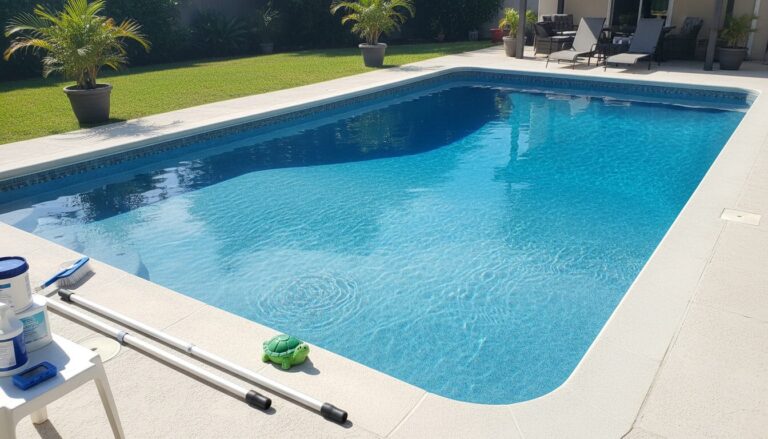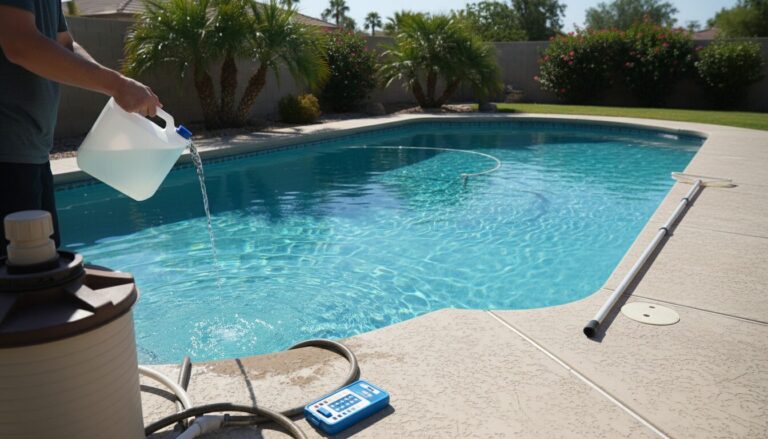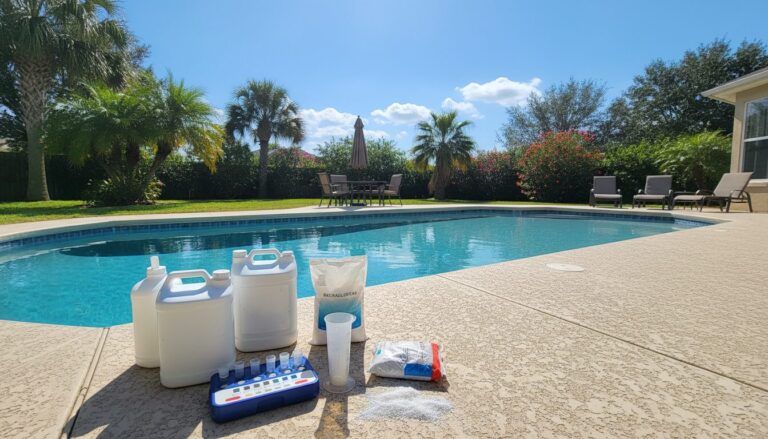
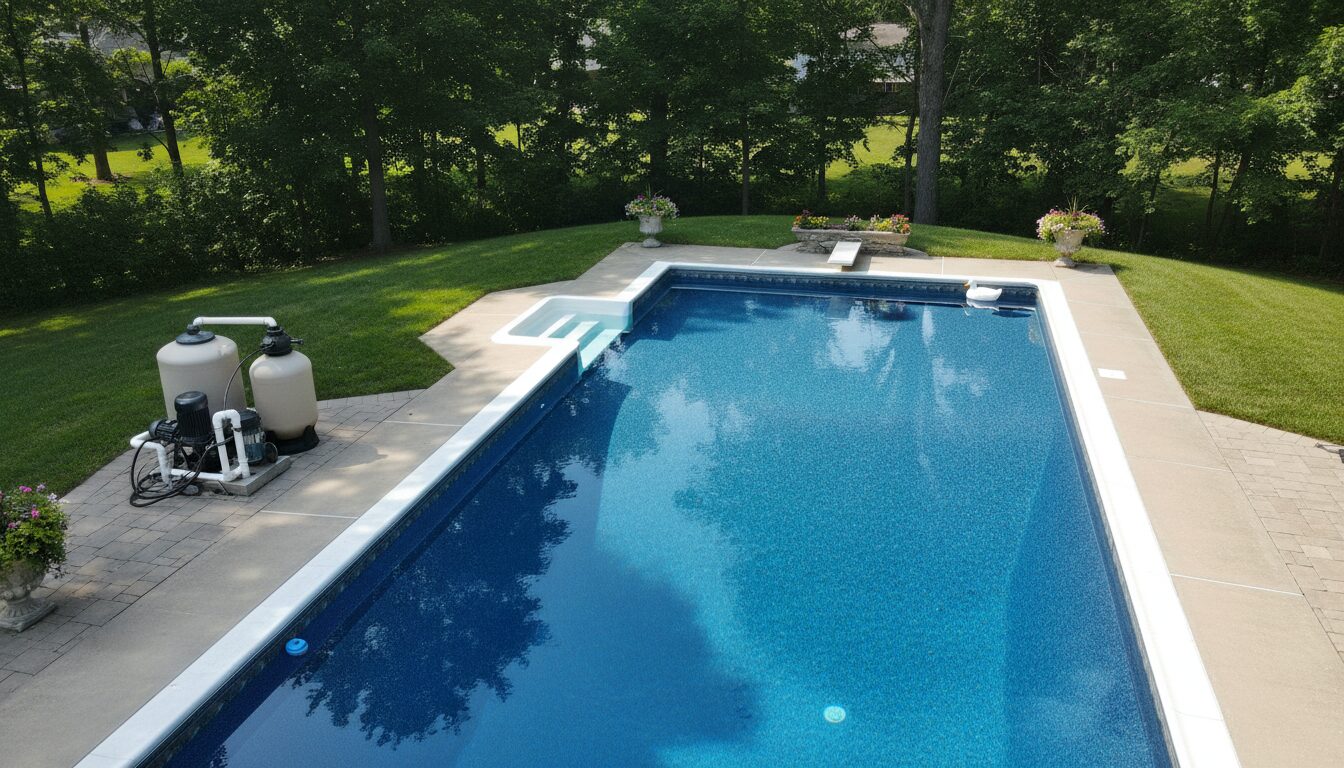

If you’ve ever typed your pool’s dimensions into a chemical calculator and gotten a wildly different number every time, you’re not alone. The size of your pool sounds simple enough, but a 24×40 inground pool can hold dramatically different amounts of water depending on how it’s built, and that gap directly changes every chemical dose you’ll ever add.
A 24×40 inground pool holds between 43,200 and 57,600 gallons, with a typical shallow-to-deep configuration landing around 50,976 gallons. That’s the number you’ll use as your baseline for chlorine, shock, CYA, alkalinity, and every other chemical in your kit. This article walks through how to calculate your pool’s exact volume, explains why depth is the variable that changes everything, and then turns that volume into real, specific doses for the chemicals you’ll add most often.
How Pool Volume Is Actually Calculated
The formula for a rectangular pool is: length x width x average depth x 7.5 = gallons. The 7.5 is the number of gallons in one cubic foot of water. For a 24×40 pool, the length and width are fixed, so the only variable is average depth. That’s where pools diverge from each other.
Average depth is not the deep end depth. If your pool has a shallow end at 3.5 feet and a deep end at 6 feet, the average depth is (3.5 + 6) / 2 = 4.75 feet. Plug that in and you get: 24 x 40 x 4.75 x 7.5 = 54,000 gallons. Use the deep end alone and you’d overestimate by nearly 15,000 gallons, which would throw off every dose you add.
Volume by Depth: The Full Range for a 24×40 Pool
Here’s how volume changes across the most common depth configurations for a 24×40 inground pool.
| Depth Configuration | Average Depth (ft) | Estimated Gallons |
|---|---|---|
| Uniform 4 ft (wading pool style) | 4.0 | 43,200 |
| 3 ft shallow / 5 ft deep | 4.0 | 43,200 |
| 3.5 ft shallow / 5 ft deep | 4.25 | 45,900 |
| 3.5 ft shallow / 6 ft deep (most common) | 4.75 | 54,000 |
| 4 ft shallow / 6 ft deep | 5.0 | 54,000 |
| 4 ft shallow / 8 ft deep | 6.0 | 64,800 |
| Uniform 6 ft | 6.0 | 64,800 |
Notice that two completely different configurations (3 ft shallow / 5 ft deep, and uniform 4 ft) produce the same volume because the average depth is identical. That’s why the formula works from average depth, not from any single measurement. For the rest of this article, the worked examples use 51,000 gallons, which is a realistic rounded figure for the most common 24×40 configuration with a 3.5-foot shallow end and a 5.5-foot deep end.
Step 1: Chlorine Maintenance Dose
Free chlorine should stay between 1 and 3 ppm in a standard outdoor pool. To bring a 51,000-gallon pool from zero to 3 ppm using 10% liquid chlorine, you need roughly 1.2 gallons of liquid chlorine (about 155 fluid ounces). If you’re using 12.5% liquid chlorine, that drops to about 0.95 gallons. Daily chlorine demand will vary based on bather load, sun exposure, and CYA level, so test every two to three days during swim season rather than dosing on a fixed schedule.
For a helpful reference on pool chemical dosing by pool size, cross-referencing your volume with a dosing table is a good habit any time you’re adding a chemical you haven’t used before on this pool.
Step 2: Shock Dose
Standard calcium hypochlorite shock is dosed at 1 pound per 10,000 gallons for routine maintenance shocking. For a 51,000-gallon pool, that’s 5.1 pounds of shock, which you’d round up to 5.5 pounds to be safe. Add it in the evening after the pump is running, and retest before swimmers get back in.
If the pool has gone green or visibly cloudy from an algae bloom, the dose jumps to 3 pounds per 10,000 gallons, putting you at roughly 15 to 16 pounds for a 51,000-gallon pool. That’s not a typo. Algae eats chlorine fast, and an undersized shock dose just gives the algae time to recover. AquaDoc’s pool shock is one option pool owners use for this kind of heavy-treatment situation, precisely because the bag sizing (1 lb and 2 lb) makes it easy to hit those larger multi-pound doses accurately. For more detail on how to shock your pool correctly based on gallon size, including timing and pre-shock pH adjustment, that’s worth reading before you treat a problem pool.
Step 3: Cyanuric Acid (Stabilizer)
CYA protects chlorine from UV degradation. The target range is 30 to 50 ppm for a standard chlorine pool and 60 to 80 ppm for a saltwater pool. Adding 1.3 ounces of granular stabilizer per 10,000 gallons raises CYA by 1 ppm. To go from zero to 40 ppm in a 51,000-gallon pool, the math looks like this: 40 ppm x 1.3 oz x 5.1 (the pool’s volume in 10,000-gallon units) = 265 ounces, or about 16.5 pounds. Add it slowly through the skimmer with the pump running and give it 24 to 48 hours to fully dissolve before retesting.
A common mistake here is adding CYA, testing an hour later, and then adding more because the reading looks low. CYA takes time to register accurately in most test kits. Wait a full day before deciding you’re short.
Step 4: Total Alkalinity and pH
Total alkalinity should sit between 80 and 120 ppm for most inground pools. To raise TA by 10 ppm, add 1.5 pounds of baking soda per 10,000 gallons. For a 51,000-gallon pool, that’s 7.65 pounds per 10 ppm of increase. If you’re opening in spring at 60 ppm and want to reach 100 ppm, you’d need roughly 30 to 31 pounds of baking soda total. That’s a significant amount. Add it in stages (about 10 pounds at a time), circulate for a few hours, then retest before adding more.
pH should stay between 7.2 and 7.6. To drop pH, muriatic acid is the standard tool. A 51,000-gallon pool is large enough that even small errors in acid dosing can swing pH significantly, so always add acid with the pump running and add it in the deep end away from the walls and liner. For smaller pools managed similarly, the same scaling principles apply whether you’re working through a 12×24 inground pool’s volume and chemical dosing or a pool three times that size.
Step 5: Calcium Hardness
Calcium hardness targets depend on pool surface type: 200 to 400 ppm for concrete and plaster, and 150 to 250 ppm for vinyl and fiberglass. To raise calcium hardness by 10 ppm in 10,000 gallons, add 1.25 pounds of calcium chloride. In a 51,000-gallon pool, that scales to 6.4 pounds per 10 ppm of increase. If you’re starting at 100 ppm and need to reach 250 ppm, you’re looking at adding roughly 96 pounds total. That’s best done over multiple sessions, adding no more than 10 ppm worth at a time, to avoid localized clouding near the point of addition. See the chemical dosing formulas every pool tech relies on for the full set of scaling equations if you’re working with less common chemicals too.
A Common Sizing Mistake to Avoid
The most frequent error pool owners make with a large pool like this is using the nominal dimensions (24×40) as if the pool is filled to the brim. In reality, water sits 6 to 12 inches below the coping, which can reduce actual volume by 1,500 to 3,000 gallons compared to a theoretical full-to-the-edge calculation. That difference rarely changes your shock dose by a full pound, but it matters for CYA and calcium hardness additions where precision compounds over multiple treatments across a season.
Frequently Asked Questions
How many gallons does a 24×40 inground pool hold?
A 24×40 inground pool holds between 43,200 and 64,800 gallons depending on depth configuration. The most common setup with a 3.5-foot shallow end and a 5.5-foot deep end yields an average depth of 4.5 feet and approximately 48,600 gallons. Use the formula length x width x average depth x 7.5 to get the exact number for your pool.
How much shock do you need for a 24×40 inground pool?
For routine maintenance, use 1 pound of calcium hypochlorite shock per 10,000 gallons, so a 51,000-gallon pool needs about 5 to 5.5 pounds. For an algae treatment, increase to 3 pounds per 10,000 gallons, putting you at 15 to 16 pounds. Always pre-adjust pH to 7.2 to 7.4 before shocking for maximum effectiveness.
How much CYA do you add to a 24×40 pool starting from zero?
To reach 40 ppm of cyanuric acid in a 51,000-gallon pool, add approximately 16.5 pounds of granular stabilizer. Add it through the skimmer with the pump running and wait 24 to 48 hours before retesting, since CYA takes time to fully register in a test kit.
How much liquid chlorine does a 24×40 inground pool need to start from zero?
To reach 3 ppm free chlorine in a 51,000-gallon pool, add approximately 1.2 gallons of 10% liquid chlorine (or about 0.95 gallons of 12.5%). Add it in the evening with the pump running and retest the following morning before opening the pool to swimmers.
How much baking soda does a 24×40 pool need to raise alkalinity?
Every 10 ppm of alkalinity increase in a 51,000-gallon pool requires about 7.65 pounds of baking soda. To move from 60 ppm to 100 ppm, add roughly 30 to 31 pounds total, in stages of about 10 pounds at a time, recirculating and retesting between additions.
A 24×40 inground pool most commonly holds around 50,000 to 54,000 gallons once you factor in a realistic average depth. Lock in that number, bookmark the scaling formulas, and every chemical dose you add from here on will be grounded in something accurate rather than a guess.