
To close a 10,000-gallon gunite pool with CYA at 50 ppm, add 2 lbs of 68% calcium hypochlorite (cal hypo) shock. That pushes free chlorine up approximately 16 ppm, well above the CYA-adjusted breakpoint of roughly 7.5 ppm for your stabilizer level, and leaves enough residual to protect the water through a full winter without sunlight burning it off.
If you’ve ever pulled the cover off in April to find a swamp, the closing shock dose is usually where things went wrong. Pool owners who close a gunite pool at 10,000 gallons often follow generic bag directions designed for midsummer maintenance, not winterizing. This post walks through why the CYA-adjusted breakpoint matters, the exact math for your situation, which shock form to use on a gunite surface, and the mistakes most likely to sabotage your spring opening.
Why CYA Changes Your Shock Requirement
CYA (cyanuric acid, also called stabilizer) holds chlorine in a bound form that is less active against algae and bacteria. The practical result is that you need a higher total free chlorine reading to get the same sanitizing power as you would at zero CYA. The commonly used rule is that effective free chlorine should equal roughly 7.5% of your CYA level. At CYA 50 ppm, that works out to 3.75 ppm as the floor for active sanitization.
For a winterizing shock, though, you are not trying to hit the minimum. You are trying to leave a reserve that survives months of cold, covered water. Plan for a free chlorine target of 10 to 15 ppm after shocking. Cold temperatures slow chlorine decay, but gunite surfaces are porous and will keep consuming small amounts over time. Starting high gives you a buffer that is still measurable when you come back in spring.
The Exact Math for a 10,000-Gallon Pool
One pound of 68% cal hypo raises free chlorine by approximately 8 ppm in 10,000 gallons. That figure comes from the standard calculation: 68% available chlorine in a 1 lb dose divided across 10,000 gallons of water. Here is how the numbers play out for your situation.
Say your pool tests at 1 ppm free chlorine before you shock. You want to land at 15 ppm. You need to raise chlorine by 14 ppm. At 8 ppm per pound of 68% cal hypo per 10,000 gallons, you need 1.75 lbs to hit that target. Round up to 2 lbs to account for any organic demand still in the water from the season, and you are covered. If the pool had a rough late season with algae or heavy swimmer load, bump that to 2.5 lbs and test after the shock clears before closing.
If you are using 73% cal hypo instead of 68%, the dose drops slightly. One pound of 73% product raises free chlorine about 8.6 ppm in 10,000 gallons, so 1.75 lbs gets you to roughly 15 ppm from a 1 ppm starting point. The difference is small enough that rounding to 2 lbs still works for either product.
Cal Hypo vs. Liquid Chlorine on a Gunite Surface
Gunite pools already tend to run higher calcium hardness than vinyl or fiberglass pools because the plaster itself leaches calcium over time. Cal hypo adds calcium to the water with every dose. If your calcium hardness is already above 300 ppm going into winter, that is worth considering before you add another 2 lbs of cal hypo at closing.
- Calcium Hypochlorite (cal hypo): 68% or 73% available chlorine, adds calcium to water, granular and easy to dose, dissolve in a bucket before adding to avoid contact with plaster surface.
- Liquid Chlorine (sodium hypochlorite): Typically 10% available chlorine, adds no calcium, pours directly into the pool, requires about 1.5 gallons to match a 2 lb cal hypo dose in 10,000 gallons. Good choice if calcium hardness is already high.
- Dichlor: Raises CYA with every dose. Avoid at closing since CYA has no benefit once the pool is covered.
- Trichlor: Same CYA problem as dichlor, plus it is very acidic and can damage plaster if added in large amounts. Not a good closing choice for gunite.
| Shock Type | Available Chlorine | Lbs or Gallons for +14 ppm (10,000 gal) | Adds Calcium? | Gunite Safe? |
|---|---|---|---|---|
| Cal Hypo 68% | 68% | 1.75 lbs (round to 2) | Yes | Yes, dissolve first |
| Cal Hypo 73% | 73% | 1.65 lbs (round to 2) | Yes | Yes, dissolve first |
| Liquid Chlorine 10% | 10% | ~1.5 gallons | No | Yes |
| Trichlor | 90% | Not recommended at closing | No | Risk of plaster damage |
Why These Differences Matter for Your Decision
If your calcium hardness tests between 200 and 300 ppm before closing, cal hypo is a fine choice and the most cost-effective way to deliver a high chlorine dose quickly. If you are already north of 350 ppm on calcium, switch to liquid chlorine for the closing shock to avoid pushing hardness into scaling territory over winter. Scaled gunite plaster in the shallow end after a cold winter is an expensive problem. AquaDoc makes a granular cal hypo shock that pool owners use for exactly this kind of closing dose, and the label includes a CYA-adjustment chart that takes the guesswork out of the math.
How to Add the Shock Correctly
- Step 1: Balance the water first. Adjust pH to 7.4 to 7.6 and total alkalinity to 80 to 120 ppm before shocking. Shock is far less effective above pH 7.8.
- Step 2: Test free chlorine. Note your starting level so you know how much of a bump you need.
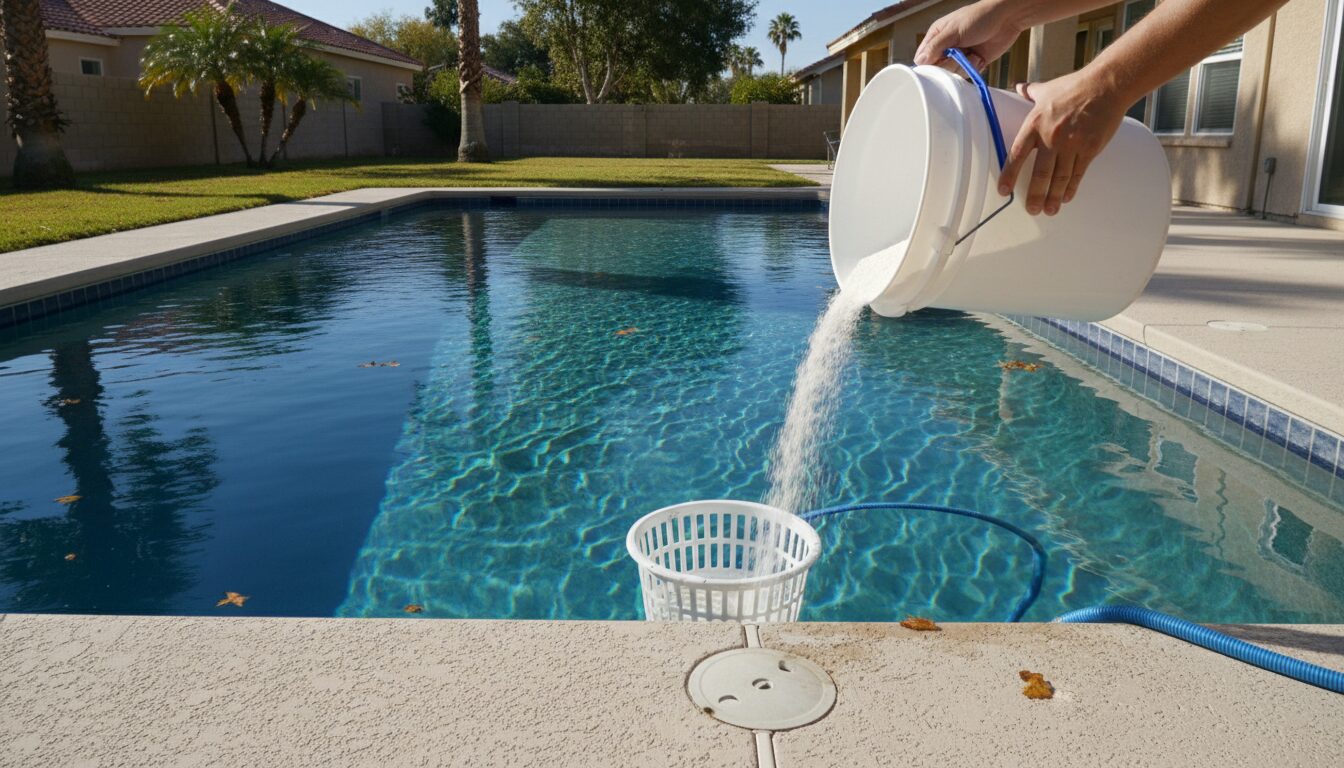
- Step 3: Pre-dissolve cal hypo. Add 2 lbs to a bucket of pool water, stir until dissolved, then pour it slowly around the perimeter. Never dump granules directly onto plaster.
- Step 4: Run the pump for at least 2 hours. Circulate the shock fully before testing or closing.
- Step 5: Retest and confirm. You want 10 to 15 ppm free chlorine before you shut the pump down and cover the pool.
- Step 6: Add algaecide and cover. A winter algaecide applied after shock gives you a second line of defense. Add it after chlorine drops below 5 ppm or it will get oxidized immediately.
The timing on that last step matters more than most people realize. Many pool owners add algaecide right after shock and wonder why it does nothing. High chlorine oxidizes most algaecides on contact. Wait until free chlorine is below 5 ppm, which may mean shocking one evening, testing the next morning, and adding algaecide then. If you want context on how swimmer load and weather events during the season affect closing chemistry, the post on summer pool chemistry when everyone’s jumping in every day explains how organic demand builds up and why that affects how much shock you actually need come closing time.
Common Closing Mistakes That Lead to a Green Spring
- Shocking too early: If you shock a week before closing and keep running the pump in warm weather, you will lose most of that chlorine before the cover goes on. Shock within 24 hours of closing.
- Skipping the pH check: Shocking at pH 8.0 wastes product. At pH 8.0, roughly half of your hypochlorous acid (the active sanitizing form) converts to hypochlorite ion, which is much weaker. Fix pH first, every time.
- Adding algaecide at the same time as shock: Covered above, but it is the single most common closing mistake. Stagger them by at least 12 to 24 hours.
- Under-dosing because the water looks clear: Clear water can still carry algae spores at concentrations that multiply under a dark cover over winter. Closing chemistry is not about the water you can see, it is about what survives six months without sunlight or circulation.
- Ignoring existing free chlorine: If your pool tests at 4 ppm before shocking, you do not need as much product to hit 15 ppm. Always start from a measured baseline, not from zero.
Pool volume calculations matter here too. If you are not certain your pool is exactly 10,000 gallons, measuring carefully before you dose is worth the five minutes it takes. Even a few thousand gallons of difference changes your required shock dose by half a pound or more. The guide on how many gallons a 20×40 inground pool holds walks through the volume formulas if you have never confirmed your pool’s actual gallon count.
Frequently Asked Questions
How much cal hypo shock do I need to close a 10,000-gallon pool?
Use 2 lbs of 68% calcium hypochlorite shock for a 10,000-gallon pool in clean, balanced condition. That raises free chlorine by roughly 16 ppm from zero, putting you comfortably above the 10 to 15 ppm closing target and well above the CYA-adjusted breakpoint of 7.5 ppm at CYA 50 ppm.
What free chlorine level should I target when closing a gunite pool for winter?
Target 10 to 15 ppm free chlorine at the moment of closing. Cold, dark, covered water loses chlorine slowly, but gunite surfaces are porous and will continue to consume small amounts over winter. Starting at 10 ppm or above ensures a measurable residual remains when you open in spring.
Does CYA level affect how much shock I need to close a pool?
Yes. CYA at 50 ppm means you need free chlorine at or above roughly 3.75 ppm for active sanitization, but for a winter closing you want 10 to 15 ppm to leave a lasting residual. At lower CYA levels, the same closing target still applies but you have more active chlorine per ppm, so the buffer works harder for you.
Can I use liquid chlorine instead of cal hypo to close a 10,000-gallon gunite pool?
Yes, and it is often the better choice if your calcium hardness is already above 300 ppm. To raise free chlorine by 14 ppm in a 10,000-gallon pool using 10% liquid chlorine, add approximately 1.5 gallons. It distributes easily, adds no calcium, and is safe for plaster surfaces.
Should I add more stabilizer before closing a 10,000-gallon gunite pool?
No. CYA only protects chlorine from UV degradation, and once the pool is covered and the pump is off there is no sunlight to cause that problem. Close at CYA 50 ppm and test again at spring opening. Add stabilizer in spring if levels have dropped over winter.
For a 10,000-gallon gunite pool at CYA 50 ppm, 2 lbs of 68% cal hypo shock applied the evening before closing gives you the 10 to 15 ppm free chlorine you need to protect the pool through winter. Balance pH first, pre-dissolve before adding, and stagger your algaecide by at least 12 hours afterward.