
If you’ve ever stood on your equipment pad in October looking up at solar panels strapped to your roof and wondered whether your normal winterizing routine even applies here, you are not alone. Roof-mounted solar heaters add elevation changes, long pipe runs, and collector panels that standard closing guides completely ignore.
For a typical pool with roof-mounted solar panels, plan on 2 to 4 gallons of non-toxic propylene glycol antifreeze for the solar circuit alone, on top of the 1 to 2 gallons you use for your main pool lines. The exact amount depends on your pipe diameter, the height of your roof, and how many collector panels you have. This article walks through how to calculate your specific volume, the correct draining and blowing sequence, and the application order that actually protects every part of the system.
Why Solar Panel Systems Need More Antifreeze Than Standard Pools
A conventional pool closing involves the skimmer lines, return lines, and maybe a cleaner line. Add roof-mounted solar panels and you suddenly have a dedicated supply line running from the equipment pad up to the roof, the collector panels themselves, and a return line running back down. In a two-story home installation, that vertical run alone can be 20 to 30 feet each way before you even count horizontal runs across the roof. More pipe means more water to displace and more surface area exposed to cold air.
There is another complication: elevation. Water that sits in a pipe running up to a roof does not drain by gravity the same way a horizontal skimmer line does. Blow out the line from below and air may travel up the path of least resistance while pockets of water stay trapped in dips along the roof pitch. That trapped water is what cracks pipes and fittings when temperatures drop below 32°F. Antifreeze is the insurance policy for those spots that air cannot reach.
Step 1: Calculate Your Solar Circuit Pipe Volume
The reference numbers that make this calculation quick: a 1.5-inch diameter pipe holds approximately 0.1 gallons per foot of length. A 2-inch pipe holds approximately 0.16 gallons per foot. Measure (or estimate) the total pipe length in your solar circuit, which includes the supply run from the pad to the roof, the runs across the roof connecting each panel, and the return run back down to the pad.
Here is a worked example. Say your solar supply line runs 25 feet up to the roof, across 15 feet of roofline, and 25 feet back down on the return side. That is 65 feet of 1.5-inch pipe. Multiply 65 by 0.1 and you get 6.5 gallons of total pipe volume. You want enough antifreeze to occupy the bottom 3 to 4 feet of each line as a protective plug, which works out to roughly 0.3 to 0.4 gallons per line. But because you cannot guarantee air blew out every trapped pocket, adding 1 full quart (0.25 gallons) per 10 feet of 1.5-inch pipe is the practical standard. For that 65-foot solar circuit, that means about 1.6 gallons just for the pipe runs, rounding up to 2 gallons to cover the panel connections and low spots. Add your main pool lines (typically 1 to 2 gallons for a standard four-line setup) and you land at 3 to 4 gallons total.
Step 2: Drain the Collector Panels First
Before any antifreeze goes into the lines, the collector panels on the roof need to be drained completely. Most solar pool heater systems have a drain valve at the lowest point of the collector array, often at the bottom manifold where all the individual tubes converge. Open that valve and let gravity do the work. This can take 10 to 20 minutes depending on how many panels you have.
Once the panels have stopped draining, connect an air compressor to the system’s blow-out port (usually a Schrader valve or a dedicated winterizing port near the equipment pad). Use 30 to 50 PSI, no higher, and blow air through the solar supply line toward the roof. You should hear water gurgling out of the drain valve and then the sound will shift to clear air. Hold pressure for 60 seconds after the gurgling stops. Repeat from the return side. This two-direction blow-out is worth the extra step because elevation changes mean air enters from one direction while water exits from another.
Step 3: Add Antifreeze to the Solar Lines
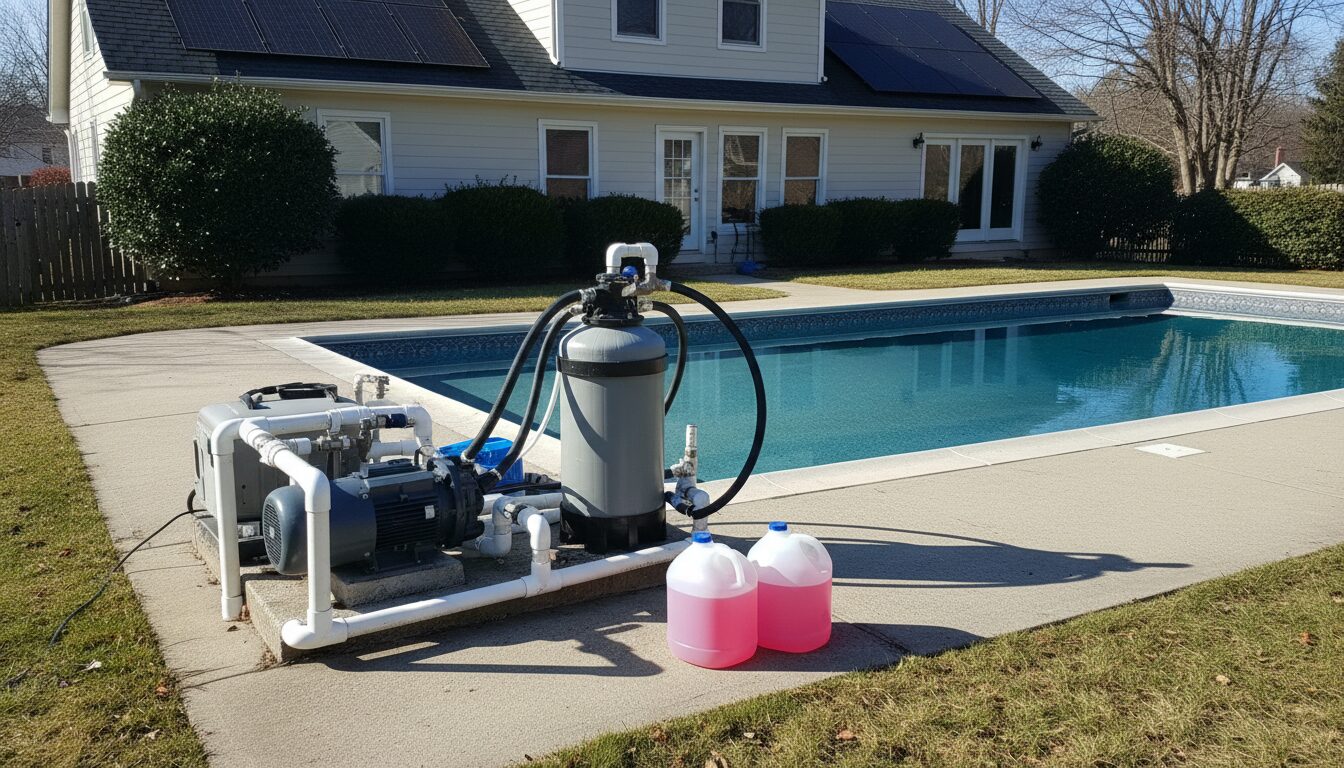
With the panels drained and the lines blown out, pour propylene glycol antifreeze into the solar supply line using a hand pump or a standard antifreeze pump kit. Work from the lowest access point so the antifreeze settles into the line by gravity rather than sitting at the top and draining back out. Add your calculated volume (at least 1 quart per 10 feet of 1.5-inch pipe) and then cap the line. Repeat for the return line. AquaDoc makes a pool-grade propylene glycol antifreeze rated to -40°F that pool owners use for exactly this purpose, and the -40°F rating matters because lighter mixes can fail in a hard freeze even if they look fine on the label.
Do not forget the small-diameter tubes connecting individual solar collectors to each other across the roof. These are often 3/4-inch or 1-inch polypropylene and they hold very little water, but they are also the most exposed to cold air and wind chill on the roof surface. A few ounces of antifreeze per connector tube adds up to less than a quart for most residential arrays and it is worth it.
Antifreeze Volume by Pipe Size and Run Length
| Pipe Diameter | Volume Per Foot | Antifreeze Per 10 Feet | Typical Solar Run (60 ft) |
|---|---|---|---|
| 3/4 inch | 0.037 gal | about 0.37 gal (1.5 qt) | about 2.2 gal |
| 1 inch | 0.041 gal | about 0.41 gal (1.6 qt) | about 2.5 gal |
| 1.5 inch | 0.10 gal | 1 qt (0.25 gal per 10 ft is the practical minimum) | about 1.5 gal minimum |
| 2 inch | 0.16 gal | about 1.6 qt | about 2.4 gal minimum |
The “antifreeze per 10 feet” column uses 1 quart as a practical minimum for 1.5-inch pipe because you are not filling the pipe completely. You are adding enough to protect any water pockets the air blowout missed. In reality, a generous pour is always safer than a tight calculation when a burst pipe repair runs $400 to $800 or more.
What Can Go Wrong and How to Avoid It
- Skipping the drain valve: If you apply antifreeze to a solar circuit before draining the panels, you dilute the glycol concentration significantly. Drain first, blow out second, then add antifreeze.
- Using automotive antifreeze: Ethylene glycol is toxic. If any residue enters your pool water when you open in spring, it creates a serious contamination problem. Use propylene glycol only.
- Not capping the lines: Antifreeze left in an open line can drain back out overnight if there is any remaining pressure in the system. Always cap or plug the lines after adding antifreeze.
- Forgetting the check valve: Most solar heater systems have a check valve that prevents pool water from back-flowing into the collectors when the pump is off. Make sure that valve is in working order before winter, because a failed check valve lets water siphon into lines you just protected and dilutes your antifreeze.
Heater-related problems at closing can also be a sign of deeper equipment issues. If you have had trouble with the heater behaving erratically before the season ended, posts like the heater worked until the storm rolled in cover situations where the system runs fine until conditions change suddenly, which is worth understanding before you seal everything up for winter.
Verifying the Antifreeze Concentration
After adding antifreeze to each line, pull a small sample from the lowest return point using a turkey baster or a short piece of tubing. Test the concentration with a propylene glycol refractometer (under $20 at most hardware stores). A mix rated to -40°F reads at approximately 60 percent glycol by volume on the refractometer scale. If your sample reads below that, add more antifreeze and test again. Do not rely on the color of the fluid alone since some propylene glycol products are already tinted and the color does not tell you anything about freeze protection.
If your heater has been through a rough season and you are questioning its overall condition going into winter, this account of a heater failure mid-season is a useful reminder of why getting the equipment in solid shape before closing matters as much as the antifreeze itself.
Frequently Asked Questions
How much antifreeze do I need for a pool with roof solar panels?
Plan on 1 quart of non-toxic propylene glycol antifreeze per 10 feet of 1.5-inch pipe, or 1 quart per 8 feet of 2-inch pipe. A typical roof-mounted solar setup with 20 to 40 feet of supply and return runs plus the roof panels usually requires 2 to 4 gallons total for the solar circuit alone, in addition to 1 to 2 gallons for your main pool lines.
Do you have to drain roof-mounted solar panels before winterizing?
Yes, drain the panels completely before applying antifreeze to the supply and return lines. Most systems have a dedicated drain valve at the lowest point of the collector array. Blow compressed air at 30 to 50 PSI through the panel circuit after draining to clear residual water before adding antifreeze.
What type of antifreeze is safe for pool solar panels?
Use non-toxic propylene glycol pool antifreeze rated to at least -40°F. Never use automotive ethylene glycol antifreeze, which is toxic and can contaminate pool water if any residue enters the system when you reopen. Propylene glycol is safe for plumbing that contacts pool water.
How do I know if my solar panel lines are fully protected?
After adding antifreeze, pull a small sample from the lowest return point and test the concentration with a propylene glycol refractometer. A proper -40°F mix reads at roughly 60 percent glycol by volume. If the sample looks mostly clear or watery, add more antifreeze and retest.
Can I just blow out solar panel lines with air and skip antifreeze?
Blowing out works on the panel collectors themselves, but the long vertical pipe runs from the roof down to the equipment pad often retain water in dips and low spots that air cannot clear completely. Adding at least 1 quart of propylene glycol antifreeze to each line after blowing out is the safer approach for any climate that regularly drops below 32°F.
For a pool with roof-mounted solar panels, budget 2 to 4 gallons of propylene glycol antifreeze for the solar circuit and another 1 to 2 gallons for the main pool lines. Drain the panels first, blow out both directions, verify concentration with a refractometer, and cap every line before the first freeze.