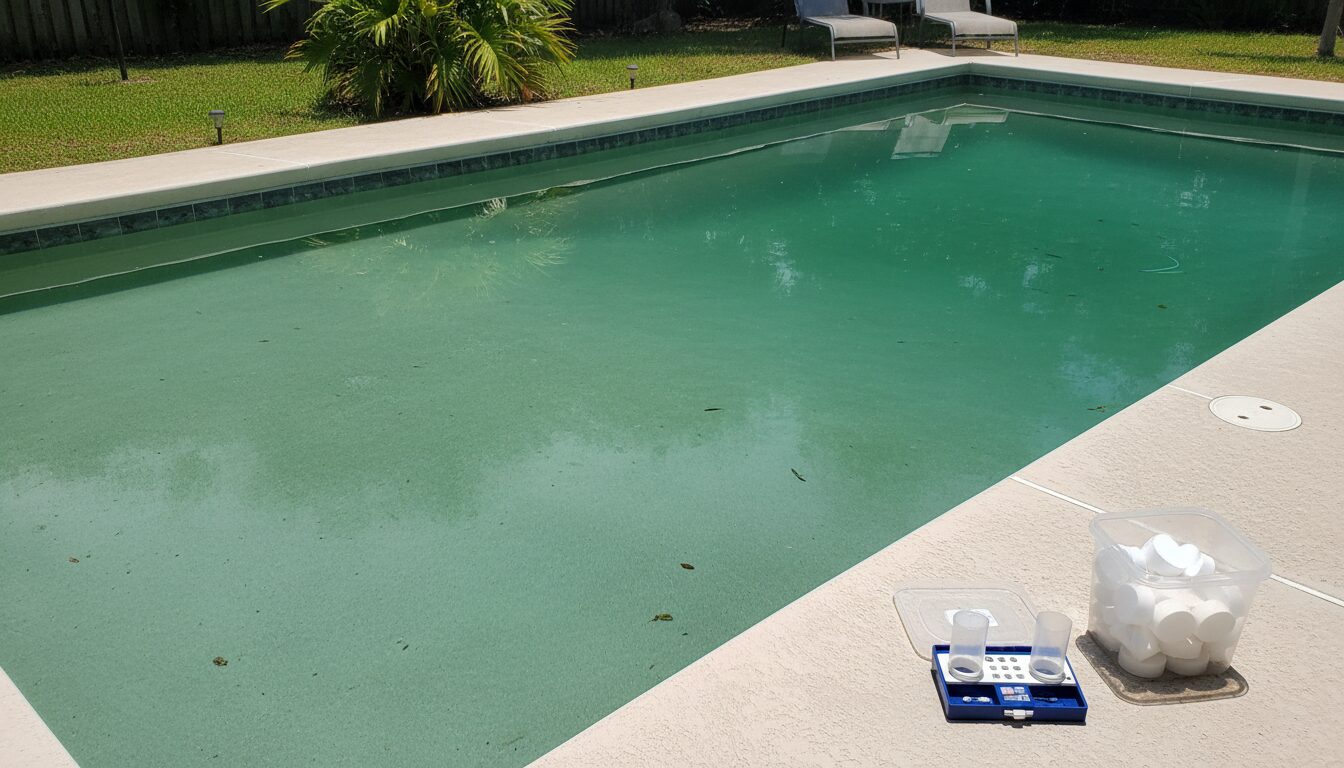

You test your water, and the results make no sense: zero free chlorine, but 5 ppm combined. The pool looks fine, the pump has been running all day, and you just threw in a dose of tablets last week. How can there be chlorine in the pool but none of it is actually working?
What you’re dealing with is chlorine lock, the state where almost all available chlorine has bonded with nitrogen compounds to form chloramines, leaving no active sanitizer in the water. The fix is breakpoint chlorination: adding enough free chlorine to overwhelm and destroy those chloramines completely. For a 20,000-gallon inground pool with 5 ppm combined chlorine and 0 ppm free chlorine, you need to add roughly 10 lbs of trichlor shock in a single treatment to cross the breakpoint threshold. This article explains how that number is calculated, what to watch out for with trichlor specifically, and exactly how to run the treatment so it actually works.
What Chlorine Lock Actually Is (and What It Is Not)
The term “chlorine lock” gets thrown around loosely, and there’s some debate about whether it’s a real phenomenon or just a shorthand for chloramine buildup. The practical reality is this: when combined chlorine climbs and free chlorine sits near zero, your sanitizer is chemically tied up and not doing its job. Some industry voices argue the “lock” label is misleading, preferring to call it simply chloramine saturation, but the treatment is identical either way. You need to break the bond between chlorine and nitrogen compounds by brute force.
Combined chlorine, also called chloramines, forms when free chlorine reacts with ammonia and nitrogen introduced by swimmers, rain, and organic debris. At 5 ppm combined, your pool is well into uncomfortable territory. Swimmers will notice the sharp, eye-irritating smell that most people mistakenly blame on “too much chlorine.” It’s actually the opposite problem.
The Breakpoint Chlorination Formula
Breakpoint chlorination requires raising free chlorine to a level that is at least 10 times the combined chlorine reading. With 5 ppm combined chlorine, your target free chlorine level is 50 ppm. Some chemists use a multiplier of 7.6 rather than 10, which gives a minimum target of around 38 ppm, but 10x is the safer and more commonly cited standard for a full break. Rounding to 40 to 50 ppm is a practical target that gives you a buffer.
Your pool currently sits at 0 ppm free chlorine, so you need to add all 40 to 50 ppm from scratch. Here is how the math works for a 20,000-gallon pool:
- Target increase: 40 to 50 ppm of free chlorine
- Pool volume: 20,000 gallons
- Trichlor available chlorine: approximately 90% for most granular trichlor shock products (some are labeled 68% to 99%, read your bag)
- Rule of thumb: 1 lb of 90% trichlor raises free chlorine by roughly 4.5 to 5 ppm in 10,000 gallons, or about 2.25 ppm in 20,000 gallons
Working through it: to raise free chlorine by 40 ppm in 20,000 gallons using 90% available trichlor, divide 40 by 2.25 to get approximately 17.8 lbs. At a 68% product (a common granular formulation), each pound raises 20,000 gallons by roughly 1.6 ppm, so 40 divided by 1.6 gives 25 lbs. The product concentration is the biggest variable here, so read the label before buying. A precise pool chlorine lock dose calculator can help you dial in the exact number for your specific product’s available chlorine percentage.
For this article we’ll use 90% granular trichlor as the working example. Targeting 40 ppm free chlorine in a 20,000-gallon pool: approximately 18 lbs. If your product is 68%, you’re looking at closer to 25 lbs. Never guess; check the bag.
Why Trichlor Shock Has One Important Catch
Trichlor is acidic and contains cyanuric acid (CYA) as a stabilizer. Both of those facts matter at shock doses.
- pH drop: Trichlor has a pH of around 2.8 to 3.0. At large doses, it will pull your pool’s pH down noticeably. Test pH before you shock, and if it’s already below 7.2, correct it first. Shocking at low pH accelerates liner and surface wear, and makes the chlorine so reactive it burns off faster than it can do its job.
- CYA accumulation: Each pound of trichlor adds roughly 0.5 to 1 ppm of CYA per 10,000 gallons. An 18 lb treatment adds around 9 to 18 ppm of stabilizer to a 20,000-gallon pool. If your CYA is already at 70 ppm or above, that additional load pushes you into the range where chlorine efficacy starts declining. Check your stabilizer level before you shock, and as a general rule, keep CYA between 30 and 50 ppm for an outdoor pool. (If CYA is already high, calcium hypochlorite shock is a better one-time option for breaking the lock.)
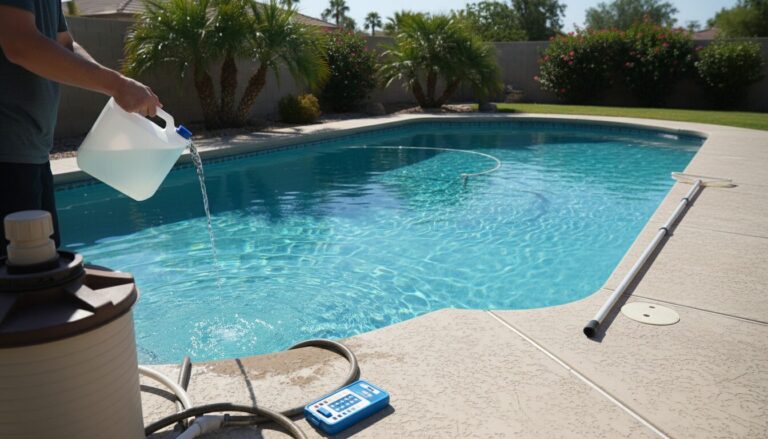
- Dissolution time: Granular trichlor dissolves more slowly than calcium hypochlorite. Pre-dissolve it in a bucket of pool water before broadcasting it, or add it through the skimmer with the pump running and no one in the pool.
Step-by-Step: Running the Shock Treatment
- Step 1: Test everything before you add a drop. Confirm free chlorine (0 ppm), combined chlorine (5 ppm), pH (target 7.4 to 7.6 before shocking), CYA, and calcium hardness. Adjust pH if needed and let the pump run 30 minutes before moving on.
- Step 2: Calculate your dose. Use the formula above based on your specific product’s available chlorine percentage. For 90% trichlor targeting 40 ppm in 20,000 gallons, that’s roughly 18 lbs.
- Step 3: Shock after dark. Sunlight destroys unstabilized free chlorine at up to 1 ppm per hour. Even though trichlor contains CYA, at the elevated concentrations used for shock treatment, adding it after sunset gives the chlorine more time to work before UV exposure begins.
- Step 4: Distribute the chemical evenly. Pre-dissolve the granules in a 5-gallon bucket of pool water (one partial scoop at a time, never the reverse), then pour the solution slowly around the perimeter of the pool. Run the pump on high the entire time.
- Step 5: Keep the pump running for at least 8 hours. Circulation ensures the shock reaches every corner of the pool, including dead zones near steps and corners where chloramines concentrate.
- Step 6: Test in the morning. Free chlorine should be measurable and combined chlorine should have dropped sharply. If combined chlorine is still above 0.5 ppm after 24 hours, you did not reach breakpoint. Add another partial dose and test again.
- Step 7: Do not swim until free chlorine drops below 5 ppm. At shock levels, the water is safe for equipment but not for swimmers. Most pools return to a swimmable range within 24 to 48 hours.
Understanding what chlorine lock is and how it forms makes it easier to prevent the next occurrence, because once you’ve been through this process, you won’t want to repeat it.
What to Do After the Shock Clears
Once free chlorine is back in the 1 to 3 ppm range and combined chlorine is below 0.2 ppm, your pool is sanitized again. But chlorine lock doesn’t happen in a vacuum. The most common underlying causes are heavy swimmer load, inadequate filtration run time, and CYA creep from continuous trichlor tablet use. If you’re relying on a trichlor floater as your only chlorine source, CYA builds steadily over the season, which suppresses chlorine effectiveness and sets the stage for chloramine accumulation. Trichlor tablets are a solid maintenance tool, but they need to be paired with regular shocking on a schedule rather than only when a problem appears.
This pattern of chemistry management becomes especially important during peak summer months. The post on summer pool chemistry when everyone’s jumping in every day covers exactly that kind of high-demand schedule and is worth reading once you’re back to normal levels. AquaDoc makes a granular trichlor shock formulated for this kind of heavy-dose treatment, which is one of the products pool owners reach for when a maintenance shock clearly isn’t enough.
Pool volume accuracy also matters more than people realize. If you’ve estimated your pool at 20,000 gallons but the real number is 22,000, your dose falls short of breakpoint. Knowing your exact gallonage is worth verifying before any large chemical treatment. The guide on what pool volume means for chemical dosing explains how to calculate it correctly.
Why Stopping Short of Breakpoint Makes Things Worse
This is the single most common mistake pool owners make when trying to fix chlorine lock. Adding two or three pounds of shock feels like you’re doing something, but if you haven’t crossed the breakpoint threshold, you’ve actually added more chlorine that will bond with the existing chloramines rather than destroying them. The combined chlorine reading can actually increase temporarily. Partial doses extend the problem. The math is counterintuitive but firm: go big enough to cross the line, or don’t shock at all until you can.
Frequently Asked Questions
How much trichlor shock does a 20,000-gallon pool need to break chlorine lock?
A 20,000-gallon pool with 5 ppm combined chlorine needs free chlorine raised to at least 40 to 50 ppm to reach breakpoint. Using 90% available chlorine granular trichlor, that requires approximately 18 lbs added in a single treatment. At 68% available chlorine, the dose rises to roughly 25 lbs. Always verify the available chlorine percentage on your product label before calculating.
What is breakpoint chlorination and why does it matter?
Breakpoint chlorination is the minimum free chlorine level required to chemically destroy all chloramines in the water rather than simply adding to the combined chlorine pool. The standard target is 10 times the combined chlorine reading. Stopping short of that threshold means your shock dose contributes to the problem instead of solving it.
Will trichlor shock raise CYA in my pool?
Yes. Trichlor contains cyanuric acid, and an 18 lb shock treatment will add approximately 9 to 18 ppm of CYA to a 20,000-gallon pool. If your stabilizer is already at or above 70 ppm, consider using unstabilized calcium hypochlorite for this shock treatment to avoid pushing CYA into the range where it suppresses chlorine activity.
Can I use non-chlorine shock instead of trichlor to fix chlorine lock?
Non-chlorine shock (potassium monopersulfate) can oxidize mild chloramine buildup, but at 5 ppm combined chlorine with zero free chlorine, you need true breakpoint chlorination from an active chlorine source. Non-chlorine shock will reduce combined chlorine readings somewhat but will not achieve the full destruction of chloramines that a high-dose trichlor or calcium hypochlorite treatment provides.
How long after shocking should I wait before testing free chlorine again?
Wait at least 8 hours with the pump running continuously, and test the following morning. Free chlorine should be above 1 ppm and combined chlorine below 0.5 ppm before you consider the treatment successful. If combined chlorine remains above 0.5 ppm after 24 hours, you did not reach breakpoint and should add a follow-up dose.
When your free chlorine is zero and combined chlorine is at 5 ppm, a maintenance dose will not move the needle. Hit the breakpoint threshold (40 to 50 ppm free chlorine in a 20,000-gallon pool), do it all at once after dark, and let the pump run through the night.