
You decided to add a heat pump and go saltwater at the same time, figured you’d bundle the work into one replumb, and now you’re staring at quotes that seem to vary by thousands of dollars with no clear explanation of what’s driving the difference. That’s a frustrating place to be, especially when you just want a warm, low-maintenance pool without overpaying for it.
A combined replumb of an above-ground pool to include both a heat pump and a saltwater chlorination system typically costs between $1,800 and $4,500, depending on pool size, equipment grade, and how much of the work you do yourself. This article walks through every cost layer: equipment, pipe and fittings, labor, electrical, and the factors that push your quote toward the high or low end of that range.
Why Bundling These Two Upgrades Makes Financial Sense
Doing a heat pump installation and a saltwater conversion at separate times means paying for labor twice, cutting pipe twice, and potentially redoing union placements when the second contractor doesn’t like how the first one left things. Bundling them into a single replumb job saves roughly $400 to $700 in overlapping labor costs, because the plumber only has to plan the equipment pad layout once, run all the new PVC in one pass, and pressure-test the whole system together. If you’re already committed to both upgrades, doing them simultaneously is almost always the smarter financial move.
Equipment Costs: What You’re Actually Buying
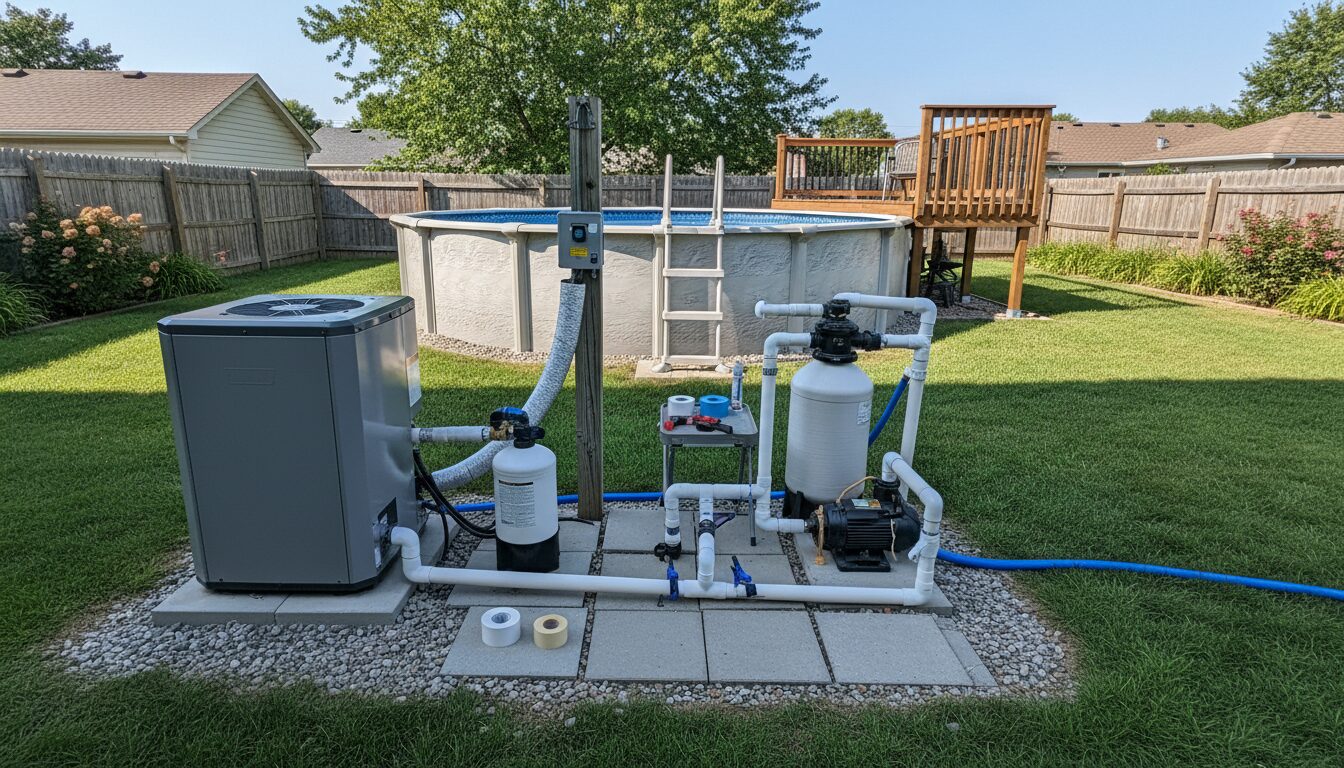
The two big-ticket items in this project are the heat pump and the salt chlorine generator. Here’s how those break down:
- Heat Pump Unit: An above-ground pool heat pump rated between 50,000 and 75,000 BTU (the right range for pools up to 18,000 gallons) costs $700 to $1,800. Titanium heat exchangers sit at the top of that range but resist corrosion far better in a saltwater environment, so the upgrade pays for itself over time.
- Salt Chlorine Generator: A salt cell and control box sized for an above-ground pool (typically rated for up to 20,000 gallons) costs $300 to $700. Inline models that splice directly into the return line are easier to plumb than drop-in versions.
- Variable-Speed Pump: Heat pumps require a minimum flow rate, usually 30 to 40 GPM, to operate without tripping their low-flow shutoff. If your existing pump can’t meet that threshold, budget $350 to $750 for a variable-speed replacement that runs the heat pump at the right flow and drops to a lower speed for filtration.
- Filter: If your current filter is undersized or aging, this is the right time to replace it. A cartridge filter sized for your pool volume runs $150 to $400.
| Equipment Item | Typical Cost Range | Notes |
|---|---|---|
| Heat Pump (50,000 to 75,000 BTU) | $700 to $1,800 | Titanium exchanger preferred for saltwater |
| Salt Chlorine Generator | $300 to $700 | Inline model simplest to plumb |
| Variable-Speed Pump | $350 to $750 | Required if current pump can’t hit 30 to 40 GPM |
| Replacement Cartridge Filter | $150 to $400 | Optional if current filter is in good shape |
Why These Differences Matter for Your Budget
The heat pump is the single largest variable in this project. A builder-grade unit with a copper heat exchanger costs roughly half what a commercial-grade titanium unit does, but salt water and copper are a corrosive combination over time. Spending an extra $400 to $600 upfront on a titanium exchanger typically extends the heat pump’s service life from 5 to 7 years all the way to 10 to 15 years. On the salt cell side, don’t let a $150 price difference push you toward an undersized unit. A cell rated for 15,000 gallons running a 20,000-gallon pool will burn through its electrode plates in two to three years instead of the typical five.
Plumbing Materials: Pipe, Fittings, and Unions
Schedule 40 PVC is the standard for above-ground pool plumbing, and it handles saltwater without any corrosion concerns at 3,000 to 3,500 ppm. For a typical above-ground pool with a 10 to 15-foot equipment run, materials come to $150 to $350. That range covers:
- 1.5-inch and 2-inch PVC pipe: Most above-ground pools use 1.5-inch, but heat pumps often need 2-inch on the return side to meet flow requirements.
- Union fittings: You need unions on both sides of the heat pump and both sides of the salt cell so you can service or replace each component without cutting pipe. Budget four to six unions at $8 to $18 each.
- Check valve: A spring-loaded check valve between the pump and heat pump prevents backflow when the system shuts off. These run $15 to $35.
- Flexible connectors: Short sections of flexible PVC or hose connect the rigid plumbing to the heat pump’s ports and reduce vibration transfer. Plan on $20 to $60 for these.
Labor and Electrical Costs
Labor is where the range opens up most. A plumber or pool technician typically charges $75 to $125 per hour for above-ground pool work, and a combined heat pump and saltwater replumb takes six to ten hours for a single-person crew. That puts labor in the $450 to $1,250 range before electrical.
The electrical piece is non-negotiable for the heat pump. Most residential heat pumps in the 50,000 to 75,000 BTU range run on a dedicated 240V circuit with a 30 to 50-amp breaker. If your panel doesn’t have a spare slot, you’re also looking at a subpanel or breaker upgrade. Electrical work for the heat pump alone typically runs $250 to $600 when a licensed electrician pulls the permit and runs the wire. The salt cell controller is simpler: it usually piggybacks onto the existing pump’s power supply or runs on a standard 120V outlet, adding $50 to $150 for wiring.
One common mistake is letting a general handyman handle the 240V connection to save money. If that wiring isn’t done to code, the heat pump manufacturer can void the warranty, and your homeowner’s insurance may not cover an equipment fire. Hire a licensed electrician for that part, full stop.
A Worked Example: 15,000-Gallon Oval Above-Ground Pool
Say you have a 15,000-gallon oval above-ground pool with an existing sand filter, a single-speed pump that tops out at 25 GPM (not enough for most heat pumps), and a 15-foot run from the pool wall to the equipment pad. Here’s a realistic cost breakdown:
- 65,000 BTU titanium heat pump: $1,400
- Salt chlorine generator rated for 20,000 gallons: $500
- Variable-speed replacement pump: $550
- PVC pipe, unions, fittings, check valve: $240
- Labor (8 hours at $95/hour): $760
- Electrical for 240V heat pump circuit: $400
- Total: $3,850
That lands solidly in the middle of the typical range. If you’re comfortable doing the PVC plumbing yourself and your existing pump is already variable-speed with enough flow, you could realistically get the same project done for closer to $2,400. When your water chemistry is finally dialed in with salt and heat, keeping the balance stable matters just as much as the hardware, and AquaDoc makes a saltwater-specific alkalinity and pH kit that pool owners use to maintain that balance without overcomplicating the routine.
If you notice unusual sounds from your pump during or after the replumb, it’s worth reading about the quiet clue hiding in a noisy pool pump before assuming the new plumbing is to blame. Sometimes a cavitating pump is a flow restriction problem, and catching it early saves a service call.
What Pushes Your Quote Higher or Lower
- Pool Size: Every 5,000 gallons above 15,000 adds roughly $200 to $400 in equipment sizing costs (larger heat pump, larger salt cell).
- Equipment Pad Distance: Runs longer than 20 feet require more pipe, more fittings, and more labor time, adding $100 to $300.
- Permit Requirements: Some municipalities require a permit for the electrical work and a final inspection. Permit fees range from $75 to $200 and add a few days to the timeline.
- Existing Plumbing Condition: Brittle or sun-damaged flex hose that needs full replacement before the new equipment goes in can add $150 to $350 to the job.
- DIY vs. Full Pro: Doing the PVC plumbing yourself while hiring out electrical saves $400 to $700 for homeowners comfortable with basic pipe work.
Frequently Asked Questions
How much does it cost to replumb an above-ground pool with a heat pump and saltwater system?
Most homeowners pay between $1,800 and $4,500 for a combined replumb that integrates a heat pump and saltwater chlorinator into an above-ground pool. The lower end applies to smaller pools under 15,000 gallons with straightforward equipment pads, while the upper end reflects larger pools, titanium heat exchangers, and union fittings throughout.
Can I install a saltwater system on an above-ground pool myself?
Yes, the salt cell and control board installation is DIY-friendly for anyone comfortable with basic plumbing and electrical connections. The heat pump side is a different story: refrigerant lines and 240V wiring should be handled by a licensed technician, which typically adds $300 to $600 to the project.
What size heat pump do I need for a 15,000-gallon above-ground pool?
A 15,000-gallon above-ground pool in most climates needs a heat pump rated between 50,000 and 75,000 BTU. Smaller units below 50,000 BTU will struggle to recover temperature after a cold night, extending run time and increasing your electricity bill significantly over a full season.
Does a saltwater system damage above-ground pool plumbing?
Saltwater at the standard 3,000 to 3,500 ppm concentration used in residential pools causes minimal corrosion to quality PVC and union fittings. The real risk is to aluminum pool frames and low-grade metal fittings, so using Schedule 40 PVC throughout the plumbing run is essential when converting to salt.
How long does a replumb job on an above-ground pool take?
A professional crew typically completes a combined heat pump and saltwater replumb on an above-ground pool in one to two days. DIY projects on the same scope realistically take a full weekend, with an extra day if you need permits or inspections before the system can run. If pump noise comes up during startup, your pool pump sounds like it’s quitting because it is covers the most common culprits and what they cost to fix.
Bundling a heat pump and saltwater system into a single replumb on an above-ground pool costs $1,800 to $4,500, with most realistically budgeted projects landing around $3,000 to $4,000 when professional labor and proper electrical work are included. Do both upgrades at once, use a titanium heat exchanger, and size the salt cell for your actual pool volume, and you’ll have a system that earns back every dollar over the next decade.