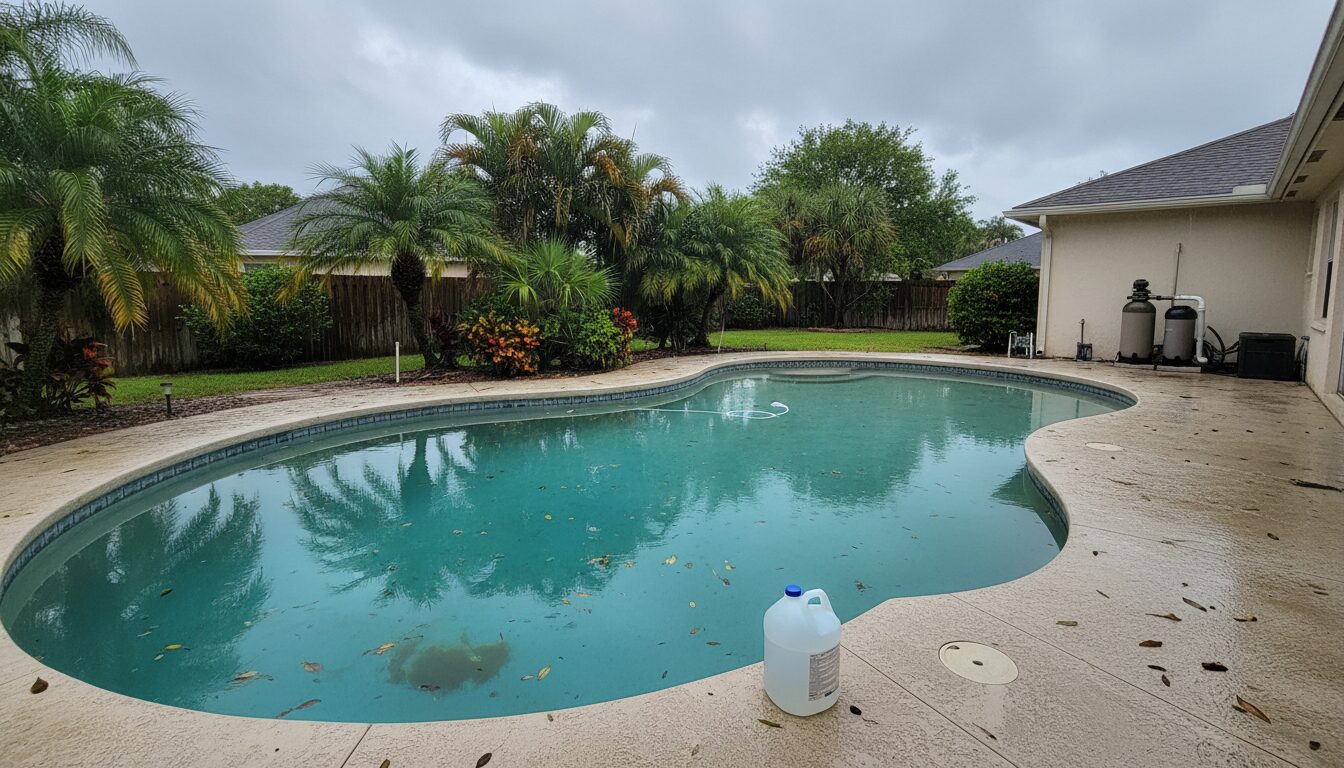

You walk out to your fiberglass pool after two solid weeks of rain, test the water, and the pH reads 8.3. The chlorine is gone, the water has that flat, faintly green tint, and you are not sure whether to reach for the acid first or the shock. Sound familiar?
Here is the direct answer: for a 20,000-gallon fiberglass pool with a pH in the 8.0 to 8.4 range after extended rain, you will typically need between 1.5 and 2.5 quarts (48 to 80 oz) of standard 31.45% muriatic acid to bring pH back to the 7.4 to 7.6 target range. The exact amount depends on where your pH and total alkalinity land after you test. This article walks through how to calculate your specific dose, the order of operations for restarting the pool, and the common mistakes that waste chemicals and time.
Why Two Weeks of Rain Hits a Fiberglass Pool Hard
Rain is slightly acidic, usually around pH 5.6 to 6.0, but its main chemical impact is dilution. When a few hundred gallons of rainwater pours into your 20,000-gallon pool, it dilutes your total alkalinity (TA). Once TA falls below roughly 80 ppm, the pH loses its buffer and begins to drift. In a fiberglass pool, the gel coat can also off-gas carbon dioxide, which pushes pH upward. The paradox is that you end up with a low-alkalinity pool at a high pH, which makes the water aggressive toward equipment and almost impossible to sanitize effectively. Free chlorine becomes largely ineffective at pH above 8.0, so even if some residual chlorine survived the rain, it was barely working.
Test Before You Dose: The Numbers That Drive Everything
Do not add a single ounce of acid until you have a fresh test in hand. You need four values before you can dose correctly:
- Free Chlorine (FC): Almost certainly near zero after two weeks of rain and sun. You will need to shock after pH is corrected.
- pH: The number that tells you how much acid you need. Target 7.4 to 7.6.
- Total Alkalinity (TA): Target 80 to 120 ppm for a fiberglass pool. If TA is below 80, you will need to raise it with baking soda after pH is settled, not acid.
- Cyanuric Acid (CYA): Two weeks of rain may have diluted your stabilizer. If CYA is below 30 ppm, your chlorine will burn off faster than normal after you shock.
Use a reliable liquid test kit or a strip that covers all four parameters. A digital reader works well for pH confirmation. Knowing your exact starting pH is the difference between a correct dose and a dose that undershoots or overshoots by a quart.
How Much Muriatic Acid for a 20,000-Gallon Fiberglass Pool
The standard dosing reference for 31.45% muriatic acid in a pool is roughly 1 quart (32 oz) per 10,000 gallons to drop pH by approximately 0.4 to 0.5 units, assuming TA is in the normal range. For 20,000 gallons that scales to about 64 oz per 0.4 to 0.5 unit drop. Here is how that plays out at common starting pH levels after a rain event:
| Starting pH | Target pH | pH Drop Needed | Estimated Acid Dose (20,000 gal) |
|---|---|---|---|
| 7.8 | 7.4 | 0.4 | 48 to 56 oz (about 1.5 qt) |
| 8.0 | 7.4 | 0.6 | 64 to 72 oz (about 2 qt) |
| 8.2 | 7.4 | 0.8 | 72 to 80 oz (about 2.5 qt) |
| 8.4+ | 7.4 | 1.0+ | 80 to 96 oz (2.5 to 3 qt) |
Why These Numbers Are Estimates, Not Guarantees
Total alkalinity directly affects how much acid it takes to move pH. When TA is high (above 150 ppm), which is unusual right after rain but possible if you over-dosed at closing, the water resists pH change and you will need more acid than the table suggests. When TA is already low (below 80 ppm), pH moves faster and you may need less. This is why dosing in stages and retesting is not optional: it is how you avoid crashing the pH below 7.2, which can etch even a fiberglass gel coat over time.
Say your pool tests at pH 8.2 and TA 95 ppm. That TA is normal, so the table estimate holds. Add 40 oz of acid to start, run the pump for 4 hours, retest. If pH is now 7.8, add another 32 to 36 oz and retest again. Two-stage dosing is slower, but it protects the pool and saves you from overshooting. Knowing your pool’s exact volume matters here: if you are unsure whether your pool is truly 20,000 gallons or closer to 18,000, check out the guide on how inground pool volume is calculated by shape and depth before you dose.
Step-by-Step: How to Add Muriatic Acid Safely to a Fiberglass Pool
- Step 1: Run the pump. Circulation must be on before you add any acid. Set it to run for at least 30 minutes before dosing and keep it running for at least 4 hours after.
- Step 2: Put on protection. Muriatic acid fumes are harsh. Wear chemical-resistant gloves, eye protection, and work in ventilated conditions away from the pool equipment.
- Step 3: Pre-dilute if you like. You can pour your measured dose into a bucket of pool water first, then walk that diluted solution around the deep end perimeter. This is especially recommended for fiberglass pools to prevent gel coat contact.
- Step 4: Pour slowly near a return jet. Never dump the acid in one spot. Walk the perimeter of the deep end and pour in a thin stream. The return jet circulation disperses it quickly.
- Step 5: Wait and retest. Wait at least 4 hours before testing again. Testing too early gives a false low reading and can trick you into adding more acid than needed.
- Step 6: Repeat if necessary. If pH is still above 7.6 after 4 hours, add a second, smaller dose. Never add both doses at once upfront.
The Restart Order of Operations After Rain
Getting the chemical sequence right saves you from chasing your tail. After heavy rain, follow this order:
- First, correct pH. Chlorine is almost useless above pH 8.0, so shocking before correcting pH wastes chemical. Get pH to 7.4 to 7.6 before anything else.
- Second, check and adjust alkalinity. If TA is below 80 ppm after acid is added, raise it with sodium bicarbonate (baking soda) at about 1.5 lbs per 10,000 gallons per 10 ppm increase. For 20,000 gallons, that is roughly 3 lbs per 10 ppm.
- Third, shock the pool. With pH in range, add calcium hypochlorite shock at 1 lb per 10,000 gallons for a maintenance dose, or 2 lbs per 10,000 gallons (4 lbs total for 20,000 gallons) if the water is visibly cloudy or showing algae. AquaDoc’s calcium hypochlorite shock is one option pool owners use for this restart dose because the 68% available chlorine concentration gives a predictable result.
- Fourth, check CYA. If rain diluted your stabilizer below 30 ppm, add cyanuric acid to bring it back to 40 to 50 ppm before relying on outdoor chlorine to hold.
Skipping pH correction and shocking first is the most common restart mistake. It wastes shock, delays clearing, and extends your downtime by 24 to 48 hours.
A Note on Fiberglass Specifically
Fiberglass pools are more forgiving than plaster when it comes to low pH, but they are not immune. Sustained pH below 7.0 can bleach the gel coat and compromise the surface’s protective layer. At the other end, sustained pH above 8.0 reduces chlorine efficiency to the point where even a full pound of shock delivers less than half its rated sanitizing power. For a fiberglass pool in a rainy climate, maintaining TA in the 80 to 100 ppm range (tighter than the 80 to 120 ppm general target) gives you better pH stability over the long haul and means less acid use season to season.
Frequently Asked Questions
How much muriatic acid do I add to a 20,000-gallon pool to lower pH from 8.2 to 7.4?
To drop pH from 8.2 to 7.4 in a 20,000-gallon pool, start with about 40 oz of 31.45% muriatic acid, run the pump for 4 hours, then retest. If pH is still above 7.6, add another 32 oz and retest again. The two-stage approach targets the same destination while protecting against overshooting.
Why does pH spike after heavy rain in a fiberglass pool?
Rain dilutes total alkalinity, which removes the buffer that keeps pH stable. Once TA falls below about 80 ppm, pH drifts upward on its own, often into the 8.0 to 8.4 range. Fiberglass gel coats can also release CO2, which contributes to the upward pH drift even when no additional rain falls.
How much muriatic acid do I need if my pH is only at 7.8 in a 20,000-gallon fiberglass pool?
At pH 7.8, add about 48 to 56 oz of 31.45% muriatic acid for a 20,000-gallon pool targeting 7.4. Add half the dose, wait 4 hours, retest, then add the remainder if needed. At this starting pH, one stage is often enough.
Should I lower alkalinity or pH first after two weeks of rain?
Lower pH first. Muriatic acid reduces both pH and total alkalinity at the same time, so a pH correction also moves TA in the right direction. Test alkalinity only after pH is settled, then decide whether a baking soda addition is needed to bring TA back to the 80 to 120 ppm range.
Is it safe to add muriatic acid to a fiberglass pool?
Yes, muriatic acid is safe for fiberglass when applied correctly. Pour it slowly near a return jet in the deep end while the pump runs, and avoid pouring directly onto the shell, steps, or any underwater lights. Pre-diluting in a bucket of pool water before adding further reduces any risk to the gel coat.
After two weeks of rain, a 20,000-gallon fiberglass pool almost always needs between 1.5 and 2.5 quarts of muriatic acid to return to a safe pH range. Test first, dose in stages, and correct pH before you shock: that sequence gets your pool swim-ready faster than any shortcut.