
Closing season is already stressful enough without staring at a bag of DE powder and wondering whether you’re supposed to dump the whole thing in or just eyeball a scoop. It’s one of those steps that every pool guide mentions but almost none of them give you a real number for.
For a 36 sq ft DE filter, add 3 lbs of DE powder as your winterizing charge before closing. That is roughly 60 to 65 percent of the standard full charge for this filter size, enough to coat and protect the grids through your closing sequence without overloading the system before you drain and blow the lines. This article covers why that number works, how to apply it correctly, what happens if you get it wrong, and how to handle the full closing sequence around it.
Why You Add DE at Closing at All
A DE filter works because diatomaceous earth coats the fabric grids inside the tank, and those grids are what actually trap particles. When you backwash at the end of the season, you flush most of that DE out. That leaves bare grid fabric exposed. During the closing steps, while the pump is still running to circulate your algaecide and other closing chemicals, unprotected grids can pick up fine debris and trap it directly in the fabric weave. That debris sits on bare fabric all winter and can cause staining or degradation that shortens grid life.
The partial charge you add at closing solves this. It coats the grids lightly so they have a protective layer during the last hour or two of circulation. It is not meant to filter the water at full efficiency. That is why you use a reduced dose rather than your full spring startup charge. If you are curious about how DE filters compare to other options on overall filtration performance, the team at CarefreePoolClub covered the tradeoffs in depth in this post on pool filter types: sand vs cartridge vs DE.
The Right Dose for a 36 Sq Ft Filter
The standard rule for DE powder dosing is 1 lb per 8 sq ft of filter area for a full charge. For a 36 sq ft filter, that puts your full charge at 4.5 lbs. At closing, you want 60 to 65 percent of that full charge, which lands you squarely at 3 lbs.
Here is the math spelled out: 36 sq ft divided by 8 equals 4.5 lbs for a full charge. Multiply 4.5 by 0.65 and you get 2.93 lbs, which you round to an even 3 lbs. That is your winterizing dose. Use a kitchen or postal scale if you want precision; eyeballing DE powder is a reliable way to either undercoat or overload the grids.
| Filter Size | Full Charge | Closing Charge (65%) |
|---|---|---|
| 24 sq ft | 3 lbs | 2 lbs |
| 36 sq ft | 4.5 lbs | 3 lbs |
| 48 sq ft | 6 lbs | 4 lbs |
| 60 sq ft | 7.5 lbs | 5 lbs |
Why These Numbers Matter for Your Closing Sequence
Using the right partial charge keeps filter pressure in its normal operating range, typically 10 to 15 PSI above your clean baseline, while the pump runs through its final circulation cycle. If you add a full 4.5 lb charge to a 36 sq ft filter right before closing, pressure can spike faster than expected, cutting short the circulation time your algaecide and other closing chemicals need to distribute evenly through the pool. At 3 lbs, you stay in a comfortable pressure window for the 1 to 2 hours most closing routines call for.
Too little DE is also a problem. Adding less than 2 lbs to a 36 sq ft filter leaves patches of bare grid fabric that grab debris during the final pump run. Those particles bond to uncoated fabric over winter in ways that are much harder to backwash out in spring than a clean grid re-coat would be.
Step-by-Step: Adding DE Powder at Closing
- Step 1: Backwash the filter completely. Run the backwash cycle until the sight glass runs clear, usually 2 to 3 minutes. This flushes out the entire season’s worth of spent DE and trapped debris. Do not skip this. Adding fresh DE on top of old, compacted DE gives you uneven grid coverage.
- Step 2: Return the valve to filter mode and restart the pump. You need the pump running and the system at operating pressure before you add DE. If you add it to a static system, it settles to the bottom of the skimmer or pump basket and never reaches the grids.
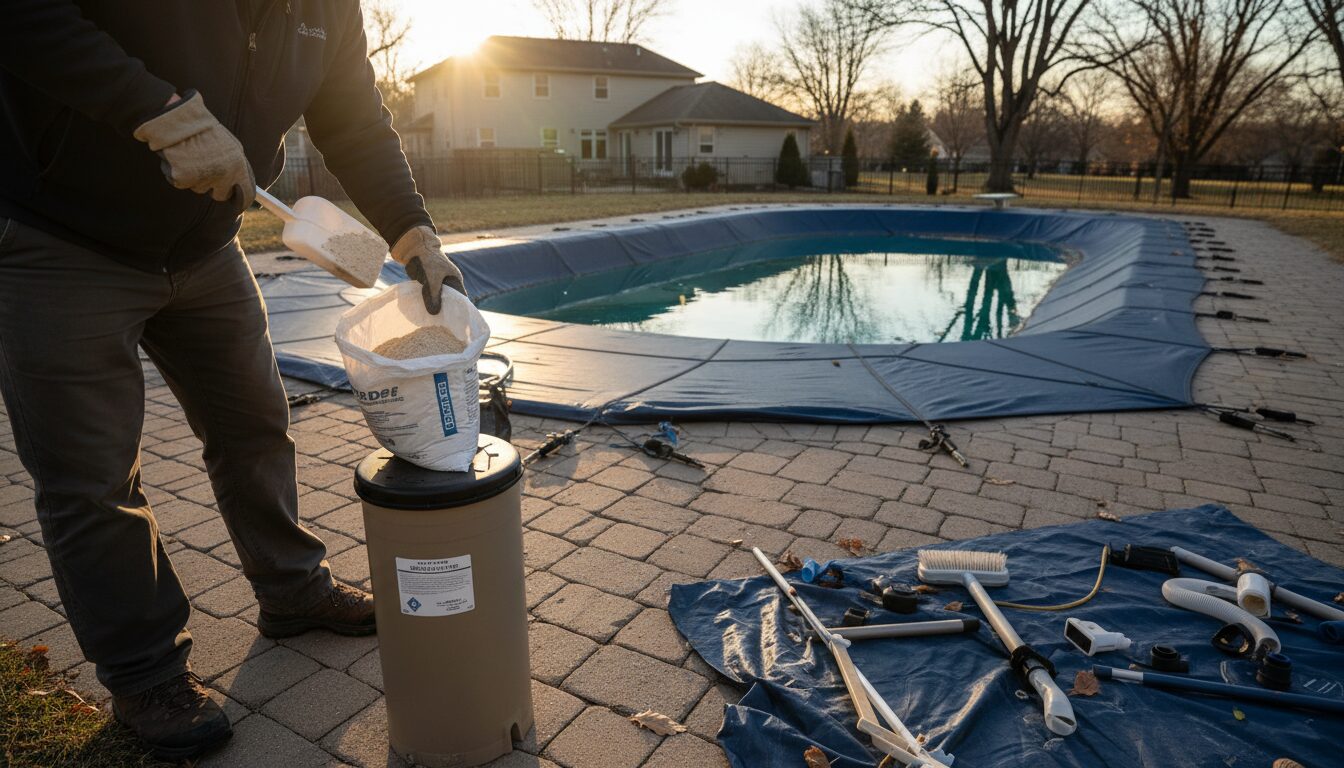
- Step 3: Measure 3 lbs of DE powder. Use a scale. DE powder is sold in bags of 25 lbs or 50 lbs, and scooping by volume is imprecise. AquaDoc’s DE powder, which pool owners use for both opening and closing charges, is marked with per-pound dosing guidelines on the bag that make measurement easier if you use it on the closing step.
- Step 4: Add the DE through the skimmer. Pour the measured DE slowly into the skimmer closest to the pump with the pump running. Pouring too fast can cause clumping. A slow, steady pour over about 30 seconds lets the slurry flow evenly through the suction line to the filter.
- Step 5: Run the pump for at least 1 hour. This circulates your closing chemicals and gives the DE time to coat all the grids evenly. Check the pressure gauge after 15 minutes. If pressure is already 10 PSI above your clean baseline, you are within normal range. If it spikes 20 PSI or more above baseline, you likely have a partial blockage or the backwash step was not thorough.
- Step 6: Turn off the pump and drain the filter. Open the drain plug at the base of the filter tank and drain fully. In freeze climates, water left inside a filter tank will expand and can crack the tank body or damage the internal manifold.
Common Mistakes to Avoid
- Skipping the backwash: Adding fresh DE to spent DE already on the grids creates thick, uneven buildup that restricts flow and pressurizes the filter faster than normal. Always backwash first.
- Adding DE with the pump off: DE added to a static system sinks to the bottom and either clogs the drain or sits in the pump basket. The grids get nothing. The pump must be running and pulling suction before you pour.
- Using a full spring charge at closing: A full 4.5 lb charge on a 36 sq ft filter at closing raises pressure quickly and can cut short your final circulation cycle before the chemicals have fully mixed. Stick to 3 lbs.
- Not draining the filter tank after adding DE: Any water left in the filter over winter in a cold climate is a cracked tank waiting to happen. Drain completely after the final pump cycle.
- Pouring DE directly into the pool: DE is not water-soluble and will cloud the water and settle on the floor. It goes through the skimmer only, with the pump running.
What to Do in Spring
When you open the pool, do not assume the 3 lb closing charge is still on the grids and ready to filter. The draining and months of sitting means that charge is effectively gone or severely degraded. At startup, backwash once to clear any residue, then add a fresh full charge of 4.5 lbs for your 36 sq ft filter. That gets you back to full filtration capacity for the season. If your water is cloudy after opening regardless of a fresh DE charge, the issue may be upstream of the filter entirely, and understanding what actually causes cloudy pool water can save you a lot of unnecessary chemical spending before you find the real source.
Frequently Asked Questions
How much DE powder do I add when closing a 36 sq ft DE filter for winter?
Add 3 lbs of DE powder as your closing partial charge for a 36 sq ft filter. The full charge for this filter size is 4.5 lbs (1 lb per 8 sq ft), and the closing dose is roughly 65 percent of that. This coats the grids for the final pump run without spiking pressure before you drain the system.
Should I backwash my DE filter before closing the pool?
Yes, always backwash before adding your closing charge. Backwashing removes the entire season’s spent DE and trapped debris so the 3 lb closing dose lands on clean grid fabric. Skipping the backwash means you are layering fresh DE on top of compacted old DE, which leads to uneven coverage and pressure problems.
Do I need to add DE powder at all when winterizing, or can I just drain the filter?
Adding a partial charge is worth doing even though you drain immediately afterward. The grids need that light protective coating during the 1 to 2 hours of final circulation while your closing chemicals distribute through the pool. Without it, bare fabric grids can trap fine debris that bonds over winter and is harder to clear at opening.
What happens if I add too much DE powder when closing a pool?
Too much DE on a 36 sq ft filter at closing raises filter pressure quickly and can force you to cut the final pump run short before your algaecide and closing shock have fully circulated. Keep the closing dose at 3 lbs. Excess DE that sits compressed in a drained tank over winter can also compact into a paste that is harder to flush in spring.
How much DE powder does a 36 sq ft filter need for a full charge when opening in spring?
A 36 sq ft DE filter takes 4.5 lbs of DE powder for a full spring startup charge, based on the standard 1 lb per 8 sq ft dosing formula. Always backwash before adding the spring charge, and add it through a running skimmer so it reaches the grids evenly.
For a 36 sq ft DE filter, 3 lbs of DE powder is your closing number: enough to protect the grids through your final pump run, not so much that you pressure out before the job is done. Measure it, pour it slowly through a running skimmer, run the pump for an hour, then drain the tank completely before temperatures drop.