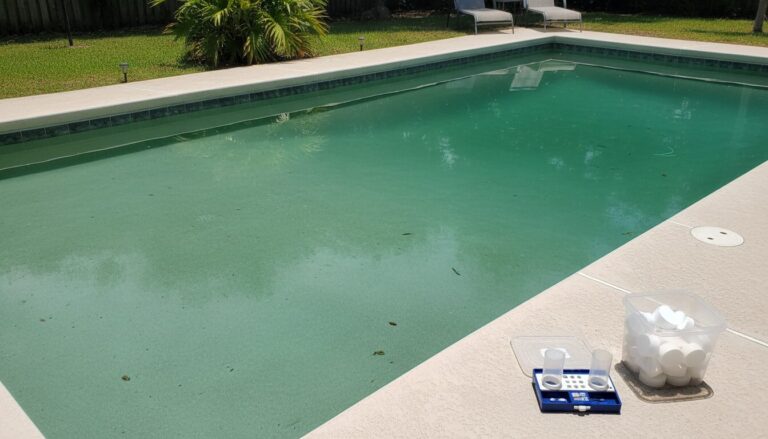

Cloudy pool water is almost always caused by one of three things: low or ineffective chlorine, water chemistry that’s out of balance (usually high pH or high alkalinity), or a filter that isn’t doing its job. Fix whichever one applies and your water will typically clear within 24 to 48 hours. The mistake most people make is throwing a clarifier at the problem first – clarifier is the last step, not the first. Here’s how to actually fix it, in the right order.
Why Is Your Pool Cloudy? The Three Root Causes
Before you add anything to the water, you need to know what you’re dealing with. Cloudy pool water falls into three categories, and the fix for each one is different.
- Low or ineffective chlorine: This is the most common cause. When free chlorine drops below 1 ppm, bacteria and fine particles multiply unchecked and scatter light, turning the water milky or hazy. High CYA (stabilizer) can make chlorine ineffective even when the test shows a “normal” reading.
- Chemistry imbalance: High pH (above 7.8), high total alkalinity (above 120 ppm), or high calcium hardness (above 400 ppm) can all cause cloudiness. When these levels are out of range, minerals and compounds precipitate out of solution and suspend in the water.
- Filter problems: A clogged, worn-out, or undersized filter cannot remove fine particles from the water. The pool may look clean from a chemistry standpoint but stay persistently hazy because nothing is actually pulling debris out.
Test your water before you touch anything. A basic test strip or drop-test kit will tell you where your free chlorine, pH, and alkalinity sit. Those three numbers point directly to the cause.
Step 1: Fix Chlorine First
If your free chlorine is below 2 ppm, that’s your answer. Shock the pool immediately. Use a calcium hypochlorite shock at a rate of 1 lb per 10,000 gallons as a starting point, but if the water is seriously cloudy or green-tinged, double that dose. Shock at dusk or after dark – UV burns off unstabilized chlorine fast, and you want it to stay in the water long enough to work.
Run the pump continuously for at least 24 hours after shocking. Keep testing every 12 hours and re-shock if free chlorine falls back below 2 ppm before the water clears. For pools that have had recurring chlorine problems, it’s worth checking your CYA level: if it’s above 80 ppm, your chlorine is chemically hobbled and no amount of shock will clear the water for long. If that’s your situation, the fix is a partial drain and refill to bring CYA down, which the site’s post on Unmasking The Culprit In Cloudy Pool Water covers in more detail.
Step 2: Correct Your Water Chemistry
Once chlorine is back in range, test pH and total alkalinity. Your targets are: pH 7.2 to 7.6, total alkalinity 80 to 120 ppm, and calcium hardness 200 to 400 ppm. High pH is the most common chemistry culprit for cloudy water – when pH climbs above 7.8, calcium carbonate starts dropping out of solution and you get that white, milky haze.
To lower pH, add muriatic acid or a dry pH reducer. Add it near a return jet with the pump running, and re-test after two hours. Don’t try to fix pH and alkalinity at the same time – adjust alkalinity first with sodium bicarbonate (to raise) or muriatic acid (to lower), then fine-tune pH. Chasing both at once just creates a cycle of corrections that never settles out.
High calcium hardness is less dramatic but worth addressing if it’s over 400 ppm. The fix there is a partial drain and refill with fresh water, since there’s no practical way to lower calcium without dilution.
Step 3: Check and Clean Your Filter
A pool with balanced chemistry and good chlorine levels should clear within a day or two – if it doesn’t, the filter is almost certainly the bottleneck. A sand filter needs backwashing when the pressure gauge reads 8 to 10 psi above baseline. A cartridge filter needs rinsing (and periodic deep cleaning with a filter cleaner) every 4 to 6 weeks under normal load. A DE filter needs backwashing and fresh DE added when pressure rises.
Run the filter continuously – 24 hours a day – while you’re clearing a cloudy pool. Once it’s clear, you can go back to your normal run schedule. If your filter is more than 5 to 7 years old and still cloudy pools keep showing up, the media or cartridge may just be worn out and past the point of cleaning its way back to performance. Replacing a filter cartridge runs $20 to $60 and often solves a problem that a dozen bottles of clarifier couldn’t touch.
Step 4: Use a Clarifier or Flocculant (Optional)
Clarifier is a polymer that clumps tiny suspended particles together so your filter can catch them. It’s useful after you’ve corrected the root cause and the water is still slightly hazy. Add a clarifier at the label dose – overdosing actually makes cloudiness worse, not better, because too much polymer can cloud the water itself.
Flocculant (floc) is a more aggressive option for very cloudy or green water. It drops particles to the bottom of the pool in a thick layer that you then vacuum to waste. Floc works fast – usually 8 to 12 hours – but it bypasses your filter entirely, so your pump needs to be off during the settling period and then you must vacuum manually. AquaDoc makes a pool clarifier that pool owners reach for after a shock treatment when particles just won’t filter out on their own, which is exactly the right timing for this product category.
Common Mistakes That Make Cloudiness Worse
- Adding clarifier before fixing chemistry: Clarifier can’t overcome a chlorine deficit or a dirty filter. Fix the root cause first.
- Shocking during the day: Sunlight destroys unstabilized chlorine quickly. Shock at dusk for maximum effectiveness.
- Turning the pump off to “save electricity”: Filtration is what clears the water. Run it continuously until the pool is clear.
- Stopping treatment too soon: A pool can look clear on day two and go cloudy again by day four if chlorine wasn’t held high long enough to fully oxidize the contamination load.
- Ignoring backwash water: If your filter is full of what it just pulled out of a cloudy pool, it needs backwashing or rinsing before it can keep working. Don’t skip this step mid-treatment.
For a broader look at water balance problems that lead to hazy water, Pool Troopers has solid resources from working pool service professionals who troubleshoot this daily.
How to Tell If It’s Working
Stand at the deep end and look at the drain. If you can see the main drain clearly, your water is clear. If the drain is visible but fuzzy, you’re close – give it another 12 to 24 hours. If you can’t see the drain at all, you’re still in active treatment mode. Keep the pump running, re-test chlorine, and add another dose of shock if free chlorine has fallen below 2 ppm.
Most cloudy pools clear in 24 to 48 hours when the root cause is actually fixed. If you’re on day three with no improvement, something is still wrong – usually a filter that can’t keep up, or a chlorine level that keeps crashing. That recurring crash scenario is worth reading up on separately.
Frequently Asked Questions
How long does it take for a cloudy pool to clear up?
With the right fix in place, most cloudy pools clear in 24 to 48 hours. If the problem is a seriously dirty filter or a heavy algae bloom, plan for 3 to 5 days of consistent treatment with the pump running continuously.
Can I swim in a cloudy pool?
No. Cloudy water reduces visibility enough that you cannot see a swimmer in distress on the bottom – that’s a serious safety risk. Cloudy water also almost always indicates chemistry is off, which irritates eyes and skin.
Will clarifier clear a cloudy pool?
Clarifier helps your filter catch fine particles, but only after the root cause is resolved. Adding clarifier to a pool with low chlorine or a clogged filter won’t work, and overdosing can actually worsen the cloudiness.
What is the fastest way to clear a cloudy pool?
Shock the pool to restore free chlorine to at least 3 to 5 ppm, correct pH to 7.2-7.6, and run the filter continuously. Add a clarifier after 24 hours if particles are still visible but chemistry is balanced.
Why does my pool keep going cloudy after I treat it?
Recurring cloudiness almost always points to a filter that isn’t cleaning properly, CYA levels above 80 ppm blocking chlorine’s effectiveness, or a chronic contamination source like heavy bather load or landscaping runoff. Fix the filter or drain some water to lower CYA, and the problem usually stops repeating.