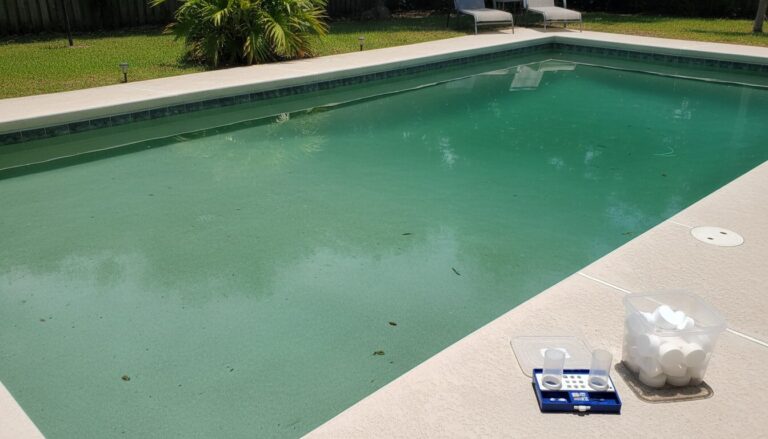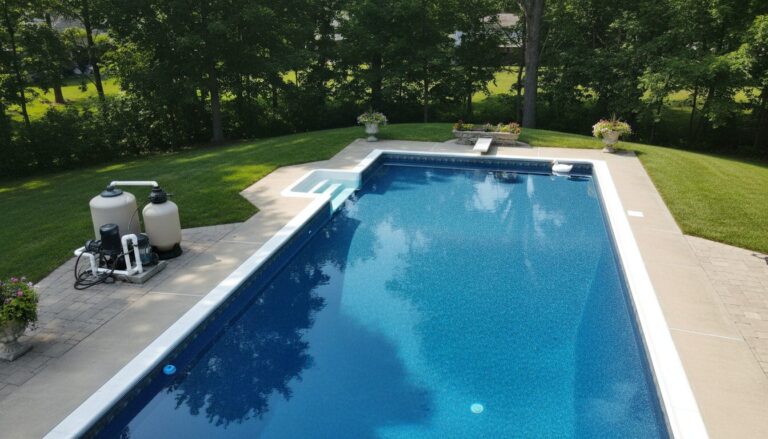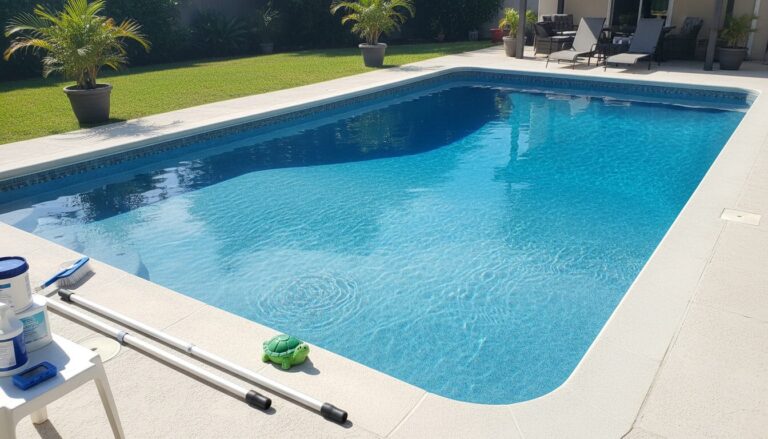

Pool pH should stay between 7.4 and 7.6. Below 7.2, the water turns corrosive – it irritates eyes and skin and starts etching plaster and metal fittings. Above 7.8, chlorine loses most of its killing power and scale begins building on your walls and equipment. If your pH is outside that range right now, fixing it is a 15-minute job once you know what you’re adding and how much.
Why pool pH matters more than most people realize
Most pool owners treat pH like a box to check, but the number has real consequences. Chlorine’s active form – hypochlorous acid – is highly sensitive to pH. At pH 7.4, roughly 50% of your chlorine is in that active killing form. Creep up to pH 8.0 and only about 3% is active. That means you can have a full chlorine reading on your test kit and still have essentially no sanitizing power in the water. High pH is one of the top reasons pools go cloudy or grow algae even when chlorine looks fine.
Low pH causes a different set of problems. Acidic water corrodes metal components including pump seals, heater elements, and ladders. It also etches pool plaster and fades vinyl liners faster. Swimmers notice it as burning eyes and that “pool smell” – which is actually chloramines forming more readily in acidic conditions, not the sign of a clean pool.
What causes pool pH to drift?
pH in most pools drifts upward over time, and that’s normal. Aeration – from return jets, waterfalls, spillovers, and even people swimming – off-gasses carbon dioxide from the water. CO2 leaving the water raises pH naturally. This is why outdoor pools in warm weather tend to creep high, and why a spa with heavy jets will show a rapidly rising pH after heavy use.
High total alkalinity also causes persistent high pH. Alkalinity acts as a pH buffer, so if your TA is above 120 ppm, your pH will keep bouncing back up after every correction. If you’re fighting a constantly high pH, check your TA first. This is exactly why experienced pool folks say you should address alkalinity before chasing pH – the Total Alkalinity vs pH relationship is one of the most important concepts in keeping water balanced without going in circles.
pH can also drop from heavy rain (rainwater is naturally acidic), large bather loads, adding chlorine in the form of trichlor tabs (which are very acidic), and algaecide treatments. Pools running primarily on trichlor tablets often fight chronically low pH for this reason.
How to test pool pH accurately
A basic liquid test kit or quality test strips will both read pH – liquid kits are generally more accurate. Test at elbow depth, away from return jets, and at roughly the same time of day each test since pH naturally fluctuates with sunlight and temperature. A digital pH meter is the most accurate option if you’re managing chemistry closely, but rinse the probe thoroughly between uses or the readings drift.
Test pH at least twice a week during summer, especially after heavy rain or a pool party. Once you know your pool’s tendencies – whether it runs high or low by default – you can stay ahead of problems instead of reacting to them.
How to raise pool pH
To raise pH, use soda ash (sodium carbonate). The standard starting dose is 6 oz per 10,000 gallons to raise pH by approximately 0.2 points. Pre-dissolve the soda ash in a bucket of pool water first, then pour it slowly near a return jet with the pump running. Wait at least 4 hours (ideally overnight) and retest before adding more. Adding too much at once sends pH spiking, and then you’re chasing it back down.
Baking soda (sodium bicarbonate) is sometimes suggested for raising pH, but it primarily raises total alkalinity and has only a mild effect on pH. If your pH is low but your TA is already fine, use soda ash, not baking soda.
How to lower pool pH
To lower pH, use muriatic acid or dry acid (sodium bisulfate). Muriatic acid is faster and cheaper per treatment; dry acid is easier to handle safely. For muriatic acid, a starting dose of roughly 8 oz per 10,000 gallons will drop pH by about 0.2 points. Always add acid to a bucket of water first – never pour it directly into the pool undiluted near a surface, and never add water to acid. Pour slowly near a return jet with the pump running, then wait at least 4 hours before retesting.
Wear eye protection and gloves when handling muriatic acid. It is genuinely corrosive – don’t let it splash on your skin, the pool deck, or metal components. AquaDoc makes a pH reducer in both liquid and granular form that pool owners use when they want a pre-measured, clearly labeled option rather than working with raw muriatic acid.
The most common pH mistakes
- Retesting too soon. Chemicals need time to mix. Test too early and you’ll overdose. Wait 4-6 hours minimum after any adjustment.
- Fixing pH when TA is out of range. If total alkalinity is off, pH corrections won’t hold. Fix TA first or you’ll add chemicals every day and still get nowhere.
- Adding too much at once. Overshoot in one direction and you’ll spend another day correcting the correction. Small doses, retest, repeat.
- Testing near a return jet. That water hasn’t fully mixed yet. Test from the middle of the pool at elbow depth for an accurate reading.
- Ignoring pH while shocking. After a shock treatment, pH often climbs, especially with cal-hypo shock. Retest pH 24 hours after shocking and adjust if needed.
For a more detailed look at adjusting pH without overcorrecting, that guide walks through the math and common edge cases that trip people up.
Frequently Asked Questions
What should pool pH be?
Pool pH should be between 7.4 and 7.6. Below 7.2, the water becomes corrosive and irritates eyes and skin. Above 7.8, chlorine loses most of its effectiveness and scale can start forming on surfaces and equipment.
How do I raise pool pH?
Add soda ash (sodium carbonate) to raise pool pH. A typical starting dose is 6 oz per 10,000 gallons to raise pH by about 0.2 points. Dissolve it in a bucket of pool water first and pour it near a return jet with the pump running, then wait at least 4 hours before retesting.
How do I lower pool pH?
Use muriatic acid or dry acid (sodium bisulfate) to lower pool pH. For muriatic acid, start with about 8 oz per 10,000 gallons to drop pH by roughly 0.2 points. Always add acid to water in a bucket first, never directly to the pool surface, and keep the pump running for even distribution.
Why does my pool pH keep rising?
pH naturally rises in most pools because aeration from return jets, waterfalls, and swimmers off-gasses CO2, which pushes pH up. High total alkalinity also makes pH drift high repeatedly. If your TA is above 120 ppm, bring it down first – correcting pH alone won’t stick until alkalinity is in range.
Does high pH affect chlorine?
Yes, significantly. At pH 8.0, only about 3% of your chlorine is in its active killing form (hypochlorous acid). At pH 7.4, that number is around 50%. High pH is one of the main reasons chlorine appears to disappear without actually sanitizing the water.
The bottom line: pH is not complicated, but it does require patience. Small adjustments, enough wait time before retesting, and a solid handle on your alkalinity level will keep your pool in range most of the season without much effort. Get those habits right and pH becomes one less thing you have to worry about.