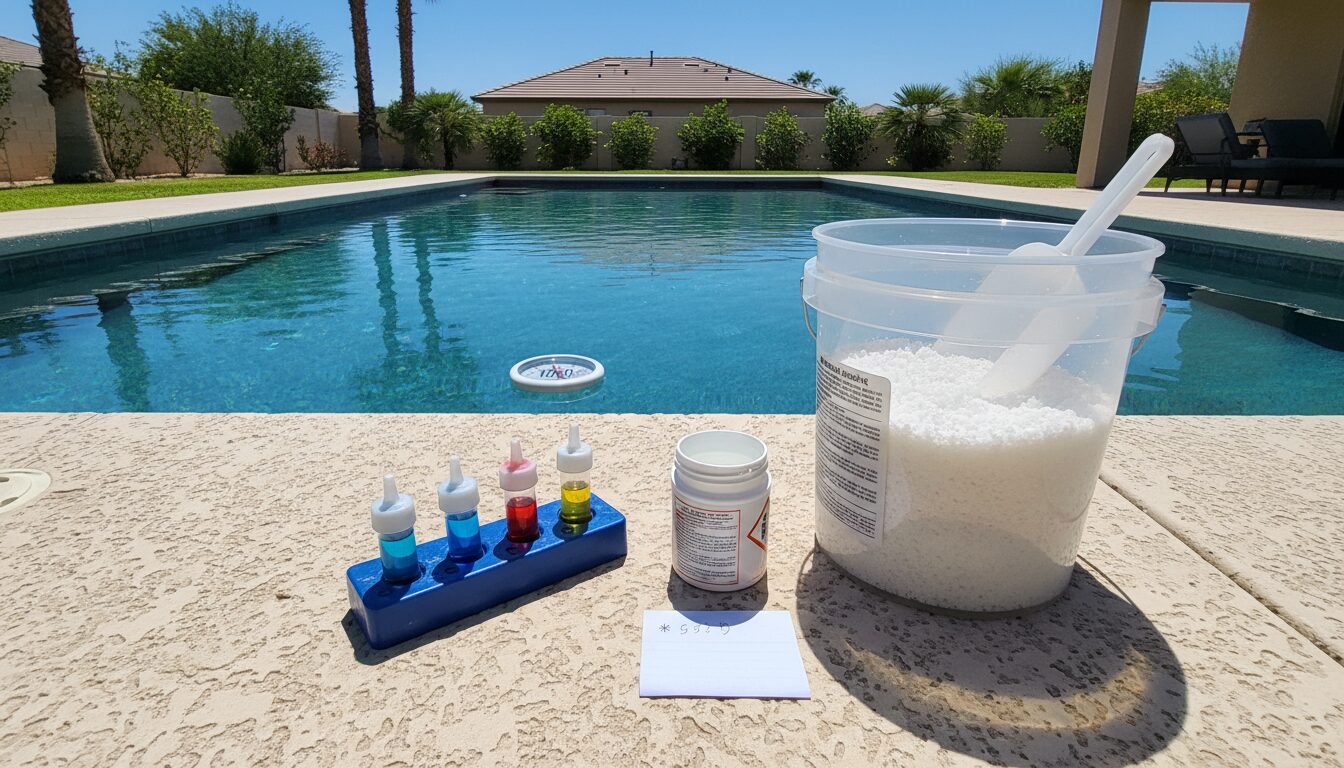

For a 20,000-gallon gunite pool with CYA at 40 ppm and air temperatures at 100°F, add 2 to 3 lbs of trichlor shock in a single treatment, applied after sundown. The lower end of that range (2 lbs) raises free chlorine by roughly 5 ppm, which is enough for maintenance shocking when the water is otherwise clean. The upper end (3 lbs) is the right call when chlorine has already dropped near zero or when the pool has been under heavy bather load in extreme heat.
If you’ve ever tested your water at 7 p.m. on a 100-degree day and watched your chlorine read nearly zero despite adding a full dose that morning, you already know what scorching heat and a full CYA load can do to your sanitation. The situation isn’t dangerous by itself, but it does require a more deliberate approach than the label instructions assume. This article walks through the exact math, explains why heat changes your dose, covers the CYA interaction, and tells you what to watch for over the following 24 hours.
Why 100°F Changes the Whole Equation
Pool chemical labels are written for average conditions, usually around 75 to 80°F with moderate sun. When temperatures climb to 100°F, two things happen simultaneously: UV radiation intensity spikes and warm water itself speeds up chlorine decomposition. Together, those factors can burn off free chlorine 25 to 50 percent faster than you’d see on a mild day. A dose that would hold a pool at 3 ppm for 12 hours in May might drop to near zero in four hours on a July afternoon.
This is why timing matters so much at extreme temperatures. Shocking at 6 a.m. before the sun is high gives chlorine almost no time to work before UV starts stripping it. Shocking after 8 p.m. lets the full dose circulate overnight, so by morning you have residual chlorine already in the water when UV exposure begins again. If you’re dealing with summer pool chemistry pressure from daily swimmers, evening dosing is especially important because bather load and heat are hitting the pool at the same time during the day.
The Role of CYA at 40 ppm
Cyanuric acid (CYA) acts as a sunscreen for chlorine molecules, slowing UV degradation. At 40 ppm, your CYA is in the middle of the ideal range (30 to 50 ppm for a chlorine pool), which means it’s doing real work without over-buffering the chlorine to the point of ineffectiveness. Here’s the trade-off: CYA also slightly slows the rate at which free chlorine kills pathogens, so at 40 ppm you need a minimum free chlorine of about 2 ppm to stay sanitary, and you should shoot for 3 to 5 ppm as your normal target.
When you’re shocking rather than just maintaining, the math shifts. A true breakpoint shock requires free chlorine at roughly 10 times the CYA level to destroy combined chlorine and kill algae. At CYA 40 ppm, that means reaching 10 ppm of free chlorine. For routine maintenance shocking when the pool is clear and combined chlorine is low, 5 to 7 ppm is sufficient. Know which situation you’re in before you decide on a dose.
Worked Example: Calculating the Dose for 20,000 Gallons
Trichlor shock (sodium dichloroisocyanurate or stabilized trichloroisocyanuric acid granules) typically delivers about 1 ppm of free chlorine per 0.5 lbs added to 10,000 gallons of water. For 20,000 gallons, 1 lb raises free chlorine by roughly 1 ppm, and 2 lbs raises it by about 2 to 2.5 ppm (accounting for small variations in product concentration, usually 87 to 90 percent available chlorine).
Say your pool reads 0.5 ppm free chlorine at 8 p.m. after a brutal 100-degree day. Your target is 5 ppm for a maintenance shock. You need to raise free chlorine by about 4.5 ppm in 20,000 gallons. That works out to roughly 2 lbs of trichlor shock as a starting dose. Add it, run the pump for two hours, then retest. If the reading is below 3 ppm at the 8 a.m. check the next morning, add another 1 lb the following evening. If you’re fighting visible cloudy water or early algae tint, start at 3 lbs instead.
One important note specific to gunite pools: because gunite and plaster are porous, they can harbor algae in microscopic surface pits that a vinyl liner or fiberglass shell wouldn’t. This means gunite owners often need to reach the higher end of the shock dose range more consistently than owners of other pool types. The 3 lb dose is not overkill for a gunite pool in extreme heat.
CYA Accumulation: The Trichlor Side Effect to Monitor
Every pound of trichlor adds approximately 5 ppm of CYA to a 20,000-gallon pool. That’s by design (the stabilizer is built into the compound), but it means frequent shocking with trichlor will push your CYA higher over the course of a summer. If you’re shocking weekly at 2 lbs per treatment, you’re adding roughly 10 ppm of CYA per week. After six weeks, CYA has climbed from 40 to 100 ppm, and at that level, chlorine becomes much less effective at killing bacteria and algae even when free chlorine reads normal.
Test CYA every two weeks during hot stretches when you’re shocking regularly. If it climbs above 70 ppm, partial drain-and-refill is the most reliable fix. Pool owners who also use trichlor tablets in a feeder or floater should count that CYA contribution alongside shock treatments. AquaDoc’s stabilized shock products include clear per-dose CYA contribution figures on the label precisely because this calculation trips up so many pool owners mid-season.
- CYA 30 to 50 ppm: Ideal range. Chlorine works efficiently and UV protection is real but not excessive.
- CYA 50 to 70 ppm: Manageable. Raise your free chlorine target slightly to maintain sanitation effectiveness.
- CYA 70 to 100 ppm: Problematic. Chlorine demand rises sharply. Consider a partial drain before continuing to shock.
- CYA above 100 ppm: Drain at least one-third of the pool and refill before adding any more stabilized chlorine products.
Step-by-Step Dosing Process for a 100°F Day
- Step 1: Test the water. Use a reliable test kit to get current free chlorine, combined chlorine, and CYA readings before you dose anything. Never shock blind.
- Step 2: Wait until after sundown. Shocking after 8 p.m. protects the dose from immediate UV loss and gives chlorine the whole night to work.
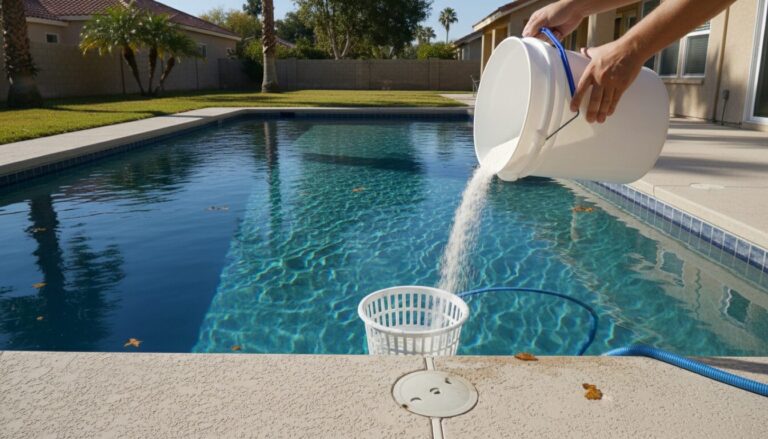
- Step 3: Pre-dissolve the trichlor shock. Add granules to a bucket of pool water first, stir, then pour around the perimeter of the pool. Never dump granules directly onto a gunite or plaster surface; the concentrated acid can bleach or etch the finish.
- Step 4: Run the pump. Keep circulation running for at least two hours after dosing, overnight if possible.
- Step 5: Retest in the morning. Check free chlorine between 7 and 8 a.m. before the sun is fully up. A reading above 2 ppm means your dose held. Below 1 ppm the following evening means you need a repeat dose.
- Step 6: Log the CYA impact. Record each shock dose so you can track cumulative CYA added over the season. This prevents the creeping CYA problem that catches many pool owners off guard by August.
Comparing Shock Options at Extreme Heat
| Shock Type | Available Chlorine | Adds CYA? | Safe for Gunite? | Best Use Case |
|---|---|---|---|---|
| Trichlor Shock | 87 to 90% | Yes (~5 ppm per lb per 20k gal) | Yes (pre-dissolve first) | Regular maintenance shocking when CYA is under 50 ppm |
| Cal Hypo Shock | 65 to 78% | No | Yes (pre-dissolve first) | Heavy algae treatment or when CYA is already high |
| Liquid Chlorine | 10 to 12.5% | No | Yes | Quick-dissolve dose on hot days; no CYA impact |
| Dichlor Shock | 56 to 62% | Yes (~9 ppm per lb per 10k gal) | Yes | Occasional use; CYA climbs fast with repeated doses |
At CYA 40 ppm and 100°F, trichlor is a reasonable choice for maintenance shocking because it adds stabilizer incrementally rather than all at once. The risk is letting CYA creep upward without noticing. If you’re already dealing with a CYA level pushing toward 60 ppm or you need a larger shock to knock out early algae, switching to cal hypo for that treatment avoids adding more stabilizer to water that doesn’t need it. Pool volume also plays into this calculation: if you’re ever unsure of your exact gallon count, working through a volume estimate like the one in how many gallons a 20×40 inground pool holds can help you confirm your baseline before dosing.
Common Mistakes in Extreme Heat Conditions
The most frequent error is shocking in the morning and wondering why chlorine is gone by afternoon. UV plus 100°F water temperature plus bather load is a triple demand on your free chlorine, and a dose added at 7 a.m. simply cannot survive all three. Evening shocking is not optional in extreme heat; it’s the difference between a dose that works and one that disappears before it sanitizes anything.
The second mistake is relying on a floating or inline trichlor tablet feeder as the sole source of chlorine during a heat wave and calling that a “shock.” Tablets are designed for maintenance levels of 1 to 3 ppm. They cannot quickly raise chlorine to the 5 to 10 ppm range needed for a true shock. Use granular shock as a separate, deliberate treatment.
The third mistake is not accounting for the pH drop that trichlor causes. Trichlor has a pH of about 2.8 to 3.0, so adding 2 to 3 lbs will lower your pool’s pH noticeably. Test pH the morning after shocking and add sodium carbonate (soda ash) if pH has dropped below 7.2. Letting pH fall too low in a gunite pool accelerates surface etching over time.
Frequently Asked Questions
How much trichlor shock do I add to a 20,000-gallon pool?
For a standard shock treatment on a 20,000-gallon pool, use 2 lbs of trichlor shock to raise free chlorine by roughly 5 ppm. At 100°F with CYA at 40 ppm, plan to dose 2 to 3 lbs and retest within 30 minutes of opening the pool the next morning, since heat burns off chlorine faster than the label assumes.
Does 100°F heat change how much shock I need?
Yes, significantly. At temperatures above 90°F, UV intensity and warm water together accelerate chlorine loss by 25 to 50 percent compared to a 75°F day. Dose at the higher end of your target range and always shock after sundown to get the most out of every pound you add.
Is CYA 40 ppm a good level before shocking a gunite pool in summer?
CYA at 40 ppm is a solid starting point and falls within the recommended 30 to 50 ppm range for chlorinated pools. It gives chlorine enough UV protection without pushing chlorine demand so high that you need excessive doses to maintain an effective sanitizing level throughout the day.
Can I use trichlor shock in a gunite pool without raising CYA too high?
Yes, but watch the cumulative effect. Each 1 lb of trichlor adds roughly 5 ppm of CYA to a 20,000-gallon pool. If you’re shocking frequently through a hot summer, test CYA every two weeks and drain partially if it climbs above 70 ppm, since high CYA dramatically reduces chlorine effectiveness even when free chlorine reads normal.
What free chlorine level should I target when shocking a 20,000-gallon pool at CYA 40?
For routine maintenance shocking with clean, clear water, target 5 to 7 ppm of free chlorine. For a true breakpoint shock to destroy combined chlorine or kill early algae, the target is 10 ppm or higher, which is roughly 10 times the CYA level. At 40 ppm CYA, that means adding about 4 lbs of trichlor shock to reach breakpoint from a starting free chlorine of zero.
At 100°F with CYA at 40 ppm, a 20,000-gallon gunite pool needs 2 to 3 lbs of trichlor shock added after sundown, with a follow-up test the next morning to confirm the dose held. Keep an eye on CYA every two weeks through the hot stretch, and switch to an unstabilized shock option if CYA starts climbing toward 70 ppm.