
Every fall, someone ties down their winter cover, steps back feeling accomplished, and then notices by January that the cover looks like a hammock with a pond in the middle – and the pillow has completely disappeared. If you have stood there wondering whether you even needed that air-filled rectangle in the first place, and what you were supposed to do with it, you are not alone.
A pool pillow – also called an air pillow or winter air cushion – floats at the center of your above-ground pool under the winter cover to absorb ice expansion and prevent damage to your liner and pool walls. The right size for most round above-ground pools is a 4×8-foot pillow, inflated to 50-60% capacity, centered and tied off before the cover goes on. This article walks through how to size it correctly for your pool, where exactly to position it, how much air to put in, and the common mistakes that turn a good pillow into a deflated mess by February.
Why the Pillow Is There in the First Place
Water expands by about 9% when it freezes. In an above-ground pool, that expanding ice has to go somewhere, and without a pillow it pushes outward against your pool wall and inward against the underside of your cover. That outward pressure is what buckles and cracks above-ground pool walls over time – sometimes in a single hard winter. The pillow gives the ice somewhere to push into instead. It compresses as the ice expands, relieving lateral pressure on the wall and keeping the cover from being pulled tight like a drumhead. As Romanelli and Son Pool Service explains, the pillow also creates a slight dome in the center of the cover, which encourages rain and snowmelt to run toward the edges rather than pool in the middle. Both jobs matter.
You also want to protect your vinyl liner. Ice sitting hard against a liner all winter can cause stress cracks, especially near the bottom where pressure concentrates. EZ Pool and Spa Supply notes that pools in climates that see repeated freeze-thaw cycles – not just one hard freeze – face the most liner wear, because the liner expands and contracts repeatedly against a rigid ice sheet. If your winters include several thaws and refreezes, the pillow earns its keep every single time.
How to Pick the Right Size Pillow
The standard rule is to cover roughly 10-20% of your pool’s surface area with the pillow. For most round above-ground pools, one 4×8-foot pillow (32 square feet) hits that target cleanly. Here is how it maps to common pool sizes:
- 15-foot round (177 sq ft): One 4×8-foot pillow covers about 18% – ideal.
- 18-foot round (254 sq ft): One 4×8-foot pillow covers about 13% – right in the target range.
- 21-foot round (346 sq ft): One 4×8-foot pillow works, but some owners use two overlapping pillows or step up to a 4×15-foot model.
- 24-foot round (452 sq ft): Use two 4×8-foot pillows placed end-to-end, or a single 4×15-foot pillow (60 sq ft), to stay above 10% coverage.
- Oval or rectangular pools: Calculate your surface area (length x width), then aim for 10-20% of that figure. A 15×30-foot oval (450 sq ft) needs at least 45 square feet of pillow, which two 4×8-foot pillows cover easily.
Pillow thickness matters almost as much as size. Thinner 0.1mm pillows are cheaper but prone to cracking in hard freezes. Spend a little more on a 0.2mm or thicker pillow – most quality ones run $15-$30 – and it will last several seasons instead of one. LinerWorld’s winter pillow guide points out that UV-resistant material also matters, since part of the pillow may be exposed to sunlight at the cover edge all winter.
How to Inflate a Pool Pillow Correctly
This is where most people go wrong: they inflate the pillow until it is firm and round, the same way you would inflate a beach ball. Do not do that. A fully inflated pillow cannot compress when ice presses against it – so it pops instead, usually sometime in January when you are not watching. Inflate to 50-60% of maximum capacity. The pillow should feel soft and pliable when you press on it, with visible slack in the material. It should look slightly flat, not round.
A standard hand pump or a low-pressure air compressor on its lowest setting both work fine. Avoid using a high-pressure inflator designed for car tires – one quick burst can overdo it. Once inflated, seal the valve with the cap that came with the pillow and give it a quick squeeze test: if you can compress it easily with your palm, the pressure is about right. If it resists firmly, let some air out.
Step-by-Step: Placing the Pillow Before You Put the Cover On
- Inflate the pillow to 50-60% on dry land before you go near the pool. It is much easier than leaning over the water.
- Cut two lengths of rope or nylon twine, each about 6 feet longer than your pool’s diameter. Rope with a little stretch is better than rigid cord.
- Tie one end of each rope to opposite sides of the pool wall – not to the cover clips or cable, but directly to the top rail or through the pool frame.
- Thread the ropes through the pillow’s grommets before tying the second end, or loop them around the pillow body if your pillow lacks grommets.
- Lower the pillow to the center of the pool and adjust the ropes so the pillow sits roughly centered with equal slack on all sides. The pillow should float, not be stretched taut.
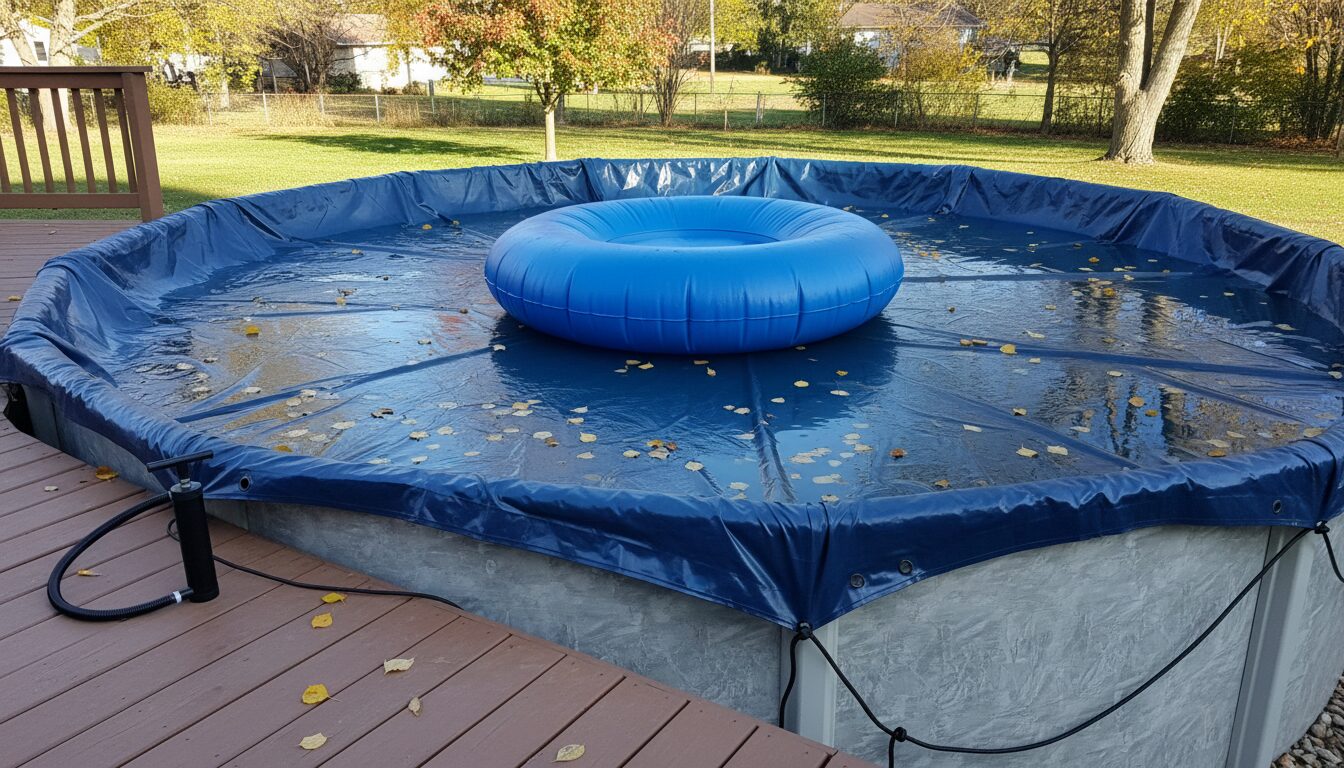
- Lay your winter cover over the pool so it drapes over the pillow. The cover should show a slight center dome from the pillow underneath.
- Secure the cover cable or clips to the pool wall as normal. Do not cinch the cover so tight that it flattens the pillow completely.
One detail that trips people up: if you tie the ropes directly through the cover’s cable system, the pillow gets yanked out of center every time the cover shifts. Keep the pillow ropes independent of the cover’s tensioning system. H and H Pools recommends using a separate bungee or rope attachment to the top rail so the pillow stays put regardless of how the cover moves.
Common Mistakes That Cause Problems Mid-Winter
- Over-inflation: A drum-tight pillow will pop when the ice load builds. Always leave it soft at 50-60% full.
- Letting the pillow drift to one side: An off-center pillow means one side of the pool wall has no ice pressure relief. Use two anchor ropes, not one.
- Skipping the pillow entirely on mild-climate pools: Even a single freeze at 28 degrees Fahrenheit can expand water enough to stress an above-ground pool wall without a pillow in place.
- Using a damaged pillow from last season: Inspect it before inflation. A slow leak mid-winter defeats the whole purpose. A new 4×8-foot pillow costs $15-$25 – replace it if there is any doubt.
- Over-tensioning the cover: If you crank the cover cable so tight that it crushes the pillow flat, you lose the dome effect that drains water to the edges. Pull the cover snug, not rigid.
If you are also managing what happens on top of the cover over winter – leaf accumulation, standing water, submersible pumps – it is worth reading about how winter covers accumulate debris and moisture and what that means for spring opening.
Worked Example: 18-Foot Round Pool
Say your pool is 18 feet in diameter. The surface area is roughly 254 square feet (pi x 9 squared). Ten percent of that is 25 square feet, and 20% is 51 square feet. A standard 4×8-foot pillow gives you 32 square feet – sitting comfortably at about 13% of surface area, right in the target range. Inflate it until it looks about half-full (aim for a thickness of roughly 4-5 inches at the center rather than 8-9 inches fully inflated). Tie it off with two ropes anchored to opposite sides of the top rail, lower it in, center it, then drape the cover over. That is genuinely all it takes for a pool this size. If you are using an AquaDoc winter closing kit, the pillow fits easily alongside the other closing chemicals in your end-of-season routine – just add it to the checklist before you reach for the cover.
Frequently Asked Questions
What size pool pillow do I need for an 18-foot round above-ground pool?
For an 18-foot round pool, use a 4×8-foot pillow. That covers roughly 13% of the pool’s surface area, which is enough to absorb ice expansion without leaving the liner unprotected at the edges. One pillow is sufficient for most round pools up to 21 feet in diameter.
How much should you inflate a pool pillow?
Inflate a pool pillow to about 50-60% of its maximum capacity – it should feel soft and pliable, not drum-tight. A fully inflated pillow is far more likely to pop when ice presses against it. Leave visible slack so the pillow can compress as the ice load builds instead of bursting.
Do you need a pool pillow for an above-ground pool?
You do not strictly need one, but it protects your liner and pool walls from ice expansion damage that can buckle above-ground pools over winter. Without a pillow, ice expanding outward has nowhere to go except into your pool wall. Most winterization guides recommend one for any pool in a climate that sees temperatures below 32 degrees Fahrenheit.
Where do you put the pool pillow when closing an above-ground pool?
Center the pillow in the middle of the pool and tie it off with two lengths of rope or twine attached to opposite points on the pool wall’s top rail. This keeps it from drifting to one side under the cover. Avoid tying it too tight – the rope should hold position but allow slight movement as ice shifts through the winter.
Can a pool pillow sink or deflate over winter, and what do you do?
Yes, pool pillows can slowly deflate over a cold winter, especially if over-inflated and then punctured by ice pressure. If yours deflates completely, the cover will sag and pool water will pond on top. The best prevention is under-inflating to 50-60% and using a thicker 0.2mm or heavier pillow rated for cold temperatures. A deflated pillow mid-season is difficult to fix without removing the cover, so the right inflation level upfront is your best insurance.