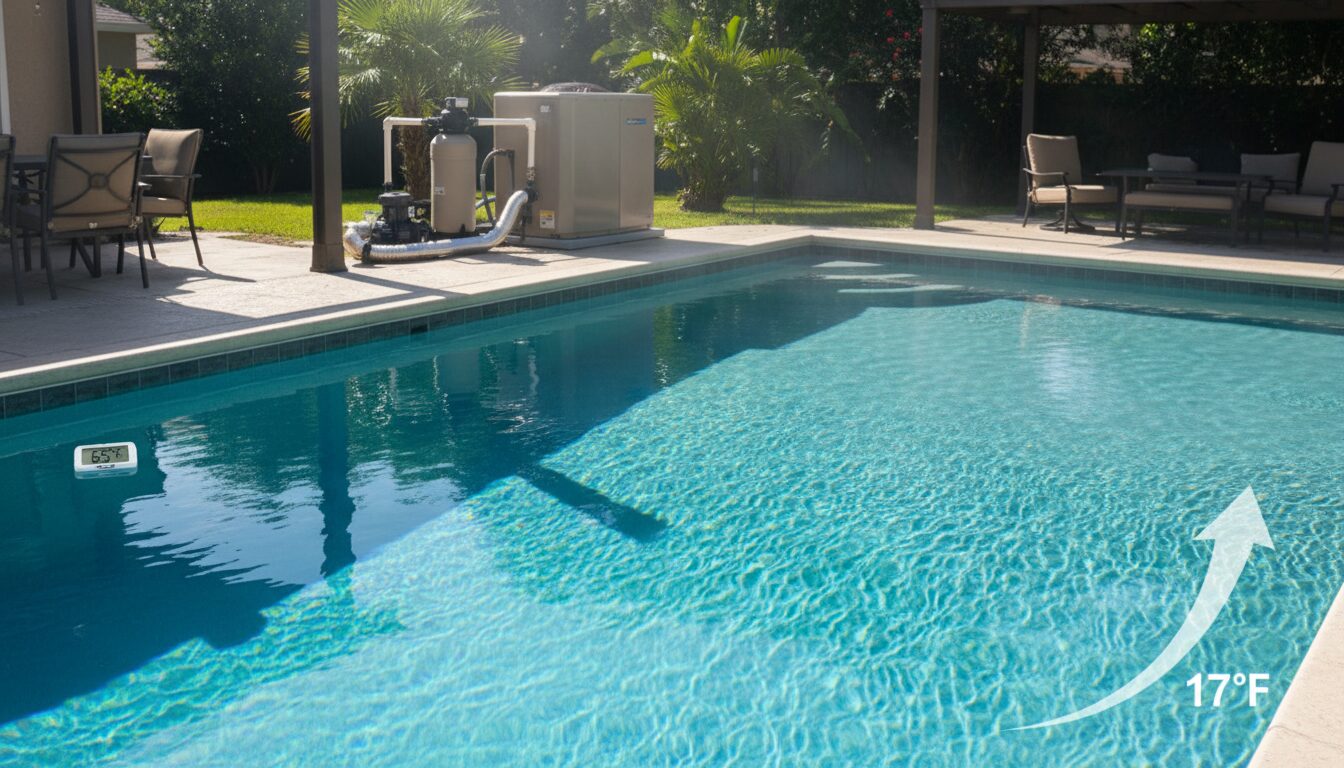

You finally get the pool ready to open, the water is sitting at a teeth-chattering 65°F, and you flip the heat pump on expecting to swim in a day or two. Then you check the thermometer 24 hours later and the temperature has barely moved. Sound familiar? Heat pumps are efficient, but they are not fast, and knowing what to actually expect – in hours, not vague estimates – changes how you plan your swim season.
Heating a 20,000-gallon pool from 65°F to 82°F takes a typical 100,000 BTU heat pump approximately 36 to 48 hours of continuous run time under real-world conditions (air temperature in the low-to-mid 70s°F, no cover, moderate wind). A 120,000 BTU unit can get there in 28 to 36 hours. This article walks through the math behind those numbers, explains every variable that stretches or shrinks the timeline, and gives you practical steps to reach swim temperature faster.
The Core Math: BTUs, Gallons, and Degrees
One BTU raises one pound of water by 1°F. Water weighs 8.34 pounds per gallon, so a 20,000-gallon pool contains roughly 166,800 pounds of water. You need to raise that water 17°F (from 65°F to 82°F). Multiply those two numbers together: 166,800 x 17 = approximately 2,835,600 BTUs of total heat energy required just to get the water there, with zero losses.
A 100,000 BTU/hr heat pump running continuously would theoretically deliver that in about 28.4 hours. But that assumes 100% of the heat stays in the pool, no overnight cooling, and the unit running at full rated output the whole time. None of those things happen in the real world, which is why the actual timeline is longer. Efficiency losses, heat loss to the atmosphere, and reduced pump output in cooler air typically add 25 to 50 percent to the theoretical run time.
How BTU Rating Changes the Timeline
Heat pump BTU ratings are the single biggest lever you control at purchase. Here is how the most common residential sizes stack up for a 20,000-gallon pool heating from 65°F to 82°F, assuming air temperature around 70 to 75°F and no solar cover:
| Heat Pump Size | Theoretical Hours | Real-World Hours (Est.) | Best For |
|---|---|---|---|
| 80,000 BTU | 35 hrs | 52 – 70 hrs | Small pools, warm climates only |
| 100,000 BTU | 28 hrs | 36 – 48 hrs | Standard choice for 20,000-gal pools |
| 120,000 BTU | 24 hrs | 28 – 36 hrs | Cooler climates, faster warm-up |
| 140,000 BTU | 20 hrs | 24 – 30 hrs | Pools in northern states, extended seasons |
Why These Differences Matter
The gap between an 80,000 BTU and a 120,000 BTU unit looks small on a spec sheet but can mean an extra full day of waiting when you factor in overnight cooling. If you are in a state where spring air temperatures sit in the 60s°F when you open the pool, sizing up is worth every dollar. A heat pump that is undersized for your climate runs constantly, wears faster, and still leaves you waiting.
What Actually Slows a Heat Pump Down
Heat pumps extract heat from outdoor air and transfer it to the water. When outdoor air temperature drops, there is less heat to extract, and the unit’s effective output falls well below its rated BTU. Below 50°F outdoor air temperature, most residential heat pumps lose 30 to 40 percent of their rated output. Below 45°F, many units shut off entirely on a safety lockout.
The four biggest factors that add hours to your warm-up time:
- Air Temperature: Every 10°F drop in outdoor air temperature reduces heat pump output by roughly 10 to 15 percent. A 100,000 BTU unit at 75°F air may only deliver 80,000 to 85,000 BTU at 55°F air.
- No Pool Cover: An uncovered pool loses heat continuously, especially at night. Overnight temperature drop of 3 to 5°F is common, which means the heat pump has to claw back ground it already gained.
- Wind: Wind accelerates evaporative heat loss from the water surface. A 15 mph breeze can roughly double the rate of surface heat loss compared to a calm day.
- Dirty Filter or Restricted Flow: Heat pumps need good water flow through the heat exchanger to work efficiently. A clogged cartridge or a filter running at high PSI starves the heat exchanger and drops efficiency. If your pool is showing signs of flow trouble, it is worth reading about why ignoring the pressure gauge hurts your pump system before you blame the heat pump itself.
A Worked Example With Real Numbers
Say your 20,000-gallon pool sits at 65°F on the morning of May 10th. Air temperature for the next three days averages 72°F during the day and drops to 58°F overnight. You have a 100,000 BTU heat pump and no solar cover.
During daylight hours (roughly 12 hours per day), the heat pump runs near full output and gains about 0.45°F per hour, adding 5.4°F per day. Overnight, with no cover and cooler air, the pool loses approximately 2 to 3°F. Net gain per 24-hour cycle: roughly 2.4 to 3.4°F. At that rate, closing the 17°F gap takes 5 to 7 calendar days, even though the heat pump runs continuously.
Add a solar cover, and overnight losses drop to under 1°F. Net gain per day jumps to 4 to 4.5°F, and you reach 82°F in 4 calendar days instead of 7. That is the single fastest free improvement available to any pool owner running a heat pump.
Step-by-Step: How to Get to 82°F Faster
- Check and clean the filter first. Before you start the heat pump, backwash or rinse your filter and confirm the system PSI is in the normal range. Restricted flow is one of the most common reasons a heat pump underperforms its rating.
- Put the solar cover on every night. Even a cheap bubble cover cut to fit makes a measurable difference within 24 hours.
- Run the pump and heat pump continuously until target temperature is reached. Cycling the pump off to save electricity during initial heat-up just extends the timeline. Wait until you are at temp to switch to timed cycles.
- Start heating before the weekend, not on Friday afternoon. A 36 to 48 hour warm-up means a Monday or Tuesday start gets you swimming by the weekend. Friday is already too late.
- Set the thermostat to 82°F and leave it. Bumping it to 90°F does not make the heat pump run hotter or faster – it just keeps it running longer after target is reached and wastes energy.
Maintaining 82°F Once You Are There
Getting to target temperature is the hard part. Keeping a 20,000-gallon pool at 82°F costs far less energy than the initial heat-up. A properly sized heat pump running 6 to 8 hours per day during warm months can maintain temperature in most U.S. climates. In spring and fall shoulder months, expect 10 to 14 hours of daily run time to hold 82°F when overnight air temperatures fall into the 50s°F.
Once your water chemistry is dialed in and you are maintaining temperature consistently, that is a good time to think about your overall pump and equipment efficiency too. Unusual noises from your circulation equipment during this period often signal an underlying problem, and unusual pump sounds are worth diagnosing early before they affect water flow to the heat pump. AquaDoc makes a line of pH and alkalinity balancers that pool owners use during spring start-up specifically because stable water chemistry helps protect heat pump heat exchangers from scale buildup over the season.
Common Mistakes That Add Days to Your Heat-Up
A few patterns come up repeatedly with heat pump warm-ups that are worth calling out directly:
- Starting Too Late in the Day: Flipping the heat pump on at 4 p.m. means the first 14 hours of run time happen in cool evening and overnight air. Start at sunrise to maximize output during the warmest part of the day.
- Running a Dirty or Oversized Filter: An oversized cartridge running at low pressure still needs to be clean. Biofilm and debris inside the filter housing reduce flow even when PSI looks normal.
- Expecting Gas Heater Speed: A gas heater can raise pool temperature 1 to 2°F per hour. A heat pump raises it 0.4 to 0.5°F per hour. Both get you there – just on very different schedules. Expecting the same speed is a setup for frustration.
- Skipping the Cover on “Warm” Nights: A night at 65°F still pulls heat from a pool at 78°F. The cover is not just for cold nights.
Frequently Asked Questions
How long does a pool heat pump take to heat a 20,000-gallon pool?
A 100,000 BTU heat pump heating a 20,000-gallon pool from 65°F to 82°F takes approximately 36 to 48 hours of continuous run time under typical conditions with air temperatures around 70 to 75°F. A 120,000 BTU unit shortens that to 28 to 36 hours. Without a solar cover, overnight heat loss can stretch the calendar time to 5 to 7 days even with the heat pump running continuously.
What size heat pump do I need for a 20,000-gallon pool?
A heat pump rated between 100,000 and 120,000 BTU is the standard recommendation for a 20,000-gallon pool in a warm-to-moderate climate. Pools in cooler climates or with significant shade exposure benefit from sizing up to 140,000 BTU to offset heat loss and avoid constant run time that shortens equipment life.
Does a solar cover really speed up pool heating?
Yes, significantly. A solar cover reduces overnight heat loss by 50 to 70 percent. Over a 48-hour heating period, that can shave 12 to 18 hours off total warm-up time. A basic bubble cover costs $60 to $150 and typically pays for itself in the first season through reduced energy use.
Why is my pool heat pump taking so long to heat the water?
The four most common causes are: outdoor air temperature below 55°F reducing unit output, no pool cover allowing overnight heat loss, a dirty or restricted filter reducing water flow through the heat exchanger, or an undersized BTU rating for the pool volume. Check all four before assuming the unit has a mechanical problem.
How many degrees per hour does a pool heat pump raise water temperature?
A 100,000 BTU heat pump raises a 20,000-gallon pool roughly 0.4 to 0.5°F per hour at optimal outdoor air temperatures (70 to 80°F). That rate drops to 0.25 to 0.35°F per hour when outdoor air falls to 55 to 60°F. Gas heaters deliver 1 to 2°F per hour, which is why heat pumps require more planning around timing.
For a 20,000-gallon pool going from 65°F to 82°F, plan on 36 to 48 hours of continuous heat pump run time under good conditions – and start at least two days before you want to swim, not the morning of.