
You finally got the quote back for replastering your pool, and the number staring at you looks nothing like what you expected. Add a tanning ledge and a raised beam edge to the picture and suddenly the estimator’s proposal has line items you didn’t even know existed. What exactly are you paying for, and is it fair?
Replastering a pool with a tanning ledge and a raised beam edge typically costs $10,000 to $22,000 for a mid-size inground pool, before any tile work, coping, or equipment upgrades. The base plaster finish, the shallow tanning shelf, and the exposed vertical beam each carry their own labor and material costs – and this article walks through all three, with real numbers, so you can read a contractor’s quote with confidence.
What Drives the Price of a Pool Replaster Job?
Before you can understand the add-ons, you need a baseline. Standard pool replastering on a plain gunite shell runs $5 to $7 per square foot for white plaster, $8 to $12 per square foot for quartz aggregate, and $12 to $20 per square foot for exposed pebble finishes like Pebble Tec. A typical 16×32 inground pool has roughly 1,100 to 1,200 square feet of shell surface, which puts a basic plaster job at $5,500 to $8,400 before any extras. According to pool service contractors in high-cost markets like San Diego, that baseline climbs another 20 to 35 percent just for regional labor rates, so location matters enormously.
The big cost drivers in any replaster bid are:
- Pool Surface Area: Every square foot of shell gets prepped, acid-washed, and re-coated. More surface equals more materials and more labor hours.
- Finish Type: White plaster is the cheapest but also the shortest-lived. Quartz and pebble aggregate cost more upfront but last 15 to 20 years versus 7 to 12 for plain plaster.
- Structural Repairs: Cracks, delamination, or hollow spots in the existing shell must be chipped out and re-gunited before the new plaster goes on. This can add $500 to $3,000 depending on severity.
- Drain and Fill Costs: Draining the pool, disposing of water per local code, and refilling can add $200 to $800 to the total.
- Tile and Waterline Work: If the waterline tile is being replaced alongside the plaster, budget an additional $20 to $45 per linear foot.
Tanning Ledge: What It Adds to the Bill
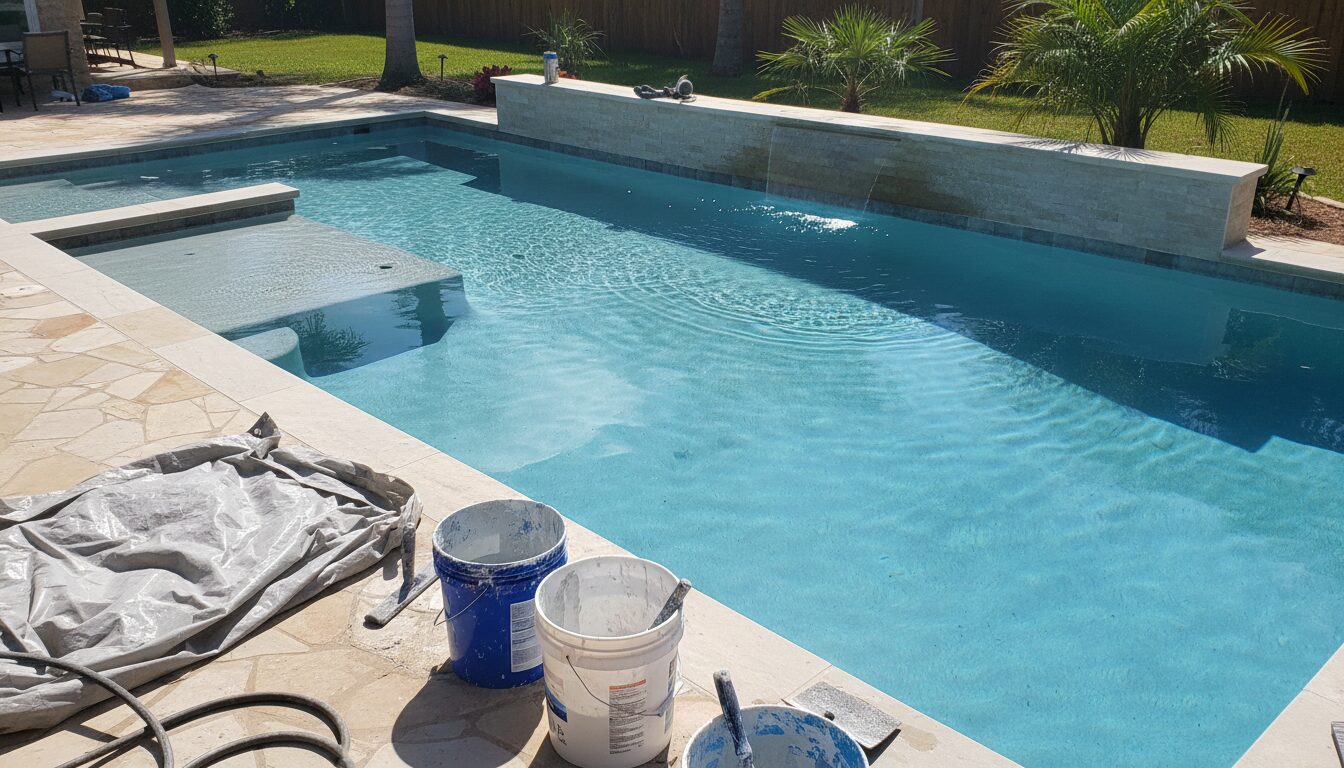
A tanning ledge – also called a Baja shelf or sun shelf – is a shallow, flat platform that sits at water depths of 6 to 12 inches. It sounds simple, but it’s one of the most labor-intensive surfaces on the entire pool to finish correctly. Why? Because you can see every square inch of it in a few inches of water. Any rough texture, discoloration, or missed spot is immediately obvious to anyone standing on the ledge or looking at it from the deck.
The tanning ledge adds $1,500 to $4,000 to a replaster project. The range depends on size (most residential ledges run 8 to 12 feet wide and 5 to 8 feet deep), finish type, and whether any drainage channels or integrated bubblers need to be worked around. Pebble and quartz finishes on a tanning ledge demand more hand-tooling than on vertical or curved shell surfaces, which is where the high end of that range comes from.
One common mistake homeowners make: assuming the tanning ledge is just “part of the pool” and already priced in. Most contractors quote the main shell separately and list the ledge as a line item. If your quote doesn’t break it out, ask – a lump-sum bid with a tanning ledge buried inside is hard to audit later.
Raised Beam Edge: The Most Misunderstood Line Item
A raised beam edge – sometimes written as a raised bond beam or raised wall – is a section of the pool’s perimeter that sits elevated above deck level, often by 12 to 36 inches. It’s a design feature on modern vanishing-edge, spillover, and resort-style pools, and it costs significantly more to plaster than a standard coping line because the vertical surface is fully visible at eye level from the patio.
Contractors typically charge $75 to $150 per linear foot for raised beam plastering and finishing, on top of the base shell bid. A raised beam that wraps 20 linear feet of the pool’s back wall adds $1,500 to $3,000 to the total. If the beam was originally built without proper waterproofing membrane and now needs structural remediation, that figure can double. The cost considerations for raising or reworking a spa bond beam in a market like Los Angeles underscore how quickly structural work on elevated walls escalates – it’s rarely a simple plaster-over-existing-concrete job.
If your raised beam also has a tile inlay or a decorative cap, add $20 to $45 per linear foot for tile installation. These are typically quoted separately by the tile sub and may not appear in the plaster contractor’s bid at all.
Sample Cost Breakdown: A 20,000-Gallon Pool With Both Features
Say your pool is roughly 16×38 with an average depth of 5.5 feet – about 20,000 gallons and approximately 1,350 square feet of shell surface. You want a quartz aggregate finish, a 10×6 foot tanning ledge, and 24 linear feet of raised beam edge along the back wall. Here’s how the numbers stack up:
| Line Item | Estimate |
|---|---|
| Shell replaster (1,350 sq ft quartz @ $10/sq ft) | $13,500 |
| Tanning ledge finish (10×6 = 60 sq ft, intensive labor) | $2,200 |
| Raised beam edge (24 linear ft @ $110/linear ft) | $2,640 |
| Drain, prep, acid wash, and refill | $600 |
| Minor crack repair (1-2 spots) | $800 |
| Estimated Total | $19,740 |
That $19,740 doesn’t include waterline tile replacement or any equipment work. For a full pool remodel that also addresses the pump, lights, and coping, total pool remodel costs can reach $30,000 to $65,000 once you add all the systems together. The replaster is typically the single largest line item in a remodel, but it’s rarely the only one.
Why These Numbers Vary So Much by Region
Pool labor costs track closely with local construction wages. A quartz replaster that costs $10 per square foot in Phoenix might run $14 to $16 per square foot in coastal California, the Pacific Northwest, or the Northeast. Permitting fees vary too – some municipalities require a permit for replastering, especially if any structural changes are involved with the raised beam. Budget $150 to $500 for permits if your town requires them.
Material availability also plays a role. Pebble aggregate products sourced from specific quarries can have regional price variation of 15 to 25 percent. If you’re in an area with a short pool season, contractors may charge a premium to schedule work in that window. Getting three competitive bids is not optional – it’s the only way to know if a number is fair for your market.
Choosing the Right Finish for High-Visibility Surfaces
The tanning ledge and raised beam are the two surfaces your guests will look at most. White plaster on a tanning ledge is the budget choice, but it stains from sunscreen, algae, and mineral deposits faster than any other finish – and those stains show up in inches of crystal-clear water. Quartz aggregate holds up better under UV, resists staining, and costs about $3 to $5 more per square foot. On a 60-square-foot tanning ledge, that’s a $180 to $300 difference to get a finish that will look better for a decade longer. It’s usually worth it.
Once the new plaster cures, keeping the water chemistry balanced is what protects your investment. Low pH etches plaster; high calcium precipitates scale. Proper startup chemistry in the first 28 days matters more than any other single maintenance task – AquaDoc’s pool startup chemicals are formulated specifically for fresh plaster applications where you need gentle, balanced treatment during that critical curing window.
After the replaster is done, you’ll also want to re-evaluate your chemical volumes. If your pool size has effectively changed because a tanning ledge was re-contoured or the depth was adjusted, the relationship between pool dimensions and actual gallonage matters more than people realize – even a few inches of depth change on a large pool can shift your chemical doses meaningfully.
Frequently Asked Questions
How much does it cost to replaster a pool with a tanning ledge?
Expect to pay $10,000 to $22,000 or more for a full replaster that includes a tanning ledge, depending on pool size, finish type, and your region. A basic white plaster finish lands at the lower end; Pebble Tec or quartz aggregate finishes push toward $18,000 to $22,000 on a mid-size pool. The tanning ledge itself typically adds $1,500 to $4,000 as a separate line item.
Why does a raised beam edge cost more to replaster than a standard coping edge?
A raised beam edge requires precise plaster work on a fully visible vertical surface at eye level, often with additional waterproofing and surface prep not needed on the main shell. Contractors typically charge $75 to $150 per linear foot for that raised section on top of the base plaster bid. If structural repairs or membrane installation are needed, costs climb further.
How much extra does a tanning ledge add to a replaster job?
A tanning ledge adds roughly $1,500 to $4,000 to a replaster project. The shallow, fully visible surface requires meticulous finishing because blemishes show clearly in just a few inches of water. Exposed aggregate finishes demand the most hand labor on ledge surfaces, which is where the high end of that range originates.
What is the cheapest pool plaster finish for a tanning ledge and raised beam?
Standard white plaster is the least expensive at $5 to $7 per square foot, but it stains and etches faster than other finishes – a real concern on a sun-exposed tanning ledge. Quartz aggregate at $8 to $12 per square foot offers a better balance of upfront cost and long-term durability for high-visibility features like ledges and raised beams.
How long does pool plaster last on a tanning ledge?
Standard plaster lasts 7 to 12 years on most shell surfaces but can degrade faster on a tanning ledge because of UV exposure, temperature swings in shallow water, and foot traffic from bathers. Quartz or pebble finishes on a tanning ledge typically last 15 to 20 years with properly balanced water chemistry maintained year-round.
A pool with a tanning ledge and raised beam edge costs more to replaster because those two features demand more precision, more labor, and often better materials than a plain shell. Budget $10,000 to $22,000 for a mid-size job with a quality finish, get three bids, and make sure each quote breaks out the ledge and beam as separate line items so you’re actually comparing the same scope.