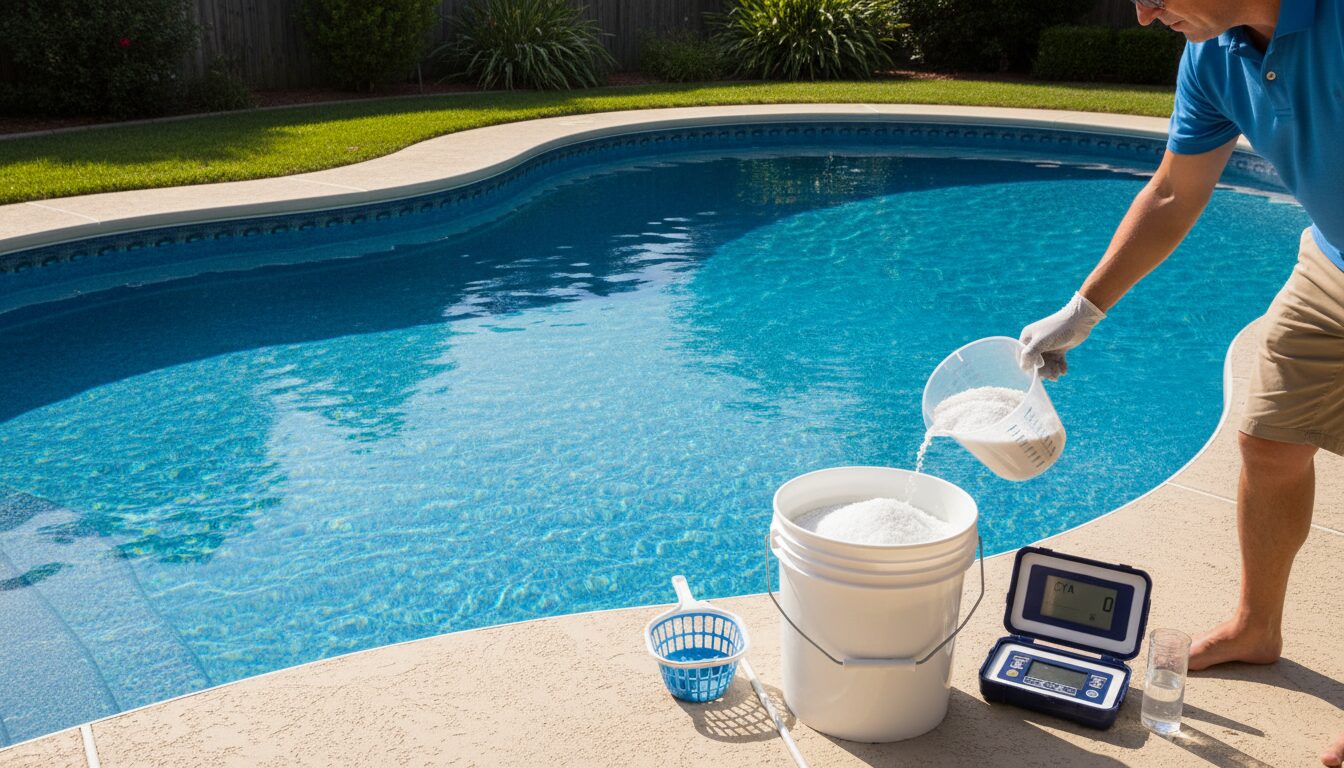

You filled your vinyl liner pool, got the chlorine dialed in, then tested the water and saw a CYA reading of zero. Now you’re staring at a bag of granular stabilizer wondering how much to actually pour in – and whether getting it wrong means a ruined liner, a wasted bag, or an overcorrected chemical mess you’ll spend weeks fixing.
For a 25,000-gallon vinyl liner pool starting from a CYA of zero, you need approximately 12.5 to 15 pounds of granular cyanuric acid to reach the recommended target of 30 to 50 ppm. This article walks through where that number comes from, exactly how to add stabilizer without damaging your liner, what to watch out for, and when trichlor tablets alone might be enough to get you there over time.
Why CYA Matters More in an Outdoor Vinyl Pool
Cyanuric acid acts as a sunscreen for chlorine. Without it, UV radiation destroys free chlorine rapidly – on a sunny day, an unprotected pool can lose 75 to 90 percent of its chlorine in just two to three hours. For a vinyl liner pool sitting in direct sun all afternoon, that means your sanitizer is essentially gone before the afternoon swim even starts. Adding stabilizer extends chlorine’s useful life dramatically, reducing your chemical costs and keeping the water safer between doses. Cyanuric acid bonds loosely with chlorine molecules, slowing UV breakdown without completely blocking chlorine’s ability to kill bacteria and algae.
The trade-off is real, though. CYA that climbs too high does the same thing UV does: it ties up chlorine so it can’t sanitize effectively. That’s why the target range matters as much as the dose. For more on when stabilizer helps versus when it becomes the problem, the guide on Pool Stabilizer: When You Need It, When It’s Already Too High is worth reading before you add anything.
The Exact Dose for a 25,000-Gallon Pool
The standard dosing rule for granular cyanuric acid is approximately 13 ounces (just under 1 pound) per 10,000 gallons to raise CYA by 10 ppm. Work through the math for a 25,000-gallon pool and a 50 ppm target:
- Target rise: 0 to 50 ppm = 50 ppm increase needed.
- 10 ppm per 10,000 gallons requires 13 oz of cyanuric acid.
- For 25,000 gallons, that’s 13 oz x 2.5 = 32.5 oz per 10 ppm rise.
- For a 50 ppm rise: 32.5 oz x 5 = 162.5 oz, which rounds to just over 10 pounds.
In practice, most product labels account for some absorption loss and recommend slightly higher doses, which is why the real-world number lands between 12.5 and 15 pounds. Start at 12.5 pounds, let it fully circulate (24 to 48 hours), then retest before adding more. Overshooting CYA is far harder to fix than undershooting it – bringing it down means draining and refilling water.
If you only want to reach 30 ppm (a perfectly reasonable target for a pool that gets moderate direct sun), use about 7.5 to 8 pounds instead. The 30 ppm floor is enough to provide meaningful chlorine protection. The 50 ppm ceiling is where most pool professionals stop, leaving headroom before you approach the 70 ppm level where chlorine efficiency starts to drop noticeably.
How to Add Stabilizer to a Vinyl Liner Pool Without Damage
This step matters more than the dose calculation. Granular cyanuric acid is slow to dissolve and can bleach or weaken a vinyl liner if dry granules sit against it. Never pour stabilizer directly into the pool, and never add it through the return jets where it could settle on the floor.
Here is the right process:
- Fill a clean 5-gallon bucket with warm water – not hot, just warm enough to help dissolve the granules faster.
- Slowly add the cyanuric acid to the bucket, stirring as you go. Do this in small batches if you’re adding more than 5 pounds at once. CYA dissolves slowly, so expect a cloudy slurry rather than a clear solution.
- Pour the slurry into the skimmer with the pump running on high. The skimmer pulls it through the filter and distributes it through the return lines, avoiding any direct contact with the liner.
- Run the pump continuously for 24 to 48 hours after adding to help it circulate fully.
- Test again after 48 hours before deciding whether to add more.
One common mistake: adding CYA and then testing an hour later. The granules take a full day or two to fully dissolve and register accurately on a test strip or liquid reagent test. Impatient additions based on early readings are one of the fastest ways to overshoot your target and end up draining water to correct it.
Does Trichlor Already In Your Floater Count?
If you are using trichlor tablets as your primary sanitizer, they contain about 57 percent available chlorine and roughly 9 percent cyanuric acid by weight. That sounds helpful, but the CYA rise from trichlor use is slow – typically 6 to 8 ppm per 10,000 gallons for every pound of tablets that dissolves. In a 25,000-gallon pool starting from zero, you would need to dissolve roughly 20 pounds of trichlor just to reach 30 ppm CYA, and that happens over weeks, not days.
If your pool is actively in use during that run-up period with no stabilizer protection, chlorine demand will be high, you’ll burn through more tablets than normal, and the water will be under-protected. Adding granular cyanuric acid directly to hit your target fast is the more efficient approach – then let ongoing trichlor use maintain or gently raise CYA from there. AquaDoc’s granular stabilizer is one option pool owners use specifically for this kind of targeted correction when tablets alone aren’t fast enough.
Worth noting: proper CYA management in pool service means tracking CYA throughout the season, not just at startup. Trichlor use adds CYA steadily all summer, so a 25,000-gallon pool that starts at 40 ppm in May can easily hit 80 or 90 ppm by August if you’re not watching. Test CYA monthly.
What Happens If You Overshoot CYA
CYA above 70 ppm starts meaningfully suppressing chlorine activity. Above 100 ppm, your chlorine may read fine on a test strip but barely sanitize at all – a condition sometimes called “chlorine lock.” If that happens in a vinyl liner pool, algae and bacteria can take hold even while your test shows 2 to 3 ppm free chlorine. If your chlorine levels look right on paper but you’re still fighting cloudy water or a faint green tinge, high CYA is often the culprit. The article on why chlorine keeps disappearing covers this in detail.
The only reliable way to lower CYA is to drain a portion of the pool and refill with fresh water. There is no chemical that breaks CYA down quickly in normal pool conditions. For a 25,000-gallon pool at 90 ppm that you want to bring to 50 ppm, you’d need to drain and replace roughly 44 percent of the water – about 11,000 gallons. That’s a meaningful cost in water and refill chemicals, which is exactly why hitting the right dose from zero is worth the extra care.
Comparing CYA Targets by Pool Type and Sun Exposure
| CYA Level (ppm) | Appropriate For | Chlorine Efficiency | Risk Level |
|---|---|---|---|
| 0 to 20 | Indoor pools, shaded pools | Highest (but burns off fast outdoors) | Rapid chlorine loss in sun |
| 30 to 50 | Most outdoor vinyl liner pools | Good balance of protection and activity | Low |
| 50 to 70 | High-sun climates, heavy use | Moderate – chlorine still functional | Approaching upper limit |
| 70 to 100+ | Avoid | Significantly reduced | Chlorine lock risk, algae growth |
For most outdoor vinyl liner pools in full sun, 40 to 50 ppm is the practical sweet spot. It protects chlorine from UV breakdown without pushing into the range where sanitizer efficiency suffers.
Frequently Asked Questions
How much cyanuric acid do I add to a 25,000-gallon pool starting from zero?
Add 12.5 to 15 pounds of granular cyanuric acid to raise CYA from 0 to 50 ppm in a 25,000-gallon pool. If you are targeting 30 ppm instead, use 7.5 to 8 pounds. Always pre-dissolve in a bucket of warm water and add through the skimmer with the pump running – never pour dry granules directly onto the liner.
What is the ideal CYA level for a vinyl liner pool?
Keep CYA between 30 and 50 ppm for a vinyl liner pool maintained with chlorine. That range provides meaningful UV protection without suppressing chlorine’s sanitizing ability. Going above 70 ppm reduces how effectively chlorine kills bacteria and algae, even when the test strip reads a normal chlorine level.
Can I use trichlor tablets to raise CYA instead of adding stabilizer separately?
You can, but it is slow. Each pound of trichlor tablets that dissolves adds roughly 6 to 8 ppm of CYA per 10,000 gallons. In a 25,000-gallon pool at zero CYA, you would need to burn through around 20 pounds of tablets just to reach 30 ppm – that takes weeks. Adding granular cyanuric acid directly is faster and more precise when starting from zero.
Will too much stabilizer make chlorine stop working in a vinyl liner pool?
Yes. CYA above 70 to 80 ppm ties up chlorine into a less active form that sanitizes much more slowly than normal. Above 100 ppm, the water may look like it has adequate chlorine on a test but still support algae and bacterial growth. Partial draining and refilling is the only reliable fix once CYA gets that high.
How long does it take for cyanuric acid to fully dissolve and register on a test?
Granular cyanuric acid takes 24 to 48 hours to fully dissolve and circulate in pool water, even when pre-dissolved in a bucket first. Run the pump continuously after adding it and wait at least 24 hours before retesting. Testing too early is one of the most common reasons pool owners over-add stabilizer and end up with CYA above 80 ppm.
The Bottom Line
For a 25,000-gallon vinyl liner pool at zero CYA, add 12.5 to 15 pounds of granular cyanuric acid to reach the 30 to 50 ppm range – pre-dissolved in a bucket, poured through the skimmer, and retested after 48 hours. Get that number right once and your chlorine works the way it should all season.