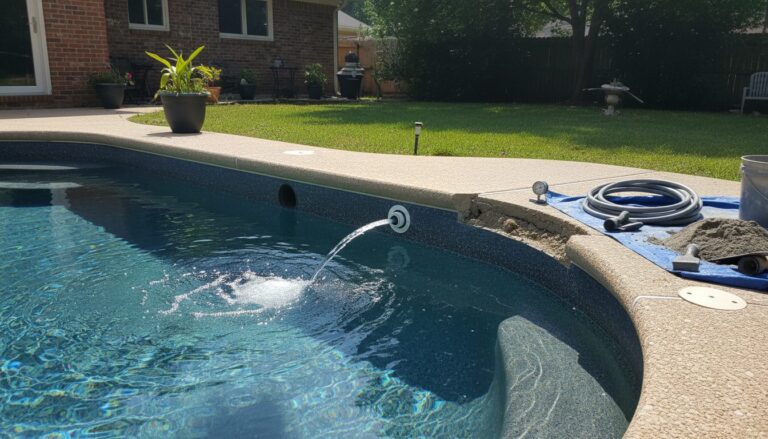


You noticed it last summer – that rough patch near the main drain that scraped your foot, the gray stain spreading from the skimmer throat, the plaster flaking off in chalky chips when you brushed the steps. Replastering is not an emergency repair you can skip for another season. The question is what it’s actually going to cost before you call the first contractor.
For a standard 12×24 inground pool with a main drain and two skimmers, replastering runs $3,500 to $7,500 installed, depending on the finish material you choose and the condition of the existing surface. That range assumes roughly 750 to 850 square feet of wet surface area, standard prep, and the fitting work around three plumbing penetrations. This article breaks down cost by finish type, explains what the main drain and skimmers add to the bill, and walks through what can push your number toward the high end so you can plan accurately.
How Big Is a 12×24 Pool in Square Feet?
Before pricing makes sense, you need to understand what you’re actually coating. A 12×24 pool is not 288 square feet – that’s just the footprint. Replaster covers the floor, all four walls, the floor-to-wall transition, and any steps or benches inside the pool. A typical 12×24 pool with a 3.5-foot shallow end sloping to a 6-foot deep end has roughly 780 to 850 square feet of total surface area. If your pool has a bench seat, integrated steps, or a rounded shallow end, add another 40 to 80 square feet. Contractors price by the square foot, so knowing this number matters when you’re comparing bids.
Replaster Cost by Finish Type
The finish you choose is the single biggest driver of price. Here’s how the common options stack up for a pool this size:
| Finish Type | Cost Per Sq Ft (Installed) | Total for 12×24 Pool | Lifespan |
|---|---|---|---|
| White Plaster | $4 – $6 | $3,200 – $5,100 | 8 – 12 years |
| Quartz Aggregate | $6 – $9 | $4,680 – $7,650 | 12 – 18 years |
| Exposed Pebble / Aggregate | $8 – $12 | $6,240 – $10,200 | 15 – 25 years |
| Colored Plaster | $5 – $7 | $3,900 – $5,950 | 8 – 12 years |
Why These Differences Matter
White plaster is the standard, and it’s the right call if budget is tight and you plan to sell the house within five years. It’s smooth, bright, and looks great when fresh. The catch is it stains more easily and goes rough faster than aggregate options, especially if your calcium hardness drifts low. Quartz aggregate blends ground quartz into the plaster mix, giving you a harder surface that resists chemicals and abrasion – worth the extra $2 to $3 per square foot if you’re keeping the pool long-term. Exposed pebble finishes are the premium choice: extremely durable, textured, and available in dozens of colors, but they’ll add $3,000 to $5,000 over basic plaster on a pool this size. Colored plaster splits the difference – same lifespan as white but with pigment added for a gray, blue, or black water effect.
What a Main Drain and Two Skimmers Add to the Cost
Every plumbing penetration in the pool shell requires extra labor and materials at replaster time. The plasterer has to hand-finish the wet plaster around each fitting, then seat a new gasket or collar so the bond is watertight. For a main drain, that work costs $100 to $200 including the new cover plate if yours needs replacing. Each skimmer throat runs $75 to $150 in additional labor. For your pool’s three fixtures, budget an extra $250 to $500 on top of the base replaster price.
One thing to check before the crew shows up: the Virginia Graeme Baker Act requires main drains in residential pools to have anti-entrapment covers rated for the pool’s flow rate. If your current cover is more than seven years old or was never VGB-compliant, the contractor will flag it. Replacing a main drain cover runs $150 to $400 depending on the fitting size and whether the sump needs to be modified. It is a safety requirement, not an upsell.
What Else Drives the Price Up
The base replaster estimate assumes a pool that’s structurally sound, properly drained, and in need of normal prep. Here’s what gets added to bills when reality doesn’t cooperate:
- Acid Washing: If the old plaster surface has heavy calcium scale or embedded staining, contractors acid wash the shell before applying the new coat. Expect $300 to $600 for a pool this size.
- Crack Repair: Hairline cracks are common and get filled during prep at minimal extra charge. Structural cracks – ones that follow rebar lines or shift with temperature – can add $500 to $2,000 depending on severity.
- Chipping the Old Plaster: Some contractors, especially those doing pebble finishes, require full removal of the existing plaster coat. Chipping out 800 square feet of old plaster adds $800 to $1,500 in labor.
- Return Jets and Light Niches: Each additional fitting adds $50 to $150, just like the skimmers. If your pool has four return jets and a light niche, add those in when estimating.
- Geographic Location: Labor costs vary significantly. A pool in Phoenix or Florida may price at $4 per square foot for white plaster while the same job in the Northeast runs $6 to $7 per square foot.
Step-by-Step: What Replastering Actually Involves
Knowing the process helps you understand why the price is what it is, and spot contractors who are cutting corners.
- Drain the Pool: The contractor pumps out all the water, usually through a submersible pump to a suitable drain location.
- Prep the Surface: Workers grind off tile line buildup, chip out any hollow spots, fill cracks, and acid wash if needed. This is the most labor-intensive phase.
- Mask and Protect Fittings: Each skimmer, return, light niche, and the main drain gets masked so plaster doesn’t foul the threads.
- Apply the Plaster: A crew of three to five people trowels the plaster coat in a single continuous session. For aggregate finishes, a second pass or pressure washing step reveals the aggregate texture.
- Seat New Gaskets and Covers: The main drain cover, skimmer collars, and any return escutcheons are seated into the fresh plaster before it sets.
- Start Filling Immediately: Fresh plaster begins drying the moment the crew leaves. You start filling the pool the same day – no exceptions.
- Run the Startup Cure: For the first 28 to 30 days, you brush the plaster daily, run the pump continuously, and balance chemistry carefully. Calcium hardness should be at 200 to 400 ppm throughout this period. This is where water chemistry matters most – AquaDoc makes a calcium hardness increaser that dissolves cleanly and is a practical choice during the sensitive startup period when you want to avoid clouding fresh plaster.
Getting Accurate Bids
Get at least three written quotes from licensed pool contractors. Each quote should specify the finish material and brand, the number of coats, whether old plaster removal is included, how fitting replacements are handled, and what the startup process involves. A quote that just says “replaster 12×24 pool – $4,200” tells you almost nothing and almost always leads to surprise line items.
Ask specifically: “Does this price include new main drain cover and skimmer collars?” That question alone will separate contractors who think in detail from those who’ll invoice you for it later. If you’ve been comparing bids and wondering about the condition of other pool equipment, a review of your pool filter type and whether it’s sized correctly is worth doing at the same time – replastering is a natural moment to assess anything else that needs attention before the pool is back in service.
Frequently Asked Questions
How much does it cost to replaster a 12×24 inground pool?
Most 12×24 inground pools cost between $3,500 and $7,500 to replaster, depending on finish material and surface condition. Basic white plaster sits at the low end around $3,500 to $4,500, while exposed aggregate and pebble-style finishes push toward $6,000 to $7,500 or more. Geographic location and any structural repairs required will move the number up or down from there.
Does having a main drain and two skimmers affect replaster cost?
Yes, but not dramatically. Each fitting requires the plasterer to hand-trowel around the fixture and install a new gasket or collar, adding roughly $75 to $150 per fitting. For a pool with a main drain and two skimmers, budget an extra $250 to $450 on top of the base replaster price. If the main drain cover is not VGB-compliant, factor in another $150 to $400 for a replacement cover.
How often does a 12×24 inground pool need to be replastered?
Standard white plaster typically lasts 8 to 12 years before it becomes rough, stained, or starts delaminating. Exposed aggregate and quartz finishes last 15 to 20 years with proper water chemistry. Maintaining balanced calcium hardness between 200 and 400 ppm is the single biggest factor in extending plaster life – low calcium water is aggressive and eats plaster faster than almost anything else.
What is the cheapest way to resurface an inground pool?
White plaster is the least expensive resurfacing option at roughly $4 to $6 per square foot installed. For a 12×24 pool with approximately 800 square feet of surface area, that puts total cost around $3,200 to $4,800 before any prep surcharges. Epoxy paint is cheaper short-term but requires reapplication every 3 to 5 years, so the lifetime cost is often higher than just plastering correctly the first time.
How long does replastering a pool take from start to swim?
The physical application usually takes one to two days for a pool this size. After that, you fill the pool immediately and run the pump continuously for the first 28 to 30 days while brushing daily – the process called the plaster startup cure. Most owners are swimming within 7 to 10 days of the plaster going on, but full surface hardness takes about a month to develop.
For a 12×24 inground pool with a main drain and two skimmers, plan on spending $3,500 to $7,500 for the full job, with white plaster at the low end and exposed aggregate at the high end. Get itemized bids, confirm fitting replacement is included, and budget an extra $250 to $500 for the three plumbing penetrations your pool has – that’s the number most online estimates quietly leave out.