
You noticed the skimmer pulling weak, or maybe you saw the dye test confirm what you already suspected: there is a leak somewhere between the skimmer box and the equipment pad. On a gunite pool, that is not a quick fix from the hardware store – it means digging into your deck, pulling old pipe, and replumbing a line that has been buried in concrete since the pool was built. If your contractor also mentioned swapping in a directional fitting while they are in there, you are probably staring at a quote that feels like a lot and wondering whether it is fair.
Replacing a gunite pool skimmer line with a directional fitting costs between $800 and $2,500 in most U.S. markets, with the majority of jobs landing in the $1,200 to $1,600 range. The spread is real and it is driven by pipe depth, how much deck must be cut, whether there is rebar in the way, and your regional labor rate. This article walks through every cost component – parts, labor, deck repair, and the directional fitting itself – so you can evaluate any quote you receive and know what is worth negotiating.
What a Skimmer Line Replacement Actually Involves on a Gunite Pool
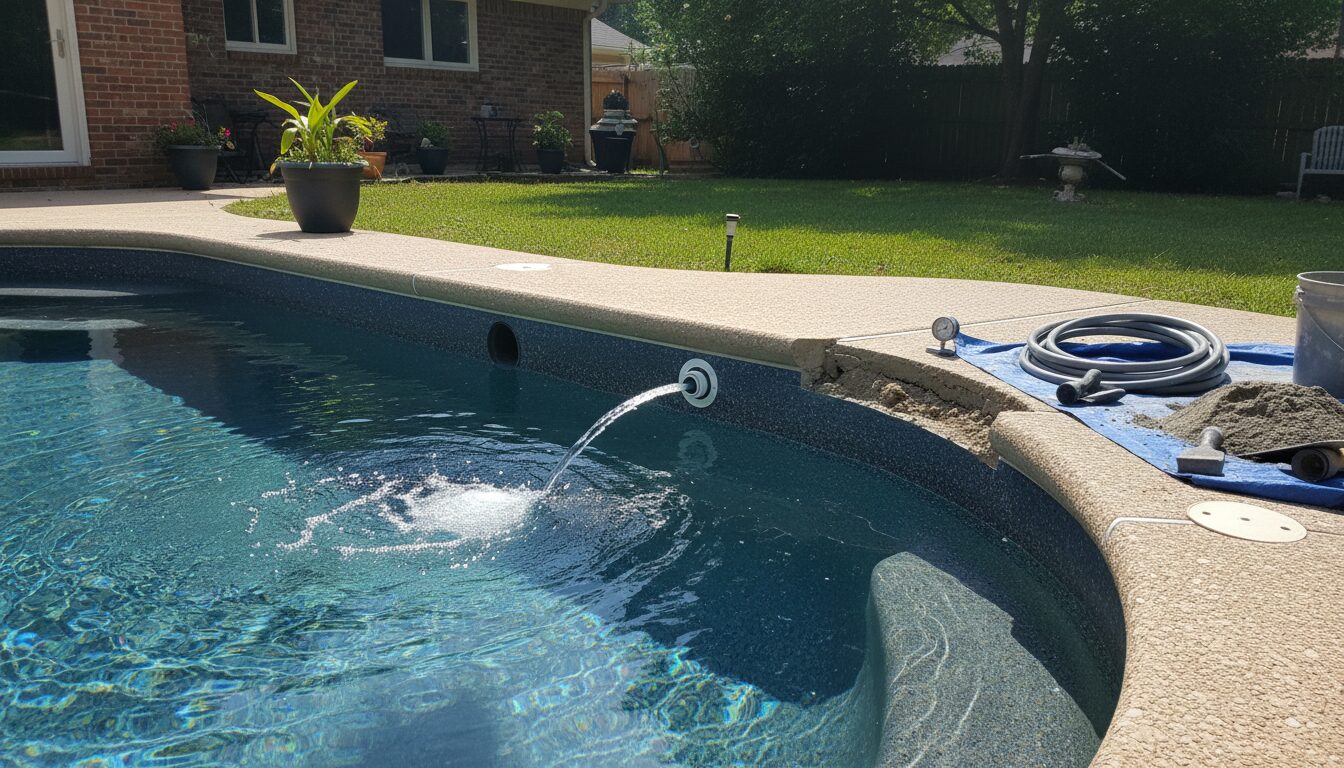
On a gunite pool, the skimmer line is a 1.5-inch or 2-inch Schedule 40 PVC pipe that runs from the bottom of the skimmer box, under the concrete deck, through the pool shell or alongside it, and out to the equipment pad. It can run anywhere from 10 feet to 60 feet depending on pool layout. The pipe is not accessible without cutting into the deck or the surrounding hardscape, which is what makes gunite skimmer line work more involved than the same repair on an above-ground pool.
A directional fitting – sometimes called a flow director or diverter elbow – is installed at the skimmer port or at a plumbing manifold to control which line receives suction and in what proportion. Plumbers often recommend adding one during a skimmer line replacement because the pipe is already exposed, so the marginal cost is low compared to scheduling a second excavation later. The fitting itself is $20 to $80 in parts; the labor to orient and glue it correctly adds 30 to 60 minutes to the job.
Cost Breakdown: Every Line Item You Should See on a Quote
A detailed quote from a reputable pool contractor should separate these costs. If you receive a single lump-sum number with no breakdown, ask for one.
| Cost Component | Typical Range | Notes |
|---|---|---|
| Diagnostic / leak detection | $150 – $350 | Often credited back if you hire the same contractor for the repair |
| Deck cutting (concrete saw) | $200 – $600 | Depends on number of cuts, deck thickness (4 in. vs. 6 in.), and rebar |
| Excavation and pipe removal | $150 – $400 | Hand dig vs. machine dig; depth of pipe burial |
| New PVC pipe and fittings | $40 – $120 | Schedule 40 PVC; more pipe = more cost |
| Directional fitting (parts only) | $20 – $80 | Threaded or slip models; brand-specific fittings cost more |
| Labor (plumbing and assembly) | $250 – $600 | 2 – 4 hours at $75 – $150 per hour depending on region |
| Pressure test | $50 – $100 | Required to confirm no new leaks before deck is patched |
| Concrete patch / deck repair | $150 – $500 | Color match adds cost; pavers or stamped concrete cost more to restore |
Why the Range Is So Wide: What Drives Prices Up
The single biggest variable is how much concrete has to come up. A skimmer line that runs 15 feet before it reaches an accessible junction might need only one saw cut and a small core drill. A line that runs 50 feet under a thick stamped-concrete deck with rebar every 12 inches is a half-day demolition job before a single length of new pipe goes in.
- Pipe depth: Skimmer lines buried 18 to 24 inches deep (common in freeze-prone climates) require significantly more excavation than lines buried just 6 to 8 inches in a mild-weather region.
- Deck material: Plain broom-finish concrete is cheap to cut and patch. Travertine pavers, flagstone, or stamped concrete require careful removal, storage, and reinstallation – adding $200 to $800 to the deck repair line alone.
- Rebar density: Older gunite pools often have heavy rebar grids. Cutting through rebar with a saw adds time and blade cost, and sometimes requires a second pass with a jackhammer.
- Access to equipment pad: If the skimmer line has to be traced all the way to the pad and re-terminated at the pump, labor hours climb quickly.
- Regional labor rates: A two-person crew in Phoenix or Tampa might bill at $80 per hour combined, while the same crew in coastal California or the New York metro area runs $130 to $160 per hour.
A Worked Example: 20,000-Gallon Gunite Pool, Two-Cut Deck Job
Say you have a 20,000-gallon gunite pool with a 4-inch broom-finish concrete deck. The skimmer line runs 25 feet to a junction at the equipment pad. Leak detection confirmed a crack at the midpoint, 14 inches below the deck surface. The contractor needs two saw cuts and about 3 feet of hand excavation.
Here is what that looks like priced out: leak detection credited back at $200, two deck cuts at $250, excavation at $175, 30 feet of new 1.5-inch Schedule 40 PVC plus fittings at $65, a directional fitting at $45 in parts, labor for plumbing and reassembly at $380 (about 4 hours at $95 per hour), pressure test at $75, and a concrete patch at $200. Total: roughly $1,390. That is a realistic mid-market number for a job of this complexity, and it lands squarely in the average range.
The Directional Fitting: Is It Worth Adding?
A directional fitting on a skimmer line lets you push more or less suction through that line independently of your main drain. Why does that matter? On a gunite pool where the skimmer and main drain share a common suction manifold, a directional fitting lets you fine-tune surface suction – useful if your pool sits near trees, if you run a robot cleaner simultaneously, or if you are trying to reduce pump cavitation at lower speeds. The incremental cost when added during a skimmer line replacement is $100 to $250 total (parts plus labor). Scheduling it as a standalone job later would cost you another service call, another small excavation, and another pressure test – probably $400 to $700. Do it now.
While you have the plumbing open, it is also worth checking your water chemistry. a clogged or poorly circulating skimmer does not just stress the pump – it can let debris settle and drive up chemical demand across the whole pool. Low circulation and imbalanced water are a pair that often shows up together.
What to Ask Before You Sign a Contract
Common mistakes pool owners make on this job: accepting a quote with no deck repair line item (it will cost you later), skipping the pressure test to save $75 (the contractor fills in the trench and you discover the new joint leaks six months later), and not asking whether the concrete patch will be color-matched. Ask these four questions before you sign:
- Is the deck repair included, and is color matching part of the scope?
- Will you pressure-test the new line before backfilling?
- Is the directional fitting oriented and labeled so I can operate it correctly?
- What is the warranty on the pipe work and on the deck patch separately?
Reputable contractors warranty the plumbing for one to three years and the concrete patch for at least one season. Anything shorter than that on the plumbing side is a red flag. AquaDoc’s pool maintenance guides note that properly balanced water chemistry – especially keeping calcium hardness between 200 and 400 ppm in a gunite pool – extends the life of PVC fittings and reduces the stress on new joints from aggressive water.
DIY vs. Hiring a Pro
This is one of the repairs where DIY almost never makes financial sense on a gunite pool. Cutting into a concrete deck without the right blade, renting a concrete saw, properly gluing Schedule 40 fittings under a slab, pressure-testing to 30 PSI, and then patching concrete to match a 10-year-old deck – each step has a real failure mode. If the directional fitting is not properly glued or oriented, you have created a new leak point that could undercut your deck slab. Hire a licensed pool contractor, get the pressure test documented, and keep the repair record with your pool file. If you are later researching related issues like replastering or other plumbing work, the structural and surface problems that follow years of water movement are worth reading up on as context for your gunite pool’s long-term care.
Frequently Asked Questions
How much does it cost to replace a skimmer line on a gunite pool?
Most gunite pool owners pay between $800 and $2,500 to replace a skimmer line, with the average job landing around $1,200 to $1,600. The wide range comes down to pipe depth, how much concrete or decking must be cut, rebar density, and local labor rates. Always get a line-item quote so you can see exactly where the money is going.
What is a directional fitting on a pool skimmer line?
A directional fitting is a threaded or slip-fit elbow installed at the skimmer port or at a plumbing manifold that lets you control and aim suction flow. It is commonly added during skimmer line replacement because the pipe is already exposed. The fitting itself costs $20 to $80 in parts, and the additional labor to orient, glue, and test it adds $80 to $170 to the final bill.
How much extra does it cost to add a directional fitting versus a straight repair?
Expect to add $100 to $250 to the base skimmer line repair cost when a directional fitting is included. Parts account for $20 to $80 of that; the rest is labor for proper orientation, gluing, and pressure testing the new joint. Compared to scheduling a separate service call to add the fitting later – which typically runs $400 to $700 – doing it during the main repair is the smarter financial move.
Do I need to cut my concrete deck to replace a skimmer line on a gunite pool?
Yes, in almost every case. Gunite pool skimmer lines run beneath the concrete deck, so at least one or two saw cuts are needed to expose the damaged section. Core drilling or jackhammering through rebar adds $200 to $600 to the project depending on deck thickness and the distance from the skimmer box to the break point.
How long does a gunite pool skimmer line replacement take?
A standard skimmer line replacement on a gunite pool takes one to two full days. Day one typically covers leak confirmation, deck cutting, and excavation. Day two covers new pipe and fitting installation, pressure testing, and deck patching. Adding a directional fitting extends the schedule by two to four hours but rarely pushes a clean job past two days total.