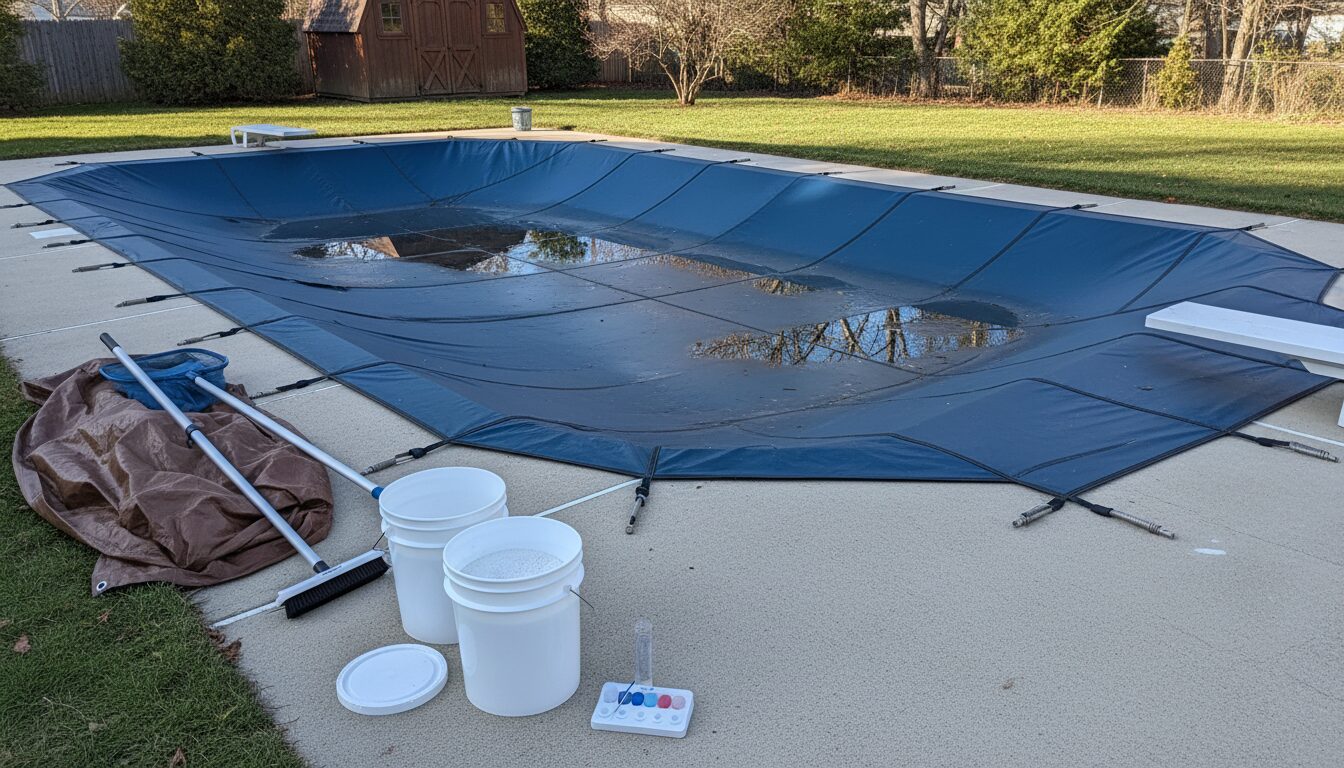

You spend real time getting chlorine, pH, and alkalinity dialed in at closing, and then you toss in a closing kit and call it done – but nobody told you what to do about the stabilizer sitting in the water. Is it fine? Too high? Will it cause problems when you pull the cover off in April?
The short answer: close with CYA between 30 and 50 ppm. That range gives residual chlorine some UV protection during the tail end of the season, won’t cause problems at opening, and accounts for the modest drop in CYA that happens over winter. The rest of this article explains what happens to stabilizer while the pool sits covered, when you actually need to adjust it before closing, and what to do in spring if the number is out of range.
What CYA Actually Does in a Closed Pool
Cyanuric acid doesn’t evaporate, doesn’t get consumed by bacteria, and doesn’t react with closing chemicals. Once it’s in the water, it stays there. During the open season, its job is to shield chlorine molecules from UV degradation – without CYA, direct sunlight can destroy up to 75 percent of unprotected chlorine in about two hours. But once your pool is covered for winter and the pump is off, there’s essentially no UV exposure and no active sanitizer demand. So CYA isn’t doing much useful work in a closed pool. The level you close with is really a number you’re carrying forward to spring, not one that’s actively protecting anything mid-winter.
That reframing matters because a lot of pool owners add stabilizer as part of their fall closing routine without checking the current level first. If you’re already at 60 ppm and you dump in another pound, you’re starting spring at a level that will work against you. For a deeper look at how CYA interacts with your chlorine throughout the season, the overview on pool stabilizer: when you need it and when it’s already too high is worth a read before you finalize your closing chemistry.
How Much CYA Actually Drops Over Winter
This is the question that matters most for spring planning. CYA is chemically stable and does not break down from cold temperatures. So why does the level often come in lower in spring than it was at closing? Dilution. Rain, snowmelt, and condensation that gets under or through a cover adds fresh water to the pool. A solid safety cover keeps most of it out, but a mesh cover or an ill-fitting solid cover can let in enough water to drop CYA noticeably over a 5 to 6 month winter.
A rough rule: expect to lose 10 to 20 ppm from dilution over a typical winter if you’re using a mesh cover or getting significant precipitation. A well-sealed solid cover in a dry climate might only cost you 5 ppm. Research from pool industry professionals confirms that CYA drops in winter are almost entirely dilution-driven, not chemical degradation. So if you close at 45 ppm with a mesh cover in a rainy climate, plan on opening somewhere around 25 to 35 ppm – which is actually a fine range to start the season.
The Right Closing Target: 30 to 50 ppm
Closing with CYA at 30 to 50 ppm hits a practical balance for three reasons. First, the last few weeks before closing often still see sun exposure, and some residual free chlorine in the water benefits from at least minimal UV protection. Second, if winter dilution knocks 10 to 15 ppm off, you open in the 20 to 40 ppm range – right in the sweet spot for spring startup. Third, you avoid the trap of opening with CYA above 80 ppm, where chlorine efficiency degrades enough to make shocking the pool genuinely difficult.
Here’s a worked example. Say you close a 20,000-gallon pool with CYA at 40 ppm and a mesh cover in a region that gets moderate winter rain. By April, dilution has added roughly 1,500 to 2,000 gallons of fresh water. That’s about an 8 to 10 percent volume increase, which dilutes your CYA to roughly 36 to 37 ppm. You open, test, and you’re in a perfect range to add your opening chlorine dose and get the pool moving. No corrective chemistry needed before you even start. That’s the closing target working exactly as intended.
When to Adjust CYA Before Closing
Test your CYA within a week of closing. If it’s between 30 and 60 ppm, leave it alone. If it falls outside that window, here’s how to handle it:
- CYA below 20 ppm: Add stabilizer before you put the cover on. At this level, any residual chlorine in the water during those last sunny weeks is essentially unprotected. Add granular cyanuric acid at roughly 13 oz per 10,000 gallons to raise CYA by 10 ppm. For a 20,000-gallon pool at 15 ppm, you’d add about 32 oz (2 lbs) to reach 40 ppm.
- CYA between 60 and 80 ppm: This is a gray zone. You can close here if you expect significant winter dilution (mesh cover, rainy climate) and your spring test has historically come in 15 to 20 ppm lower. If you’re in a dry climate with a solid cover, consider doing a small partial drain before closing to bring the level down.
- CYA above 80 ppm: Don’t close at this level if you can help it. A partial drain is the most practical fix – draining 20 percent of the water in a 20,000-gallon pool and refilling with fresh water will drop CYA from 90 ppm to roughly 72 ppm. A second partial drain gets you to around 58 ppm. The article on how pool volume affects chemical dosing can help you calculate partial-drain math for your specific pool size.
One common mistake: using trichlor tablets or dichlor shock right up until closing day without accounting for the CYA those products add. Every pound of trichlor added to 10,000 gallons raises CYA by about 6 ppm. If you’ve been running tablets all season, your CYA at closing is almost certainly higher than it was in June. Always test before closing, not before the last weekend swim.
What High CYA at Closing Does to Spring Startup
Opening a pool with CYA above 80 ppm is a frustrating experience. Chlorine is still present and still measurable on a test kit, but it’s tied up by excess stabilizer and reacts slowly. You might add a full shock dose – 1 lb of cal-hypo per 10,000 gallons – and watch free chlorine barely budge. Algae can establish faster than the chlorine can knock it down. The result is a green pool that seems resistant to treatment, not because the chemistry is wrong, but because the CYA is throttling chlorine’s effectiveness.
Pool chemistry professionals note that the ratio of free chlorine to CYA matters more than either number alone – a free chlorine level of 3 ppm at 80 ppm CYA is far less effective than the same 3 ppm at 40 ppm CYA. If you’re staring down a green pool at opening and CYA is above 80, drain first, then shock. AquaDoc’s pool opening chlorine is dosed for pools in normal CYA ranges, so correcting the stabilizer level before you reach for the shock makes every other opening product work the way it should.
A solid pre-closing and opening checklist helps keep these variables from slipping through the cracks. The pool closing chemicals checklist from Pool Chem Tracker covers the full sequence of what to test and treat before you put the cover on, which is useful if you want to confirm nothing else is out of range at the same time you’re handling CYA. And for a step-by-step walkthrough that bridges closing into spring startup, True Blue Pools’ 14-step winterizing guide lays out the full process in a practical order.
Does Pool Type Change the Target?
A few situations shift the ideal closing CYA range slightly:
- Saltwater pools: Same 30 to 50 ppm target. Salt chlorinators generate chlorine just like any other source, and CYA protects it the same way. Don’t close lower than 30 ppm just because you have a salt system.
- Indoor pools: No UV exposure means CYA isn’t doing protective work at any point. Closing with 20 to 30 ppm is fine for an indoor pool; there’s no reason to push toward 50 ppm.
- Above-ground pools in cold climates: These often get partially drained to below the return fittings, which can dilute CYA by 15 to 25 percent if you drain more than a few inches. Account for that dilution when setting your closing level.
Frequently Asked Questions
What CYA level should I have when closing my pool for winter?
Aim for 30 to 50 ppm when closing an outdoor chlorine pool. That range provides some UV protection during the last sunny weeks of the season without loading the water with excess CYA that will still be elevated when you open in spring. Test within a week of your planned closing date, not at the end of summer.
Does cyanuric acid drop over winter when the pool is covered?
Yes, but only modestly and almost entirely due to dilution. A covered pool typically loses 10 to 20 ppm of CYA over a 4 to 6 month winter as rain and snowmelt add fresh water. Chemical breakdown from cold temperatures is negligible. If you close at 50 ppm with a mesh cover, expect to open somewhere around 35 to 45 ppm.
What happens if my CYA is too high when I open the pool in spring?
High CYA at opening – anything above 80 ppm – suppresses chlorine effectiveness enough to make shocking the pool genuinely difficult. Algae can gain a foothold before chlorine can respond. The fix is a partial drain before adding opening chemicals: draining 20 percent of a 20,000-gallon pool drops CYA from 90 ppm to roughly 72 ppm. A second partial drain gets you below 60 ppm.
Should I add stabilizer when closing my pool?
Only if your CYA tests below 20 to 25 ppm at closing. If you’re already in the 30 to 50 ppm range, adding more stabilizer before closing is unnecessary and will leave you with elevated CYA in spring. Adding stabilizer as a routine part of your closing kit – without testing first – is one of the most common and avoidable closing mistakes.
What CYA level is too high to open a 20,000-gallon pool in spring?
If your spring test shows CYA above 80 ppm in a 20,000-gallon pool, plan a partial drain before adding opening chemicals. At 100 ppm CYA, normal shock doses of 1 to 2 lbs of cal-hypo per 10,000 gallons will barely register as effective free chlorine, and you’ll spend money on product without clearing the water. Drain first, then treat.
The bottom line: close your pool with CYA at 30 to 50 ppm, skip the stabilizer if you’re already there, and you’ll spend a lot less time fighting your pool chemistry at opening time.