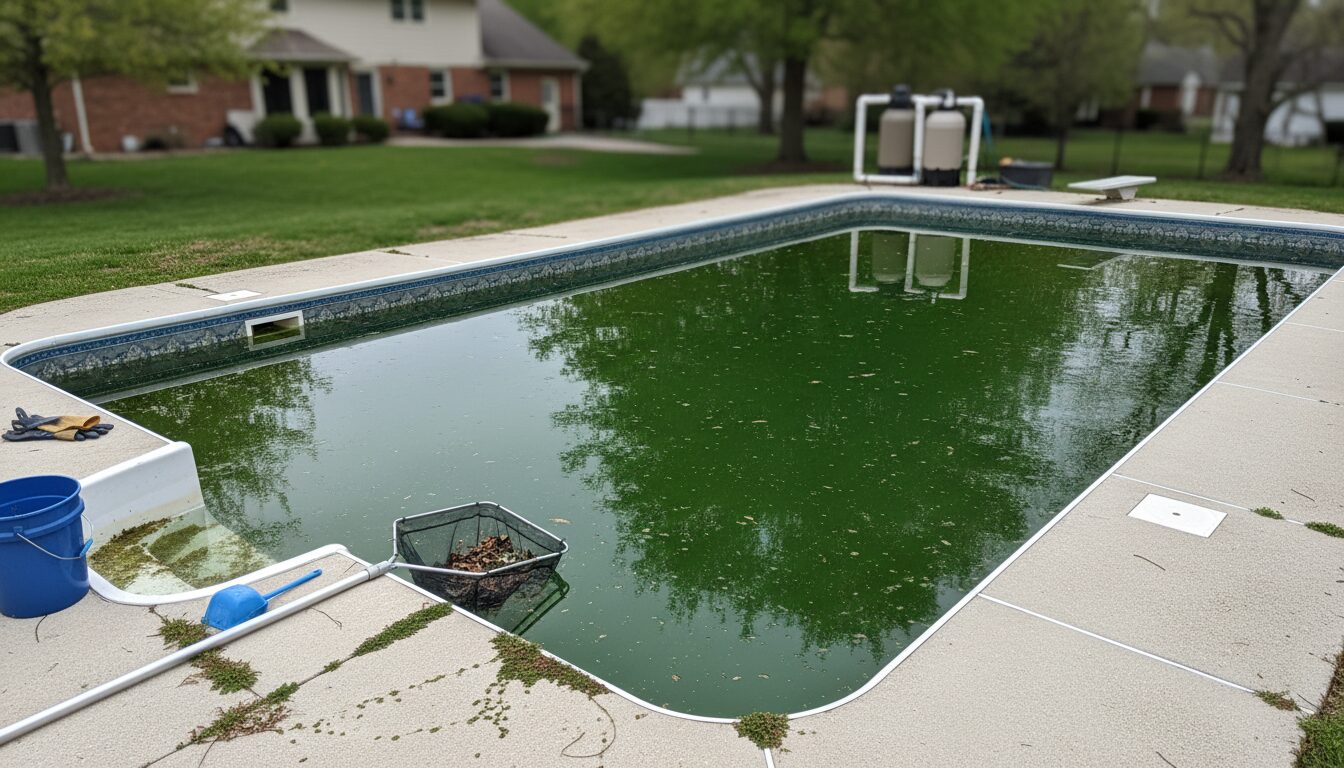

You pull the cover off your pool in spring and the water looks less like a swimming pool and more like a swamp. If you have been there, you already know that a normal weekly shock dose is not going to cut it. The question is: how much do you actually need?
For a 20,000-gallon inground pool with green water at opening, plan on 6 to 18 lbs of calcium hypochlorite (68% available chlorine), depending on how dark the water is. Light green calls for roughly 6 lbs, medium green needs about 12 lbs, and a deep green or nearly black pool needs 18 lbs or more. The rest of this article walks through why those numbers are what they are, how to calculate your exact dose, and the exact order of steps that actually gets the water clear.
Why a Green Winter Pool Needs So Much More Shock Than Normal
A routine maintenance shock targets 10 ppm of free chlorine. Opening a green pool is a different job entirely. Algae consumes chlorine aggressively as it dies, which means the water burns through the first few pounds of shock before the free chlorine level even rises enough to show on a test strip. You are essentially paying a chlorine debt before you can build any working residual. The more algae, the bigger that debt.
There is also an oxidation load from everything else that built up over winter: dead leaves, bird waste, windblown organics, and the byproducts of whatever bacteria got established while the water sat stagnant. All of that consumes chlorine. The target for killing algae in pool water is a free chlorine level of 30 ppm for light green, up to 60 ppm for heavy algae. A standard 1 lb bag of 68% cal-hypo raises 10,000 gallons by about 7 ppm, so a 20,000-gallon pool gets roughly 3.5 ppm per pound. Do the math and you can see quickly why single-bag thinking does not work here.
Step 1: Test the Water Before You Add Anything
Do not skip this step and do not guess. Dip a good test kit before you open the shock bucket, because pH is the single biggest factor controlling how well chlorine works. At pH 7.0, roughly 73% of your chlorine is in the active hypochlorous acid form. At pH 8.0, that drops to about 3%. You can pour every bag of shock you own into a high-pH pool and barely dent the algae.
Test for pH, total alkalinity, and cyanuric acid (CYA). Record the numbers. You want:
- pH: 7.2 to 7.4 before shocking. Lower it with muriatic acid if needed.
- Total alkalinity: 80 to 120 ppm. This buffers pH so it holds steady while you shock.
- CYA: 0 to 20 ppm at opening time. High CYA suppresses shock effectiveness. If you closed with 50 ppm or above still in the water, you may need to partially drain and refill.
Step 2: Calculate Your Shock Dose by Algae Color
Algae color is the fastest field estimate of how heavy the load is. Here is the working framework for a 20,000-gallon pool:
| Algae Severity | Water Color | Target Free Cl (ppm) | Cal-Hypo Needed (68%) | Approximate Bags |
|---|---|---|---|---|
| Light | Teal green, slightly hazy | 30 ppm | 6 lbs | Six 1-lb bags |
| Medium | Murky green, can’t see bottom | 45 ppm | 12 lbs | Twelve 1-lb bags |
| Heavy | Dark green or black | 60 ppm | 18 lbs | Eighteen 1-lb bags |
Why These Numbers Matter for Your Decision
The chlorine math assumes you are starting from zero free chlorine, which is typical after a winter cover comes off a neglected pool. If your test shows even 2 or 3 ppm already in the water, you can subtract about one pound of cal-hypo from the light green dose. The color estimate also assumes standard gunite or plaster surface conditions. If algae is visibly embedded in cracks or steps, budget toward the heavier end of each range because those pockets keep releasing organisms into the water after the initial dose.
Step 3: Add the Shock Correctly
Dose at dusk. Sunlight destroys unstabilized chlorine at a rate of up to 1 ppm per hour in direct UV, and cal-hypo at opening levels (with little or no CYA in the water) is especially vulnerable. Adding at dusk gives the chlorine the entire night to work on the algae without being burned off by morning sun.
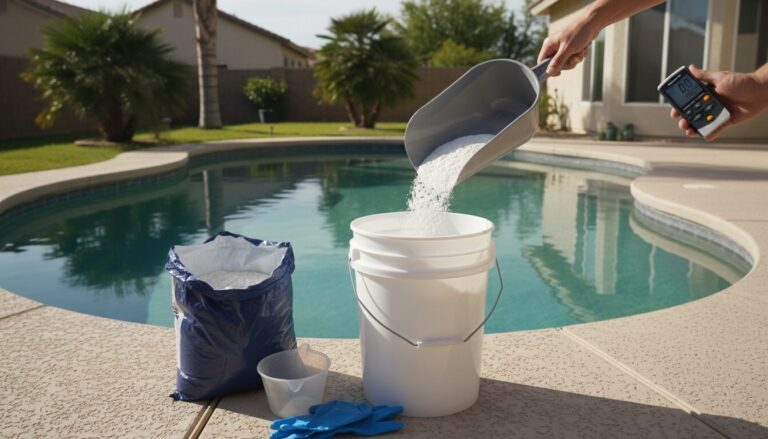
- Pre-dissolve each pound of cal-hypo in a bucket of pool water before pouring it in. This prevents bleaching of vinyl liners and surface damage on plaster. For a gunite pool, you can broadcast it around the perimeter, but pre-dissolving is still safer.
- Pour the dissolved solution around the perimeter of the pool with the pump running.
- Run the filter continuously through the night and all the following day. Do not backwash until you see pressure rise 8 to 10 PSI above the clean baseline, because early backwashing flushes out dead algae that the filter is still trapping.
- Brush the walls, floor, and steps thoroughly after shocking. This breaks up algae mats and gets the chlorinated water into contact with every surface. If you want to understand why brushing matters as much as the chemical dose itself, the explanation in Green Algae Again Because You Skipped Brushing Your Pool is worth reading.
Step 4: Test Again in the Morning and Repeat if Needed
Retest free chlorine 8 to 12 hours after shocking. Here is the critical rule: if free chlorine has dropped below 10 ppm and the water is still clearly green or hazy, add another full dose. This is the mistake most people make. They shock once, see no immediate change, and assume something is wrong with the product. What is actually happening is that the algae load consumed the first dose and the chlorine residual fell before it could finish the job.
Keep shocking until the water holds free chlorine above 10 ppm overnight without dropping. Once that happens, the algae is dead. The water will still be cloudy or grayish white from suspended dead algae cells, but that is a filtration problem now, not a chemical one. Run the filter around the clock and backwash when pressure climbs. AquaDoc’s cal-hypo shock is one product pool owners reach for in this situation because the formulation dissolves quickly and the 68% concentration makes the dose math consistent bag to bag.
Common Opening Mistakes That Send You Back to Square One
- Shocking before fixing pH: High pH turns your shock into an expensive mistake. Always correct pH first, without exception.
- Underdosing and then waiting: A light dose into a heavy algae load achieves almost nothing. The chlorine is consumed before it reaches the algae deep in the water. Go big enough on the first dose based on the color guide above.
- Turning off the pump overnight: Shock needs circulation to reach every corner of a 20,000-gallon pool. Stagnant water means uneven treatment and algae that survives in dead zones.
- Ignoring CYA levels at opening: If you carried 70 or 80 ppm of CYA into spring from last season’s trichlor tablets, the cyanuric acid is essentially neutralizing your shock. You may need to dilute by partial draining before any chemical treatment will work properly.
- Backwashing too soon: Early backwashing removes the dead algae before the filter captures it fully and can send viable algae back into the plumbing. Wait for that pressure rise.
What About Pool Size Variations?
The numbers above assume a true 20,000-gallon pool. If you are not sure of your pool’s actual volume, the shape and depth matter more than the listed dimensions. A 24×40 inground pool, for instance, holds significantly more than 20,000 gallons once you account for the deep end, and that changes every dose. The post on How Many Gallons Does a 24×40 Inground Pool Hold? Volume and Chemical Dosing walks through the volume math if you need to verify your number before buying shock.
For a quick field check: multiply length by width by average depth by 7.5 to get gallons in a rectangular pool. A 20×40 pool with a 5-foot average depth comes out to 30,000 gallons, not 20,000. Getting this wrong by even 25% means you are undershooting the dose on an already demanding job.
Frequently Asked Questions
How much shock does a green 20,000-gallon pool need at opening?
A light green 20,000-gallon pool needs roughly 6 lbs of calcium hypochlorite (68% available chlorine) to hit a shock level around 30 ppm. A medium green pool needs about 12 lbs, and a dark green or black pool needs 18 lbs or more. Always test and dose at dusk, then retest in the morning before stopping.
Can I use liquid chlorine instead of cal-hypo to open a green pool?
Yes. One gallon of 10% liquid chlorine raises a 20,000-gallon pool by roughly 5 ppm of free chlorine. For a light green pool targeting 30 ppm you would need about 6 gallons, and for a dark green pool targeting 60 ppm you would need 12 gallons or more. Liquid chlorine does not raise calcium hardness, which makes it a better choice for gunite pools already high in calcium.
Do I need to balance pH before shocking a green pool?
Yes, and this step is often skipped with costly results. Chlorine loses most of its algae-killing power above pH 7.8. Target pH 7.2 to 7.4 before adding shock so that a high percentage of the chlorine is in the active hypochlorous acid form. Skipping this step can cut your shock’s effectiveness nearly in half.
How long after shocking can you swim in a 20,000-gallon pool?
Wait until free chlorine drops back to 3 ppm or below before swimming, which typically takes 24 to 48 hours after a heavy opening shock. Test with a reliable kit before letting anyone in the water, regardless of how clear it looks.
Why does my 20,000-gallon pool still look green after shocking once?
A single shock dose often is not enough for heavy algae. Dead algae turns gray or white but stays suspended in the water and can drop your chlorine quickly as it oxidizes. Run the filter continuously, brush the walls, and test chlorine every 12 hours. You may need a second full shock dose if chlorine falls below 10 ppm before the water clears.
A green winter pool is a bigger chemical job than most people budget for at opening, but the math is not complicated once you know the starting point. Match your shock dose to the actual color of the water, fix pH first, dose at dusk, and keep the filter running until the water clears.