
You finally installed the pool slide, the kids are thrilled, and then you notice your electric bill quietly climbing through July. If you have ever wondered whether the slide pump is to blame, you are right to ask. Those motors run more hours than most owners realize, and the cost adds up faster than a lazy river.
Running a pool slide pump all season costs most homeowners between $25 and $150, depending on motor size, how many hours per day you run it, and your local electricity rate. This article walks through how to calculate your exact cost, what drives it up or down, and a few practical ways to trim the number without anyone noticing a difference on the slide.
What Kind of Pump Does a Pool Slide Actually Use?
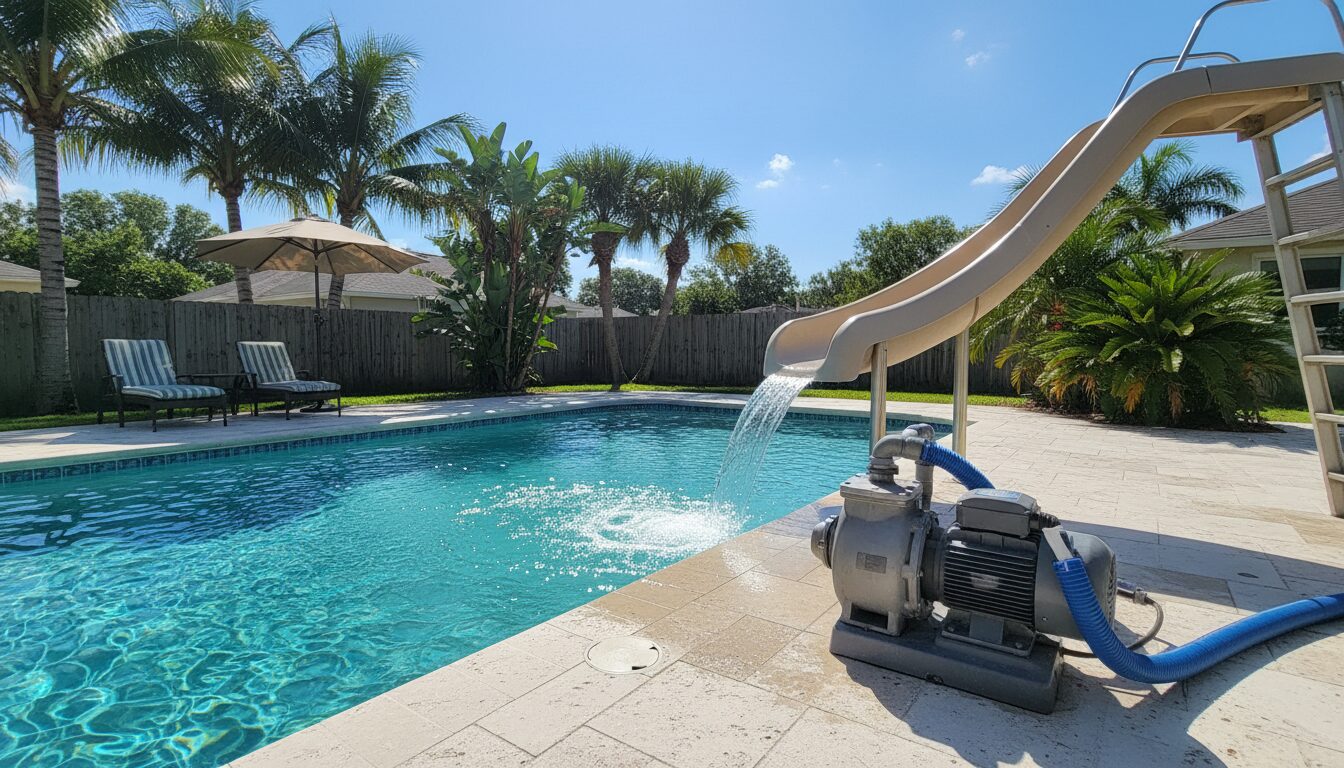
A pool slide uses a dedicated booster or circulation pump that is separate from your main pool pump. Its only job is to push water up the slide and over the top at enough flow to make the ride fast and smooth. Most residential slides require a pump rated between 1 HP and 2 HP, with a target flow rate of 60 to 100 GPM. Some compact slides for above-ground pools use smaller half-HP motors, while large fiberglass or concrete slides with long flumes can need a full 2 HP unit to maintain pressure.
Unlike your main pump, the slide pump typically runs only when the slide is actively in use. That matters a lot for the math, because a pump that runs 4 hours on a Saturday and sits idle the rest of the week behaves very differently from one that runs all day.
The Core Calculation: Watts, Hours, and Kilowatt-Hours
The formula for electricity cost is simple: multiply the pump’s wattage by the hours it runs, divide by 1,000 to convert to kilowatt-hours (kWh), and multiply by your electricity rate. The national average residential rate in 2025 is roughly $0.16 per kWh, but rates in California, New York, or New England often run $0.22 to $0.30 per kWh, while parts of the South and Midwest sit closer to $0.10 to $0.13.
Here is the formula spelled out:
- Find your pump’s wattage (check the motor nameplate or owner’s manual).
- Estimate average daily run hours.
- Multiply: Watts x Hours per Day = Watt-hours per Day.
- Divide by 1,000 to get kWh per day.
- Multiply by your electricity rate to get daily cost.
- Multiply by the number of days in your swimming season.
Worked Example: A Real Season With Real Numbers
Say you have a standard 1.5 HP slide pump that draws about 1,200 watts under load. You run the slide on weekends and a few afternoons per week, averaging 4 hours per day of actual operation. Your season runs from Memorial Day to Labor Day, roughly 90 days, but the slide is not in use every single day, so realistic operating days land around 60. Your electricity rate is $0.17 per kWh.
The math: 1,200 watts x 4 hours = 4,800 watt-hours per day, or 4.8 kWh. At $0.17 per kWh, that is $0.82 per day. Over 60 operating days, your seasonal cost is roughly $49. That is a beer-money number for most families, but if your rate is $0.25 and you run the slide 90 days, the same pump costs closer to $108.
Cost Comparison by Pump Size and Electricity Rate
| Pump Size | Approximate Wattage | Daily Cost at $0.13/kWh | Daily Cost at $0.17/kWh | Daily Cost at $0.25/kWh | 90-Day Season at $0.17/kWh (4 hrs/day) |
|---|---|---|---|---|---|
| 0.5 HP | 400 W | $0.21 | $0.27 | $0.40 | $24 |
| 1 HP | 800 W | $0.42 | $0.54 | $0.80 | $49 |
| 1.5 HP | 1,200 W | $0.62 | $0.82 | $1.20 | $74 |
| 2 HP | 1,800 W | $0.94 | $1.22 | $1.80 | $110 |
Why These Differences Matter
The table makes it obvious that pump size is the biggest lever, not electricity rate. Moving from a 1 HP to a 2 HP pump more than doubles your seasonal cost at any rate. That said, if you live in a high-rate area like coastal California, even a 1 HP pump costs you twice what a homeowner in rural Texas pays. Know both numbers before you shop for a replacement pump, because buying a bigger motor than your slide actually needs is a common and expensive mistake.
What Drives the Cost Up in Practice
- Running the pump longer than needed: Leaving the slide pump on all day during pool hours instead of running it only when the slide is in active use can triple your seasonal cost. A timer fixes this immediately.
- Undersized pump working harder: A pump that is too small for the slide’s flume length runs continuously at max load and still delivers a weak ride. The motor runs hot, ages faster, and draws more current than it should.
- Clogged or partially closed valves: Restricted flow makes the motor work harder than its rated draw, pushing actual wattage above what the nameplate says. If a pump sounds like it is straining, check for a nearly closed valve or debris at the inlet.
- Older single-speed motors: Single-speed slide pumps run at full draw regardless of conditions. Newer variable-speed capable setups can throttle back when the slide is lightly used, but most slide pumps are still single-speed by design.
Practical Ways to Reduce Slide Pump Running Costs
The single best move is a digital timer or smart outlet wired to the slide pump circuit. Set it to run only during your actual swim window, say 10 a.m. to 6 p.m. on weekends, and you cut operating hours by 50 percent or more compared to leaving it on for the full pool day. At 4 hours of real use versus 8 hours of open-ended operation, you cut the seasonal bill in half without changing anything about how the slide performs.
Keeping the pump inlet strainer clean also matters more than most people expect. A clogged basket makes the motor work against vacuum resistance, which raises effective wattage and shortens motor life. Check it every two weeks during peak season.
If your pump is making noise that does not sound right, that is worth addressing before it becomes a bigger problem. The quiet clue hiding in a noisy pool pump explains what different pump sounds actually signal, which helps you catch a struggling motor before it fails mid-season and forces an emergency replacement that costs far more than the electricity savings ever would.
Sizing the pump correctly from the start also pays off over years, not just one season. Many slide manufacturers publish minimum and maximum GPM specs for their flumes. Meeting the minimum is enough for safe, enjoyable operation. Exceeding it with an oversized motor just burns extra electricity for no better ride. AquaDoc publishes a free flow-rate reference chart that pool owners use to match pump output to slide requirements before making a purchase decision, which can save a costly return or swap later.
When the Slide Pump Is Contributing to Bigger Pool Electrical Issues
If your overall pool electricity bill seems higher than expected and you are not sure which piece of equipment is to blame, the slide pump is worth isolating. Plug-in energy monitors (a standard hardware store item around $20 to $30) can sit on the outlet feeding the pump and log actual kWh consumption over a week. That gives you a real number to compare against the theoretical wattage on the nameplate, and sometimes reveals that an aging motor is drawing 20 to 30 percent more than rated, a clear sign it is approaching end of life.
Speaking of motors showing wear, if your slide pump has started making grinding, whining, or cavitation sounds, that is not a sign to run it less. It is a sign something is failing. A motor that is struggling mechanically draws more power and can trip breakers. When your pool pump sounds like it is quitting, it usually is, and the same applies to slide pump motors that share the same basic construction as main pool pumps.
Frequently Asked Questions
How much does it cost to run a pool slide pump all season?
A typical pool slide pump running 4 hours a day for a 90-day season costs between $25 and $120, depending on motor size and your electricity rate. A 1 HP pump at $0.17 per kWh runs about $49 for the season; a 2 HP pump at $0.20 per kWh runs closer to $110. Using a timer to limit actual run hours is the fastest way to push that number toward the lower end.
How many watts does a pool slide pump use?
Most dedicated pool slide pumps draw between 400 watts and 1,800 watts, depending on motor size. A 1 HP pump draws roughly 750 to 900 watts under real operating load, while a 1.5 HP model typically pulls 1,100 to 1,400 watts. Check the nameplate on the motor for the exact amperage, then multiply by your voltage (usually 120V or 240V) to get actual wattage.
Should I run a pool slide pump on a timer?
Absolutely. Putting your slide pump on a timer and limiting it to actual swim hours, typically 3 to 5 hours per day, can reduce electricity use by 40 to 60 percent compared to running it open-ended during pool hours. A digital outdoor timer rated for the pump’s amperage costs $20 to $50 and pays for itself in the first season.
What size pump do I need for a pool slide?
Most residential pool slides require a dedicated pump rated between 1 HP and 2 HP, targeting a flow rate of 60 to 100 GPM to maintain adequate flume pressure. Always check your slide manufacturer’s specification sheet first. Undersizing the pump means poor performance and an overworked motor; oversizing means you are paying for electricity you do not need.
Does a pool slide pump need to run at the same time as the main pool pump?
The slide pump is a separate motor and can run independently, but most setups tie it to pool hours so water stays in circulation while the slide is in use. Running them together also keeps chemistry consistent, since slide water returns to the pool continuously. You do not need the slide pump running overnight or whenever the pool is closed, so a shared timer schedule makes sense for most households.
At the end of the day, running a pool slide pump all season is a modest cost, usually $25 to $150 total, and a timer alone can keep it toward the lower end without anyone sacrificing a single ride.