
You blow out the lines, cap everything off, and then stand there staring at the jugs of antifreeze wondering whether one is enough or whether your setup needs three. A pool with a dedicated spa jets line feeding multiple jets plus five separate return jets is a genuinely bigger winterization job than the basic two-return setup most guides assume.
For a pool with one dedicated spa jets line and five return jets, you need between 1.5 and 2.5 gallons of pool-grade propylene glycol antifreeze in total, depending on pipe diameter and the length of each run. This article breaks that number down line by line, walks through a worked example with real measurements, and covers the mistakes that leave pipes cracked in January.
Why This Setup Uses More Antifreeze Than You Think
Most winterization guides are written for a simple pool: one skimmer, one main drain, two or three returns. Add a dedicated spa jets line and two extra returns and you have meaningfully more pipe volume to protect. The spa jets line in particular is not just one pipe. It runs from the equipment pad to a distribution manifold, and that manifold branches into individual jet bodies, each with its own short stub of pipe. All of that volume needs either air-blown completely clear or filled with antifreeze to survive a freeze.
The standard rule for pool antifreeze is 1 quart per line for typical 1.5-inch return stubs up to about 20 feet from the pad. That works fine for a basic return jet. It does not account for a spa manifold with six or eight jets branching off it, or for a return line running 40 feet to the far end of a large pool. Those lines need more, and underestimating is exactly how you end up with a cracked fitting in spring.
Line-by-Line Antifreeze Breakdown
Return Jets: Five Lines
Each of your five return jets is typically plumbed with 1.5-inch or 2-inch PVC from the return manifold near the equipment pad. A 1.5-inch pipe holds roughly 0.1 gallons per foot of run. A 2-inch pipe holds about 0.17 gallons per foot. For returns in the 15-to-25-foot range (pad to wall), 1 quart per return is enough, as long as you blow the line first and pour the antifreeze in behind the air. For longer runs, use 1.5 quarts per line to be safe.
- Short runs (under 20 feet): 1 quart per return jet, so 5 quarts total for five returns.
- Medium runs (20 to 35 feet): 1.5 quarts per return jet, so 7.5 quarts (just under 2 gallons) for five returns.
- Long runs (over 35 feet): 2 quarts per return jet; at this point your five returns alone need 2.5 gallons.
The Dedicated Spa Jets Line
This is the line most people underfill. The dedicated spa jets line runs from the pump or blower to a manifold inside or behind the spa shell, and from there individual 0.75-inch or 1-inch stubs branch to each jet body. A six-jet spa might have 6 feet of manifold pipe plus six 2-foot stubs: that is roughly 0.75 to 1 gallon of total volume before you even count the main feed line from the equipment pad. Plan on at least 2 quarts for the manifold and jet stubs, plus 1 quart for the feed line from the pad. A large spa jets system with 8 or more jets and a long feed run can easily need 1 full gallon on its own.
Skimmer Lines and Main Drain
These are not part of your five-returns question, but they are part of the same winterization job and worth accounting for so your total jug count is right. Two skimmer lines take 1 quart each. The main drain line, which typically runs deeper and longer than return stubs, needs 1 to 1.5 quarts. That adds another 0.75 to 1 gallon to your shopping list.
Worked Example: A 20,000-Gallon Pool With Spa Jets and Five Returns
Say you have a 20,000-gallon inground gunite pool with an attached raised spa. The equipment pad sits about 25 feet from the near end of the pool and 40 feet from the far end. Here is how the antifreeze math plays out:
| Line | Pipe Size | Run Length | Antifreeze Needed |
|---|---|---|---|
| Return 1 (near wall) | 1.5 in | 18 ft | 1 qt |
| Return 2 (near wall) | 1.5 in | 20 ft | 1 qt |
| Return 3 (mid pool) | 1.5 in | 28 ft | 1.5 qt |
| Return 4 (far wall) | 2 in | 38 ft | 2 qt |
| Return 5 (far wall) | 2 in | 40 ft | 2 qt |
| Spa jets line (feed + manifold + 6 jets) | 1.5 in feed / 1 in stubs | 22 ft feed | 3 qt |
| Skimmer 1 | 1.5 in | 20 ft | 1 qt |
| Skimmer 2 | 1.5 in | 22 ft | 1 qt |
| Main drain | 2 in | 35 ft | 1.5 qt |
Total: 14.5 quarts, which is just over 3.5 gallons. That is for the full system. Strip out the skimmers and main drain, and the five returns plus spa jets line alone come to 11 quarts, or about 2.75 gallons. Buy four 1-gallon jugs so you have a small buffer and are not short by half a cup at the last fitting.
Why These Numbers Matter for Your Decision
The difference between a 25-foot return and a 40-foot return in 2-inch pipe is about 1.5 quarts of pipe volume. That gap matters because pipe that is only partially filled with antifreeze can still freeze at the air-antifreeze interface. The goal is for every section of pipe below the frost line to be either completely free of water (via blow-out) or completely filled with antifreeze. Partially treated lines give you false confidence.
The spa jets line deserves special attention because the branch fittings at the manifold are often the first thing to crack. Those fittings sit in a wet environment, hold standing water if not fully drained, and are expensive to access for repair. If you are uncertain about how completely your blow-out cleared the stubs, pour a full quart directly into the spa jets line after blowing it out rather than trying to guess.
Common Mistakes When Winterizing a Spa Jets Line
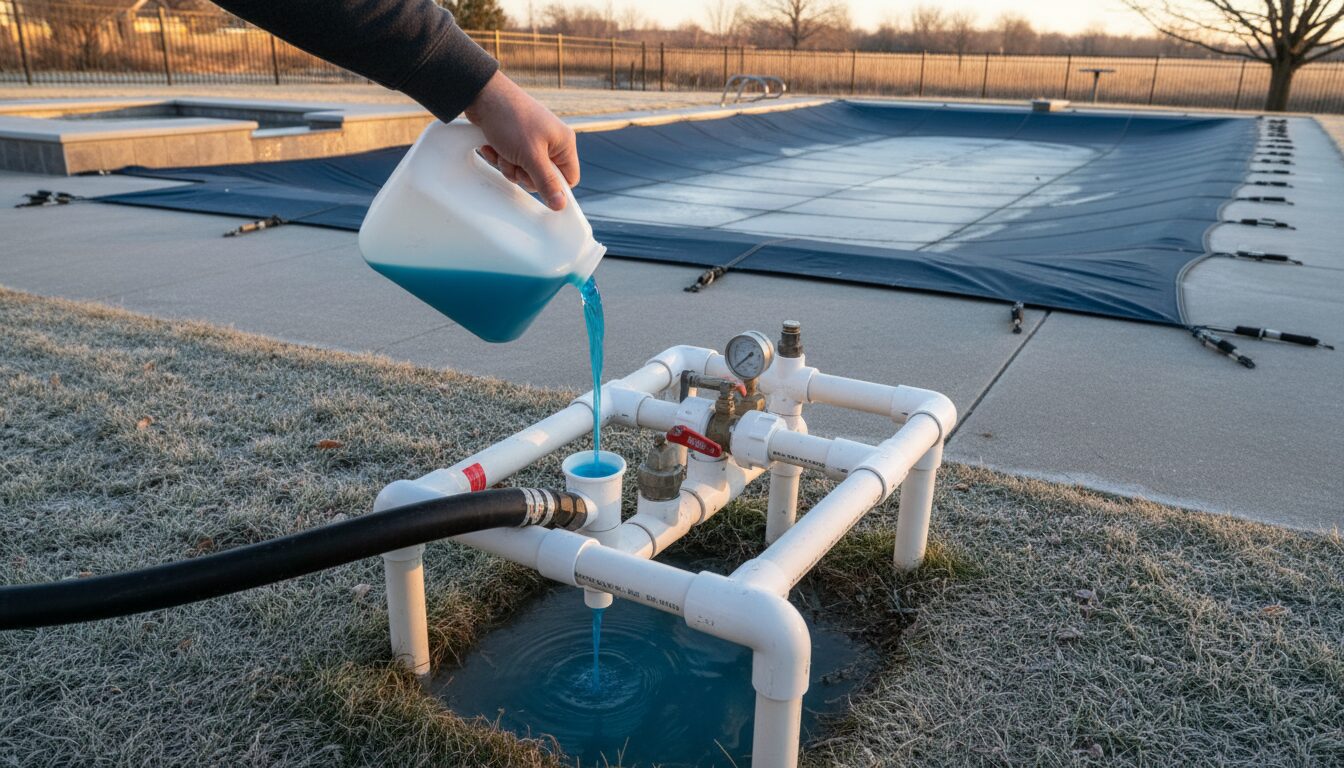
- Skipping the blow-out: Antifreeze works best as a backup layer after compressed air has pushed most of the water out. Trying to displace standing water with antifreeze alone takes far more product and rarely works completely.
- Using automotive antifreeze: Ethylene glycol antifreeze is toxic and not safe for pool plumbing. Use only propylene glycol-based pool antifreeze, rated to at least minus 40 degrees Fahrenheit.
- Pouring antifreeze into the skimmer and hoping it reaches the returns: It does not. Each line needs to be treated individually from the access point closest to that line.
- Forgetting the jet body check valves: Many spa jet bodies have small internal check valves that trap water. Pop out the jet faces before winterizing and clear those cavities before sealing.
- Underestimating the feed line to the spa: Owners often treat the manifold stubs but forget the main feed running from the equipment pad to the spa. That line can be 20 or more feet of pipe holding real volume.
AquaDoc’s pool-grade propylene glycol antifreeze is formulated specifically for plumbing that contacts pool water, so it is non-toxic and safe to leave in the lines through winter and into spring opening. It is worth having an extra jug on hand because the last fitting you treat is usually the one you underestimate.
If your pool’s plumbing has aged or the skimmer housing looks worn, it is also worth checking whether any pipe repairs might be needed before next season. The costs involved in a main drain and skimmer replaster job give you a sense of what neglected winterization can eventually lead to in terms of repair bills.
Frequently Asked Questions
How much antifreeze does a pool with five return jets need?
A pool with five standard return jets typically needs 1 quart of pool antifreeze per return line for short runs under 20 feet, or up to 2 quarts per line for runs over 35 feet. That means the return side alone can range from 5 quarts (1.25 gallons) up to 10 quarts (2.5 gallons) depending on pipe length and diameter.
Does a dedicated spa jets line need more antifreeze than a regular return?
Yes. A dedicated spa jets line feeds a manifold that branches into multiple individual jet bodies, each with its own pipe stub. That combined volume, plus the main feed line from the equipment pad, typically requires 2 to 3 quarts, and up to 1 full gallon for systems with 8 or more jets or a long feed run from the pad.
What concentration of pool antifreeze should I use?
Use propylene glycol-based pool antifreeze rated to at least minus 40 degrees Fahrenheit. Never substitute automotive antifreeze, which contains ethylene glycol and is toxic to swimmers. Most pool-grade antifreeze comes pre-diluted and ready to pour directly into lines after blow-out.
How much total antifreeze does a pool with a spa jets line and five returns typically need?
For the five returns and spa jets line combined, budget 2.5 to 3.5 quarts. Add skimmer and main drain lines and the full-system total for a typical setup runs 1.5 to 2.5 gallons. Pools with longer pipe runs or 2-inch plumbing throughout can exceed 3 gallons for the complete winterization.
Can I use too much pool antifreeze?
Using more than the calculated minimum is fine and is standard practice. Excess propylene glycol-based antifreeze dilutes harmlessly into pool water at opening and is non-toxic at those concentrations. The far more costly mistake is using too little, which leaves water in a line that freezes, expands, and cracks PVC pipe or fittings at the worst possible time.
The bottom line: a pool with a dedicated spa jets line and five return jets needs at least 2.5 to 3.5 quarts for those lines alone, and closer to 3 to 4 gallons once you include skimmers and the main drain. Buy one jug more than you think you need and treat every line individually after blowing it out.