
Test your pool water 2-3 times per week during active swimming season, and at least once a week when the pool is getting light use. That is the real answer most pool guides bury or skip entirely. Chlorine burns off fast in heat, gets diluted by rain, and gets consumed by bather load faster than you expect. If you are only testing once a week in July, you are flying blind for most of the week – and that is when green water happens.
Why Testing Frequency Actually Matters More Than the Chemicals You Buy
Most pool owners who call a service company with a chemistry problem have the same backstory: they tested on Sunday, everything looked fine, and by Thursday the pool was cloudy or green. The issue is not that they used the wrong chemicals. The issue is that they waited six days to find out something had gone wrong. Testing frequently is the single habit that keeps small imbalances from becoming expensive fixes.
Pool chemistry is not static. Chlorine gets consumed by sunlight, heat, bather load, organic debris, and rain. pH drifts upward on its own as CO2 escapes the water. A pool that tests perfect on Monday can be genuinely out of range by Wednesday after three hot days and a few kids in the water. The goal of testing is not to confirm that everything is fine – it is to catch problems early, when a small adjustment costs pennies instead of a bag of shock and three days of filtration.
What Is the Right Testing Schedule by Chemical?
Not every chemical needs daily attention. Here is a practical breakdown of what to test and how often:
- Free chlorine: 2-3 times per week in summer, once a week in cooler months.
- pH: Every time you test chlorine. These two go together – always.
- Total alkalinity: Once a week. It shifts more slowly than pH, but it controls how stable your pH stays. If you have been chasing pH problems, check alkalinity first.
- CYA (stabilizer): Once a month. It builds up slowly and only leaves the water through dilution or draining.
- Calcium hardness: Once a month. Critical for plaster and vinyl liner longevity, but it does not swing quickly.
- Combined chlorine (chloramines): Once a week if you are not shocking regularly, more often if the pool smells like chlorine or causes eye irritation.
When Should You Test More Often Than Usual?
There are specific situations where you should test same-day, not wait for your regular schedule. These are not edge cases – they happen all summer long.
- After a rainstorm. Rain dilutes chlorine, introduces phosphates and debris, and can drop alkalinity. A heavy downpour in the afternoon means you should test that evening.
- After heavy swimming. A pool party or a full day of kids in the water can cut your free chlorine in half. Test within a few hours after the event.
- During a heat wave. Sustained temps above 90 degrees accelerate chlorine loss dramatically, especially in pools with low or no CYA. Testing every day during a week-long heat wave is not overkill.
- After adding chemicals. Always test 4-8 hours after a significant chemical addition to confirm the adjustment landed where you wanted it.
- When the water looks off. Cloudy water, an odd smell, or any visual change is a sign to test immediately, not at the end of the week.
Test Strips vs. Liquid Test Kits: Does It Change How Often You Should Test?
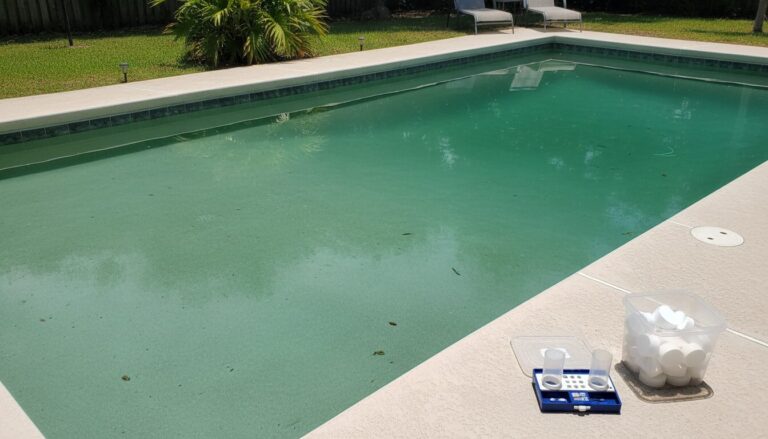
Test strips are fast and cheap per use, which makes them the right tool for your 2-3 times per week chlorine and pH checks. A good 6-way or 7-way strip handles chlorine, pH, alkalinity, CYA, calcium hardness, and sometimes bromine – everything you need for a quick read. The tradeoff is accuracy: strips give you a ballpark, not a precise number.
Liquid drop test kits (the kind where you count drops into a vial) are meaningfully more accurate, especially for total alkalinity and CYA. Use a liquid kit at least once a week to verify what your strips are telling you, and always use a liquid kit when you are trying to diagnose a problem. If you only own strips and you keep having chemistry issues you cannot explain, that is worth investigating – the strips may be giving you a false read.
Some pool owners add a digital tester for chlorine and pH and use it daily without thinking twice about it. If that level of precision keeps your pool easy to manage, it is absolutely worth it.
Does Testing Schedule Change by Pool Type or Season?
Salt water pools still require regular testing – they are not self-maintaining. Salt cells produce chlorine, but pH tends to drift high in salt pools, so you actually need to monitor pH more frequently in some setups, not less. Test free chlorine and pH at least twice a week in a salt pool.
In fall and spring, when the pool is open but getting minimal use, once-a-week testing covers most scenarios. Water changes slowly in cool weather and with low bather load. In winter, if your pool is open year-round, maintain a weekly schedule. If you closed the pool for the season, test on opening day before adding anything – that first read sets your baseline for everything that follows.
Above-ground pools can lose heat and temperature stability faster than in-ground pools, which means chlorine can spike and drop more unpredictably on hot days. The same 2-3 times per week schedule applies, and erring toward the more frequent end during summer makes sense. A line like AquaDoc’s 3-in-1 test strips was built for exactly this kind of quick, routine check – grab them on your way past the pool in the morning and you have your numbers in 30 seconds.
The Mistake That Makes Testing Feel Pointless
The most common testing mistake is not testing too infrequently – it is testing and then not acting on the results. A lot of pool owners test, see that chlorine is low, add a little, and move on without rechecking 24 hours later. Or they test and see a high pH, note it, and plan to fix it this weekend. That gap between testing and acting is where small problems become medium ones.
Make it a rule: if you test and something is out of range, adjust the same day. Then test again the next morning to confirm the correction worked. This turns chemistry management into a feedback loop instead of a weekly guessing game. If you want to go deeper on why specific numbers drift and what they mean for each other, the relationship between alkalinity and pH is a good place to start.
Frequently Asked Questions
How often should I test my pool water in summer?
Test chlorine and pH at least 2-3 times per week during swimming season. After heavy use, a rainstorm, or a stretch of hot weather, test the same day rather than waiting for your regular schedule.
Can I test my pool water too often?
No. Testing more often never hurts – it just gives you more data. The only downside is the cost of test strips if you run through them quickly, which is why a liquid drop test kit is a smarter long-term investment for anyone who tests frequently.
How often should I test CYA and calcium hardness?
Test CYA (stabilizer) and calcium hardness once a month during swimming season. These levels change slowly, so weekly testing is not necessary – but skipping them for an entire season is how you end up with harder problems down the road.
Do I need to test pool water in winter?
If your pool stays open year-round, test once a week in winter. If the pool is closed for the season, test the water on opening day in spring before adding any chemicals.
What is the most important thing to test in a pool?
Free chlorine is the most critical number – it is your primary defense against bacteria and algae. pH is a close second, because it determines how effectively that chlorine actually works. A pool with great chlorine levels and a pH of 8.0 is not nearly as protected as the numbers suggest. Getting both right consistently is what separates pool owners who rarely have problems from the ones who are always fighting something.