
If you’ve ever stood in front of a shelf of pool antifreeze jugs trying to figure out whether you need two bottles or six, you already know the math isn’t obvious. The problem gets worse when someone tells you “just pour some in each line” without explaining that skimmer lines and return lines aren’t the same length, the same diameter, or connected to the same fixtures.
The short answer: skimmer lines typically need 1 to 2 quarts of antifreeze each, and return lines typically need 2 to 3 quarts each, based on standard 1.5-inch pipe and average run lengths of 25 to 40 feet. But that range shifts with pipe diameter and the actual footage of your plumbing, so the rest of this article walks through the volume formula, a worked example for both line types, and the common mistakes that leave pockets of water behind to freeze and crack.
Why Skimmer Lines and Return Lines Need Different Amounts
Skimmer lines pull water from the surface of the pool down through the skimmer throat and along the suction side of your plumbing to the pump. They’re often shorter than return lines because the skimmer sits at the pool’s edge, close to the equipment pad. Return lines, on the other hand, run from the equipment pad back to the pool wall fittings – sometimes traveling 40 to 60 feet around landscaping, a deck, or the far side of a pool. More pipe means more volume, which means more antifreeze to displace the residual moisture left after blowing out.
The other difference is fittings and geometry. Skimmer lines connect to a skimmer body that itself holds a cup of water around the throat, so you’re also protecting that fixture. Return lines terminate at eyeball fittings seated flush in the pool wall – smaller dead-end cavities – but the longer run makes up for it in total volume.
The Volume Formula You Actually Need
Pipe volume is calculated in gallons per linear foot. For the standard pipe sizes used in residential inground pools:
- 1.5-inch pipe: holds 0.0918 gallons per foot, or roughly 0.92 quarts per 10 feet
- 2-inch pipe: holds 0.163 gallons per foot, or roughly 1.63 quarts per 10 feet
You don’t fill the pipe completely with antifreeze. You blow the line out first with an air compressor or a shop vac in blower mode, which pushes out the bulk of the water. What remains is residual moisture at low points, bends, and fittings. The antifreeze goes in after blowing out, protecting that remainder. A practical target is filling roughly one-third to one-half of the pipe’s calculated volume with antifreeze per line.
Worked Example: A Typical Inground Pool
Say your pool has two skimmer lines and four return lines. The skimmer lines each run about 25 feet of 1.5-inch pipe from the skimmer to the pump. The return lines each run about 40 feet of 1.5-inch pipe from the pump back to the pool wall.
Skimmer lines: 25 feet x 0.0918 gallons/foot = 2.3 gallons total capacity per line. At one-third fill for residual protection, that’s about 0.75 gallons, or roughly 3 quarts, per line. In practice, most pool closers use 1 to 2 quarts per skimmer line because a well-blown-out line holds very little residual water. Start with 1 quart, pour it slowly through the skimmer throat, and add a second if the line is older or has low points where water collects.
Return lines: 40 feet x 0.0918 gallons/foot = 3.7 gallons total capacity per line. At one-third fill, that’s about 1.2 gallons, or just under 5 quarts. Again, after blowing out, you won’t need to fill a full third, but return lines are longer and have more places where water can sit. Budget 2 to 3 quarts per return line as your working number, and 3 quarts if your lines are older 2-inch pipe.
For this pool: 2 skimmer lines at 2 quarts each = 4 quarts. Four return lines at 3 quarts each = 12 quarts. Total: 16 quarts, or four 1-gallon jugs. That’s a concrete shopping number you can take to the store.
How to Add Antifreeze to Each Line Type
The process is different for skimmer lines and return lines, and getting it backwards wastes product and leaves gaps in protection. For step-by-step guidance on the full blowing and antifreeze sequence, this walkthrough from EZ Pool and Spa covers the technique clearly.
Skimmer Lines
- Lower the pool water level below the skimmer throat – typically 12 to 18 inches below the coping for inground pools.
- Plug the skimmer basket port that connects to the suction line at the bottom of the skimmer.
- Blow out the line from the equipment pad using an air compressor set to 30 to 50 PSI – enough pressure to clear the line but not enough to damage fittings.
- Once air is blowing out into the pool, cap the return end, then pour 1 to 2 quarts of non-toxic, propylene glycol pool antifreeze rated to -50°F directly into the skimmer throat.
- Insert a rubber expansion plug in the skimmer opening to hold the antifreeze in the line. A properly seated plug prevents antifreeze from draining back into the pool.
A clogged skimmer line is one of the more frustrating pre-winter surprises, and it can trap water that antifreeze won’t reach – something worth checking before you blow out the lines. If you want background on how skimmer blockages compound into bigger problems, this post on how a clogged skimmer led to a murky mess explains the chain reaction well.
Return Lines
- Close the return line valves at the equipment pad.
- Blow out each return line from the equipment pad side. You’ll see bubbles coming out of the return eyeball fittings in the pool wall when the line is clear.
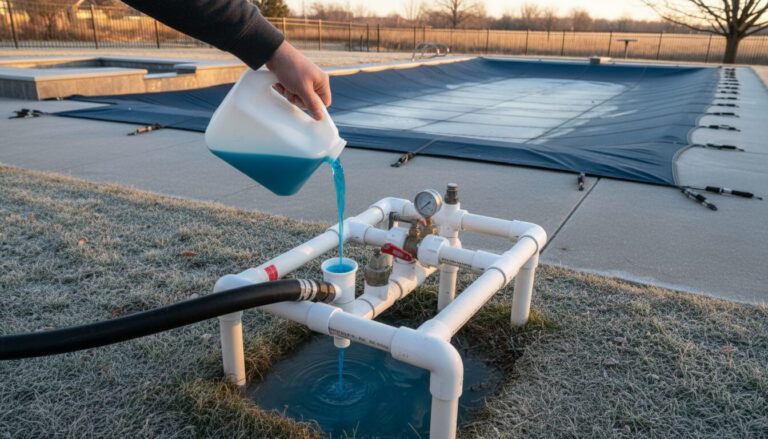
- While air is still flowing, pour 2 to 3 quarts of antifreeze into the return line port at the equipment pad. The air pressure will carry the antifreeze toward the pool-side fitting.
- Close the valve and plug the return fitting in the pool wall with an expansion plug to hold the antifreeze in place.
AquaDoc’s pool antifreeze is formulated at -50°F protection using propylene glycol, which is what pool owners typically reach for because it won’t harm liner material, plaster, or pool water chemistry if a small amount dilutes into the pool in spring.
Common Mistakes That Leave Water Behind
- Skipping the blow-out step: Pouring antifreeze into a line still full of water just dilutes it. The antifreeze ends up too weak to protect against freezing, and you’ve wasted product. Always blow out first.
- Not accounting for low points: If your plumbing dips under a pathway or deck, water pools at the low point even after blowing. Add an extra half-quart at those spots and make sure your air pressure is high enough to push through the dip.
- Using one-quart-fits-all for every line: A 20-foot skimmer line and a 60-foot return line are not the same. Under-filling the return line leaves dry sections where condensation can freeze overnight.
- Forgetting the main drain line: If your pool has a main drain, it has its own line that needs the same blow-out-and-antifreeze treatment – typically 2 to 3 quarts depending on depth and run length.
- Leaving plugs loose: Antifreeze drains back into the pool overnight if the expansion plugs aren’t fully seated. Test each plug by pulling on it lightly before you walk away.
If you notice gurgling or unusual sounds in your suction plumbing before closing, it may point to a partial blockage or air leak that will complicate the blow-out, and a look at diagnosing a gurgling suction line is worth a read before you start.
Comparison: 1.5-Inch vs. 2-Inch Pipe Antifreeze Needs
| Line Type | Pipe Size | Typical Run Length | Antifreeze per Line |
|---|---|---|---|
| Skimmer line | 1.5 inch | 20 to 30 feet | 1 to 2 quarts |
| Skimmer line | 2 inch | 20 to 30 feet | 2 to 3 quarts |
| Return line | 1.5 inch | 35 to 50 feet | 2 to 3 quarts |
| Return line | 2 inch | 35 to 50 feet | 3 to 4 quarts |
The pipe diameter difference matters more than most people realize. A 2-inch pipe holds about 78 percent more water per foot than a 1.5-inch pipe, so if your pool was replumbed or built after 2010 with 2-inch return lines (common in higher-flow systems), add 1 full quart per line to your estimate. When in doubt, measure the outside diameter of the pipe at a visible section – 1.5-inch pipe measures about 1.9 inches outside, and 2-inch pipe measures about 2.375 inches outside.
Frequently Asked Questions
How much antifreeze do I need for a skimmer line?
A 1.5-inch skimmer line holds about 0.6 gallons per 10 feet of pipe. For a typical 30-foot skimmer run, you need roughly 2 quarts of non-toxic pool antifreeze. Always blow out the line first so the antifreeze fills residual moisture rather than a full water column.
How much antifreeze does a return line need?
A 1.5-inch return line needs about 2 to 3 quarts for a typical 40-foot run. If your returns are 2-inch pipe, increase that to 3 to 4 quarts per line to account for the larger bore. Blow out the line first, then pour antifreeze in from the equipment pad while air is still pushing it toward the pool-side fitting.
Can I use the same antifreeze for skimmer and return lines?
Yes. Non-toxic, propylene glycol-based pool antifreeze rated to at least -50°F works for both line types. Never use automotive antifreeze (ethylene glycol) in pool plumbing – it is toxic and will contaminate the water when the pool opens in spring.
Do I need antifreeze if I blow out the pool lines with an air compressor?
Blowing out removes most of the water, but residual moisture always stays at low points, bends, and fittings. Adding 1 quart of antifreeze per line after blowing out is inexpensive insurance against a crack from that remaining water, and it costs far less than repairing a split pipe in March.
How much antifreeze do I need for a pool with 3 skimmer lines and 4 return lines?
For 3 skimmer lines averaging 30 feet each and 4 return lines averaging 40 feet each in 1.5-inch pipe, plan on 6 quarts for the skimmers (2 quarts each) and 10 to 12 quarts for the returns (2.5 to 3 quarts each), for a total of 16 to 18 quarts – roughly four to five 1-gallon jugs. Adjust up by about 30 percent across the board if your plumbing is 2-inch pipe.
The bottom line: skimmer lines need 1 to 2 quarts each, and return lines need 2 to 3 quarts each for standard 1.5-inch pipe. Calculate your pipe length, add it up, buy one extra jug as a buffer, and you won’t be making a second trip to the store mid-closing.