
You drain a couple of inches off the top every week to manage overflow from rain, splash-out, or a spigot that got left on a little too long. No big deal, right? It turns out that routine habit quietly siphons a meaningful amount of cyanuric acid out of your pool all summer long, and by Labor Day you may be wondering why chlorine keeps vanishing.
Here is the short answer: draining 2 inches per week from a 10,000-gallon pool over a 16-week summer removes roughly 23 to 26 ppm of CYA – enough to cut your stabilizer level by one-third or more if you started the season at 75 ppm, or nearly wipe it out if you started lower. The rest of this article walks through the math step by step, explains why that matters for your chlorine, and tells you exactly how to top the stabilizer back up without overshooting.
Step 1: Figure Out How Many Gallons You Drain Each Week
Two inches sounds like a small number, but pool surface area turns it into real gallons fast. The formula is: length (ft) x width (ft) x 0.167 (ft per inch) x 7.48 = gallons per inch of depth. Multiply by 2 for your 2-inch drain.
A rectangular 10,000-gallon pool is roughly 12 x 24 feet. Running that through the formula: 12 x 24 x 0.167 x 7.48 = about 360 gallons removed per week. (If your pool is oval or kidney-shaped, the surface area is smaller, so your actual drain is closer to 300 to 320 gallons per week – use your pool’s square footage if you know it. The 12×24 inground pool gallons guide on this site explains exactly how to confirm your pool’s true volume if you are not sure.)
Step 2: Calculate the Dilution Ratio Each Week
Every time you drain 360 gallons and refill with fresh water, you are replacing 3.6 percent of the pool’s total volume with water that contains zero CYA. That means your existing CYA concentration drops by a factor of:
Remaining fraction = (10,000 – 360) / 10,000 = 0.964
In other words, after one week your CYA is 96.4 percent of what it was before the drain. That is a 1.6 percent loss per cycle – not dramatic in isolation, but it compounds every single week.
Step 3: Run the Full Summer Math
Compound dilution over 16 weeks (a reasonable Memorial Day to Labor Day window) looks like this:
Remaining fraction after 16 weeks = 0.964^16 = 0.558
That means you retain about 55.8 percent of your starting CYA. The other 44.2 percent is gone down the drain. Here is what that translates to at common starting levels:
| Starting CYA (ppm) | CYA After 16 Weeks (ppm) | Total Lost (ppm) | Still in Target Range? |
|---|---|---|---|
| 30 ppm | 17 ppm | 13 ppm | No – below 20 ppm floor |
| 50 ppm | 28 ppm | 22 ppm | Marginal |
| 75 ppm | 42 ppm | 33 ppm | Yes – still comfortable |
| 100 ppm | 56 ppm | 44 ppm | Yes, assuming you started high intentionally |
Why These Numbers Matter for Your Chlorine
CYA is what shields free chlorine from UV degradation. Without enough of it in an outdoor pool, sunlight can destroy the majority of your chlorine within an hour or two of adding it. As this breakdown of how pool stabilizer works explains, CYA binds loosely to chlorine molecules and slows the photodegradation process dramatically – a pool with 50 ppm CYA can retain chlorine 6 to 8 times longer than an unstabilized pool in direct sun.
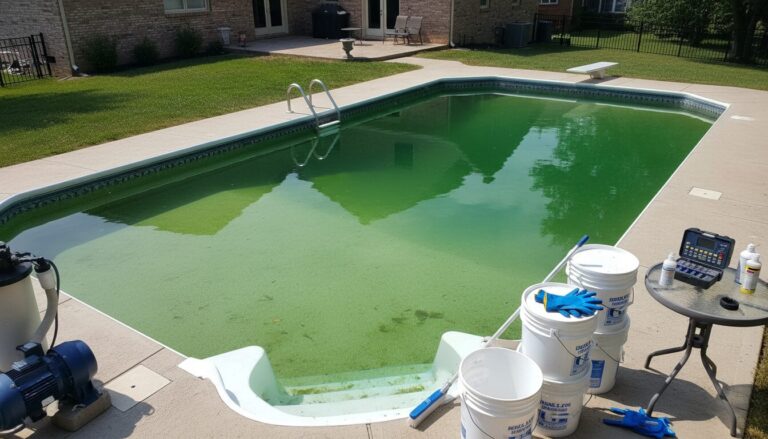
So if you started summer at 50 ppm CYA and drained 2 inches every week, by mid-August you are hovering around 28 ppm. That is not catastrophic, but it is low enough that you will notice your chlorine demand creeping up, especially during heat waves. If you started at 30 ppm, you are likely below 20 ppm by July and your chlorine is essentially unprotected. That is usually the point where pool owners start suspecting algae or a faulty chlorinator, when the real culprit is just stabilizer depletion. You can read more about the signs and thresholds in the chlorine disappearing overnight explainer on this site.
The target CYA range for a traditionally chlorinated outdoor pool is 30 to 50 ppm. Salt systems run a little higher, 60 to 80 ppm, because salt chlorinators are less efficient at high CYA but also more vulnerable to rapid chlorine loss without it. According to this summer CYA management guide, staying below 80 ppm is important because very high CYA levels suppress chlorine’s ability to sanitize effectively even when your free chlorine test reads normal.
How to Replace Lost Stabilizer Correctly
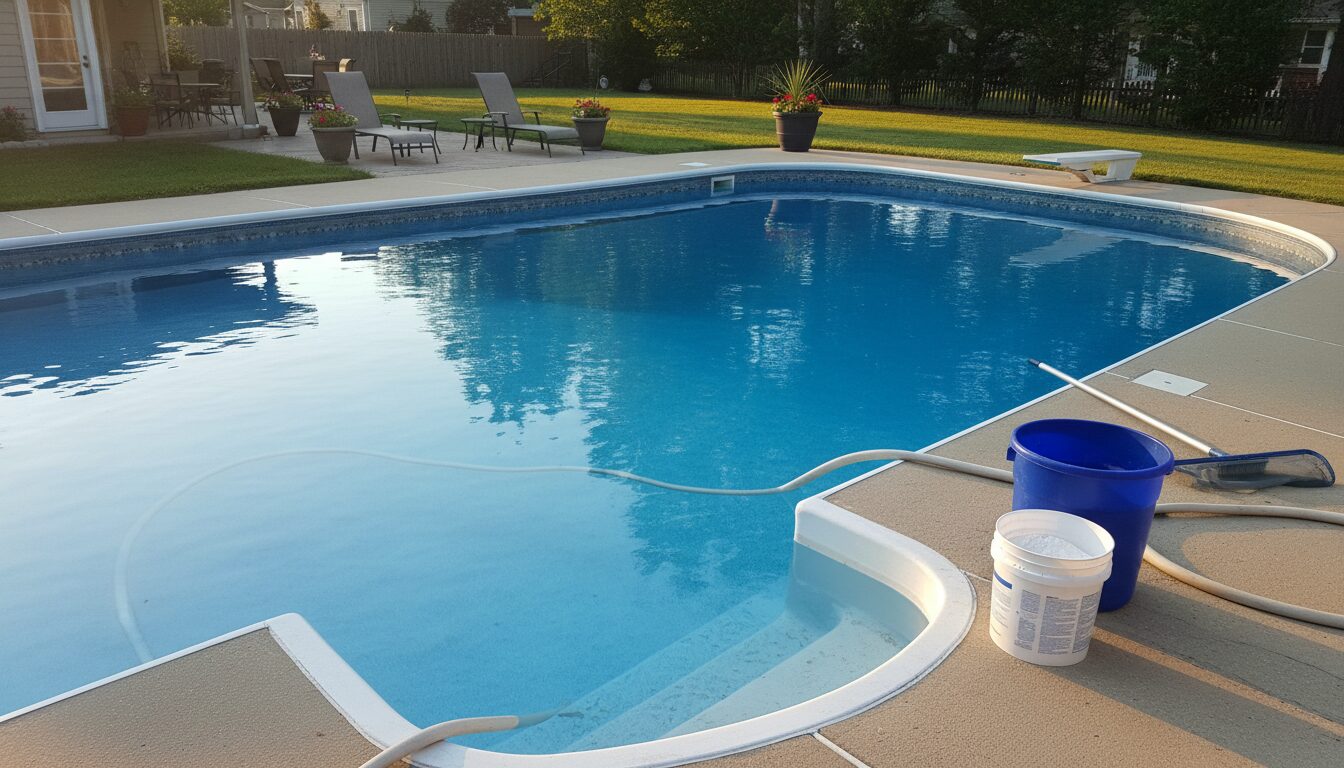
Granular cyanuric acid dissolves slowly – think 24 to 48 hours in most cases – so patience matters here. Add it incrementally, retest, and repeat. Dumping a full correction dose at once and retesting the same afternoon will give you an artificially low reading and tempt you to add more than you need.
The dosing math is simple: 1.3 oz of granular CYA raises a 10,000-gallon pool by approximately 1 ppm. So if you need to raise CYA by 15 ppm, you need about 19.5 oz, or just over 1.2 lbs. Add it through the skimmer while the pump is running, or pre-dissolve it in a bucket of warm water first (this speeds things up considerably).
Here is a quick reference for common correction amounts in a 10,000-gallon pool:
- Raise CYA by 10 ppm: 13 oz (0.8 lb) of granular cyanuric acid
- Raise CYA by 20 ppm: 26 oz (1.6 lb)
- Raise CYA by 30 ppm: 39 oz (2.4 lb)
- Raise CYA by 44 ppm (full season loss at 100 ppm start): about 57 oz, or 3.6 lb
AquaDoc makes a granular stabilizer formulated for this kind of mid-season correction – a brand several pool owners use specifically because it dissolves more evenly than hardware-store bulk bags, which can clump and take days to fully enter solution.
Common Mistakes When Managing CYA Losses From Draining
- Testing too infrequently: CYA does not change daily the way pH does, so many pool owners test it once at the start of summer and forget it. A monthly test is the minimum for a pool with regular drainage.
- Confusing dilution loss with CYA buildup: If you are also using trichlor tablets, those add CYA continuously. The net effect of tablets plus weekly draining can go either direction. Track both inputs and losses to stay on target. The pool stabilizer guide on this site covers both scenarios in detail.
- Adding CYA all at once before a rain event: If you add a correction dose and then get three inches of rain, you will just drain it again. Check the forecast and time your additions during a dry stretch.
- Ignoring backwash losses: Backwashing a sand filter sends 200 to 300 gallons out per cycle. If you backwash weekly, add another 3,200 to 4,800 gallons of total discharge to your summer loss calculation on top of the drain-down water. That can push your real CYA loss 10 to 15 ppm higher than the drain-only figure. More detail on how this works is in the cyanuric acid pool management breakdown.
Should You Adjust Your Draining Habit to Protect CYA?
Not necessarily. The reason you drain 2 inches per week – rainfall management, controlling total dissolved solids, keeping the water line below the coping – is usually legitimate. The fix is not to stop draining; it is to test more often and replenish CYA as part of your regular summer maintenance routine rather than treating it as a set-and-forget chemical.
A reasonable approach: test CYA at the start of summer, again at the 4-week mark, and every 3 weeks after that. If you are draining consistently, expect to add one correction dose – somewhere in the 0.5 to 1.5 lb range – at least once or twice between Memorial Day and Labor Day.
Frequently Asked Questions
How much stabilizer does a 10,000-gallon pool lose draining 2 inches a week?
Over a 16-week summer, draining 2 inches per week from a 10,000-gallon pool removes roughly 23 to 26 ppm of CYA – about one-third to one-quarter of your starting level, depending on pool shape. Each individual 2-inch drain-and-refill dilutes CYA by about 1.6 to 1.7 percent, which compounds week after week into a significant seasonal loss.
How often should I test CYA in an outdoor pool during summer?
Test CYA every 3 to 4 weeks during the swim season, especially if you are draining water regularly. CYA does not degrade on its own under normal conditions, so any drop you detect is almost entirely due to water removal through draining, backwashing, or heavy splash-out.
How much cyanuric acid do I add to raise CYA by 10 ppm in a 10,000-gallon pool?
You need roughly 13 ounces (about 0.8 lb) of granular cyanuric acid to raise CYA by 10 ppm in a 10,000-gallon pool. Add it through the skimmer or pre-dissolve it in a bucket of warm water, and retest after 24 to 48 hours before adding more to avoid overshooting.
Does backwashing also lower CYA in a pool?
Yes. A single backwash cycle typically discharges 200 to 300 gallons, removing a small but real amount of CYA with it. If you backwash weekly on top of a 2-inch drain, your cumulative CYA loss over summer will be 10 to 15 ppm higher than the drain-only calculation alone would suggest.
What happens if CYA drops too low in an outdoor pool?
If CYA falls below 20 ppm in an outdoor pool, UV radiation from the sun can destroy free chlorine within an hour or two of adding it, making effective sanitation nearly impossible. Target 30 to 50 ppm for a traditionally chlorinated pool, or 60 to 80 ppm if you run a salt system.
The bottom line: a 10,000-gallon pool draining 2 inches per week will lose roughly 44 percent of its starting CYA by the end of a 16-week summer – enough to push you out of the safe range if you started anywhere below 75 ppm. Test monthly, keep granular CYA on hand, and treat mid-season top-ups as a normal part of summer maintenance rather than a sign something went wrong.