
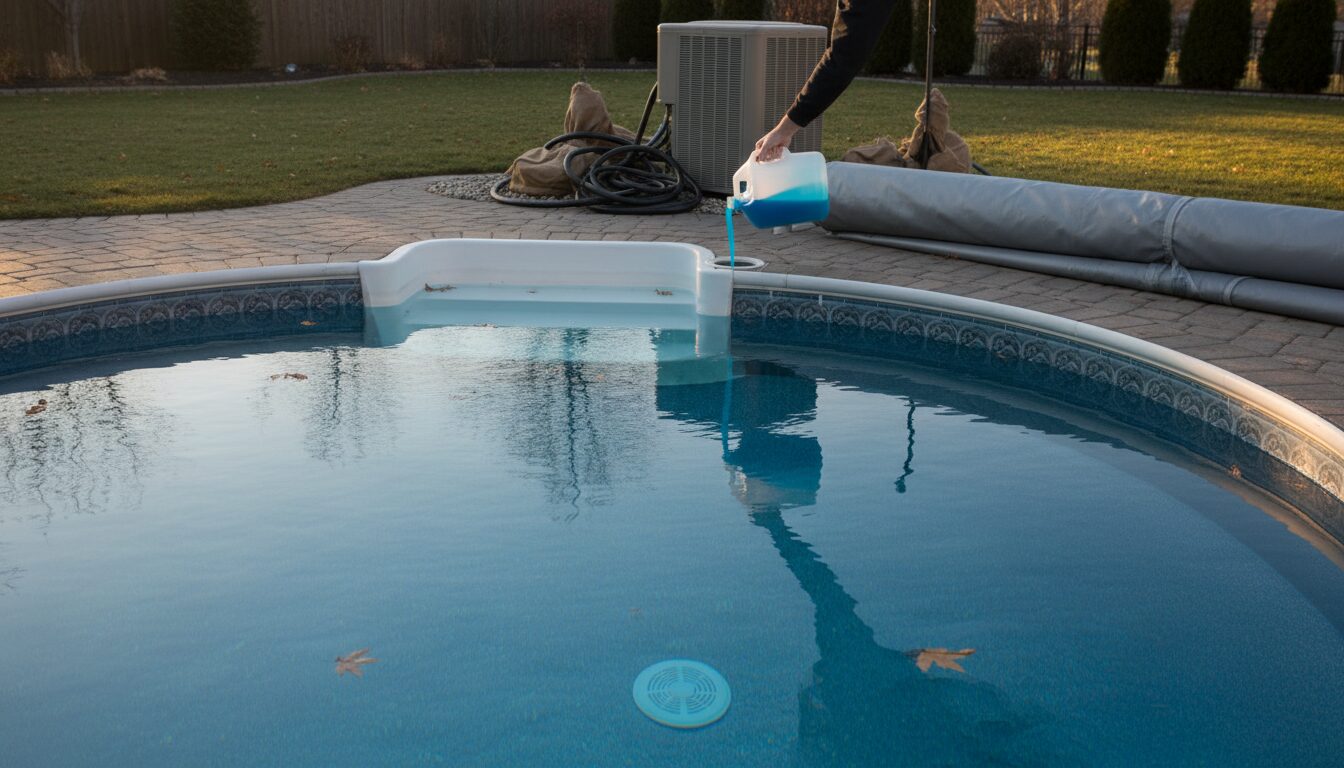

A 15,000-gallon pool with a heat pump and an in-floor cleaning system typically needs 2 to 3 gallons of pool-grade propylene glycol antifreeze to protect all plumbing lines after blowing them out. That range accounts for the heat pump bypass loop, the main return lines, both skimmer throats, and the branch lines feeding the in-floor pop-up heads. The in-floor system is the variable that blows up most generic antifreeze guides, because those branch lines add real pipe volume that a simple two-skimmer, six-return pool does not have.
If you have stood at the equipment pad in October trying to figure out whether one jug covers everything, you already know the standard advice falls apart fast once a heat pump and an in-floor manifold enter the picture. This post breaks the job down line by line, gives you real volumes to work from, and walks through the pour sequence so nothing gets missed.
Why Pool Volume Does Not Determine Antifreeze Quantity
The 15,000 gallons sitting in your shell has nothing to do with how much antifreeze you need. That water stays in the pool all winter and does not freeze because it has too much thermal mass. What you are protecting is the water trapped inside the PVC and flexible pipe runs between the pool, the equipment pad, and every fitting in between. Those lines can be as little as a few hundred feet or as much as 400 to 600 linear feet on a complex installation with an in-floor system. Volume in those lines is what you are calculating, not pool volume.
Standard 1.5-inch PVC holds roughly 0.09 gallons per linear foot. Two-inch pipe holds about 0.16 gallons per foot. So a 20-foot run of 1.5-inch pipe from a skimmer to the pump contains less than 2 quarts of water. That sounds small until you count every branch, every stub, and every manifold port in an in-floor zone.
Line-by-Line Breakdown for This Setup
Skimmer Lines
Most 15,000-gallon inground pools have two skimmers. Each skimmer throat and the pipe run to the equipment pad holds roughly 0.5 to 0.75 gallons after a good air blow-out. Plan on 1 to 1.5 gallons total for both skimmer lines. Blow the line clear first, then pour antifreeze directly into the skimmer basket well until you see it appear at the pipe inlet below the basket. That confirms the line is charged.
Return Lines
A 15,000-gallon pool commonly has 4 to 6 return jets. After blowing each return clear from the equipment pad, pour approximately 1 quart per return line into the pipe from the pad side before plugging the return fitting in the pool wall. With five returns that is roughly 1.25 gallons dedicated to returns alone.
Heat Pump Bypass Loop
The heat pump refrigerant circuit is sealed and does not need antifreeze. What does need protection is the water-side plumbing: the inlet and outlet pipes connecting the pool circulation loop to the heat pump, plus any flexible hose sections. Blow these lines clear, then pour 1 quart into each stub (inlet side and outlet side) before capping them. If your heat pump has a full bypass valve assembly with additional fittings, budget an extra quart. Total for the heat pump loop: 0.5 to 1 gallon. For a deeper look at how in-season heat pump plumbing affects your overall equipment costs, the post on pool slide pump running cost all season walks through similar equipment-pad plumbing considerations worth understanding before you button everything up for winter.
In-Floor Cleaning System Lines
This is where most antifreeze estimates go wrong. An in-floor cleaning system uses a dedicated pump, a valve manifold, and multiple zone branch lines running under the pool floor to pop-up heads. Each zone’s branch piping from the manifold to the farthest head can easily run 15 to 30 feet of 1.5-inch pipe, plus the stub back to the manifold. Three zones with 20-foot average branch runs hold roughly 0.75 to 1.5 gallons of water between them. Run the system’s air purge cycle on each zone sequentially before pouring. After purging, pour antifreeze into each zone port on the manifold until you are confident the branch is charged. Budget 1 to 1.5 gallons specifically for the in-floor lines.
Main Drain Line
If your main drain line runs to the equipment pad (versus a dedicated gravity drain), blow it clear and pour 0.5 gallons into the line before closing the valve or plugging the fitting. Many service techs cap the main drain line and skip the antifreeze on the theory that the line stays submerged, but any exposed section in the equipment pad area can still freeze.
Worked Example: Total Antifreeze for This Exact Setup
Say your pool has two skimmers, five return jets, a heat pump with a bypass loop, a three-zone in-floor cleaning system, and a main drain. Here is what the math looks like:
| Line or System | Estimated Volume After Blow-Out | Antifreeze Needed |
|---|---|---|
| 2 skimmer lines | 1.0 to 1.5 gal | 1.0 to 1.5 gal |
| 5 return lines | 1.0 to 1.25 gal | 1.0 to 1.25 gal |
| Heat pump bypass loop | 0.5 to 1.0 gal | 0.5 to 1.0 gal |
| In-floor cleaning zones (3) | 0.75 to 1.5 gal | 1.0 to 1.5 gal |
| Main drain line | 0.25 to 0.5 gal | 0.5 gal |
| Total | 4.0 to 5.75 gal |
Wait, that is higher than the 2 to 3 gallon figure in the opening. Here is the distinction: the 2 to 3 gallon range applies when every line has been thoroughly blown out with a commercial compressor, leaving only a thin film of residual water. If your blow-out is complete and clean, the residual volume per line drops substantially, and the lower end of the table applies. If you are relying on a shop vac or a weaker blower, the lines hold more water and you need to trend toward the higher numbers. For best results, blow each line until no water sprays from the return or skimmer opening, then pour. This guide on how many gallons of antifreeze it takes to winterize a pool covers blow-out technique and residual water scenarios in detail and is worth reading alongside this post.
Why These Differences Matter for Your Decision
The in-floor system is the single biggest variable. A pool without it needs roughly 1.5 to 2 gallons total. Add a heat pump loop and you are at 2 to 2.5 gallons. Add three in-floor zones and you are at 3 gallons minimum with a solid blow-out, and potentially 4 to 5 gallons if the blow-out is incomplete. Buy one extra gallon beyond your estimate. At roughly $8 to $12 per gallon for pool-grade propylene glycol, that insurance costs less than a cracked fitting repair, which runs $200 to $600 depending on where the break is.
AquaDoc pool antifreeze is formulated with propylene glycol rated for potable water plumbing, which matters when residual antifreeze eventually mixes back into your pool water at spring startup. It is the type of product pool owners use specifically because it does not require an emergency water change if a small amount migrates into the shell.
Common Mistakes to Avoid
- Skipping the in-floor purge cycle: If you pour antifreeze into the manifold without running the zone purge first, water trapped in the branch lines never gets displaced. Run the purge cycle on each zone, then pour.
- Treating the heat pump as one line: The inlet and outlet are separate stubs. Each one needs its own antifreeze charge. Missing one leaves a freeze-vulnerable pocket right at the heat pump connections.
- Using automotive antifreeze: Ethylene glycol is toxic. Only propylene glycol rated for pool or potable water plumbing belongs in your lines.
- Pouring before blowing: Antifreeze mixed with a full line of water raises the freeze point only slightly. The blow-out is not optional. Blow first, pour second, plug last.
- Forgetting low-point drains on the equipment pad: Many heat pump installations have a low-point drain valve on the water-side piping. Open and drain it before pouring, or the antifreeze goes in on top of standing water and barely dilutes the freeze risk.
Frequently Asked Questions
How much antifreeze does a 15,000-gallon pool need to winterize?
Pool volume itself does not determine antifreeze quantity. What matters is the total volume of your plumbing lines. A 15,000-gallon pool with a heat pump and in-floor cleaning system typically needs 2 to 3 gallons of pool-grade propylene glycol antifreeze after a thorough blow-out, and up to 4 to 5 gallons if the blow-out is only partial.
Do you need antifreeze in a pool heat pump during winterizing?
You do not pour antifreeze into the heat pump refrigerant circuit, since that is a sealed system. However, the water-side bypass loop and any flexible hose connections between the pool plumbing and the heat pump need antifreeze treatment. Pour approximately 1 quart into each stub (inlet and outlet) after blowing out those lines.
How much antifreeze do in-floor pop-up heads need?
Each in-floor cleaning zone typically holds 0.25 to 0.5 gallons of water in its branch lines from the valve manifold to the heads. A system with three zones needs roughly 0.75 to 1.5 gallons of antifreeze dedicated to those lines alone, poured after the air purge cycle is run on each zone.
Can you use automotive antifreeze in a pool?
No. Automotive antifreeze contains ethylene glycol, which is toxic and will contaminate pool water. Always use propylene glycol antifreeze rated for potable water or pool plumbing. It is the only type safe to leave in lines that connect back to your pool at spring startup.
What happens if you use too little antifreeze in pool lines?
If residual water mixes with too little antifreeze, the freeze point of the mixture may not drop far enough to protect the pipe. Even a small pocket of water trapped in a low point or return fitting can freeze, expand, and crack PVC. For climates that regularly drop below 20°F, target full displacement of each line rather than a minimal pour, and err toward buying one extra gallon as a buffer.
For a pool with a heat pump and in-floor cleaning system, plan on 2 to 3 gallons of pool-grade propylene glycol antifreeze after a complete blow-out, and keep one additional gallon on hand to cover any line you are not fully confident was purged dry.


