
You finally decide to call a pro to close your pool this fall, then get three quotes that are all over the map – $175 from one company, $450 from another, and a third that won’t even give you a number without seeing the pool first. What’s going on? Regional labor markets, local climate severity, pool complexity, and what each company actually includes in “winterization” all move the price in different directions.
Professional pool blow-out and winterization costs range from $150 to $600 for most residential pools, with the national average landing around $250 to $350 for a standard inground pool. Above-ground pools typically come in lower, at $100 to $300. This article breaks down pricing by region, explains what drives the cost up or down, and shows you exactly what should be included so you’re not paying for shortcuts that cause burst pipes in January.
Why Region Is the Biggest Pricing Variable
Pool winterization pricing is shaped more by geography than almost any other factor. In cold-climate states, a missed drop of water in a return line can freeze, expand, and crack the pipe – so contractors do more thorough work, use higher-pressure compressors, and spend more time on the job. That rigor costs money. In warmer states, “winterizing” sometimes means little more than balancing chemicals and throwing on a cover, which takes less time and uses less equipment.
Local labor markets also matter. A pool tech in coastal Connecticut earns more per hour than one in rural Arkansas, and those wage differences flow directly into your service quote. Demand is another driver: companies in cold-climate markets are slammed every October, so prices firm up during peak closing season. If you’re in a Midwest or Northeast market, booking early (late September vs. mid-October) can sometimes save you $30 to $50 just by getting off the rush-period pricing.
Pool Winterization Cost by Region
The table below summarizes typical professional winterization costs across major U.S. regions for a standard inground pool. These are service-only estimates – chemicals, cover replacement, and antifreeze are sometimes bundled or billed separately depending on the company.
| Region | Typical States | Inground Pool Cost | Above-Ground Pool Cost | Freeze Risk |
|---|---|---|---|---|
| Northeast | NY, NJ, CT, MA, PA | $250 – $500 | $150 – $300 | Very High |
| Midwest | OH, MI, IL, MN, WI | $200 – $450 | $125 – $275 | High |
| Mid-Atlantic / Upper South | VA, MD, DE, NC, TN | $175 – $350 | $100 – $225 | Moderate |
| Southeast | GA, SC, AL, MS, FL | $150 – $275 | $100 – $175 | Low |
| Southwest / West | TX, AZ, CA, NV | $150 – $300 | $100 – $200 | Low to None |
| Mountain / Northern Plains | CO, UT, ID, MT, ND | $225 – $500 | $150 – $275 | Very High |
Why These Regional Differences Matter for Your Decision
In the Northeast and Mountain states, paying toward the top of those ranges is worth it. Plumbing repairs from a single freeze event routinely cost $500 to $2,000 or more – significantly more than just paying a competent pro to blow the lines properly. In warmer climates where hard freezes are rare, you have more room to shop around on price without meaningful risk of freeze damage. For Delaware and similar Mid-Atlantic markets, this complete pool winterization guide for Delaware homeowners spells out what’s at stake in a moderate-freeze climate and what corners you simply can’t cut.
Above-ground pools are consistently cheaper to close because the plumbing is simpler. Most above-ground setups have a single skimmer and two or three return lines, compared to an inground pool that might have six to eight returns, a main drain, dedicated plumbing for a heater, and possibly a spa or water feature. Every extra line is more time on the compressor and more plugs to install.
What’s (Usually) Included in the Price
Not every company bundles the same services, so it’s worth asking for an itemized quote. A complete professional winterization should include all of these:
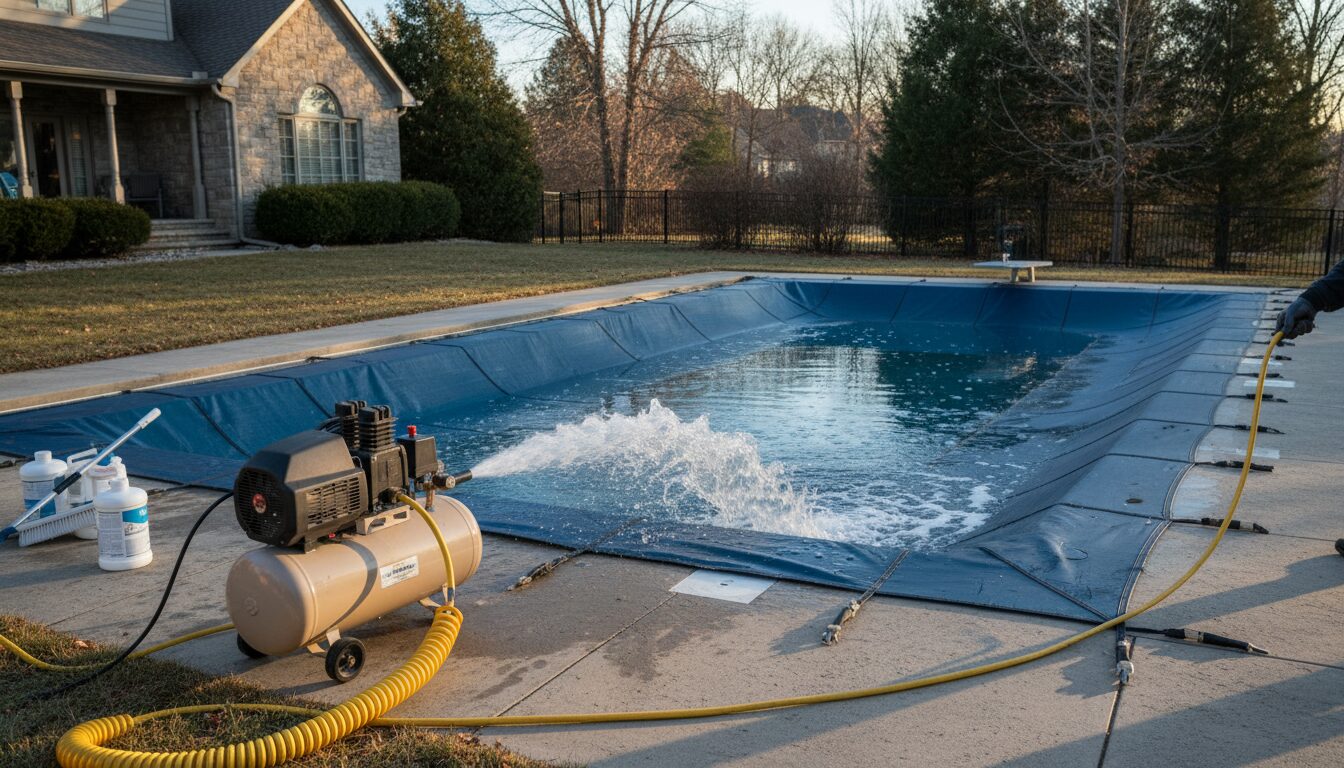
- Line blow-out: A gas-powered or industrial electric compressor forces air through every plumbing line until water is fully cleared. A shop-vac does not cut it for inground pools – the line needs enough CFM and PSI to push water through long pipe runs.
- Equipment draining: The pump, filter, heater, chlorinator, and any other inline equipment gets drained so standing water can’t freeze inside housings or heat exchangers.
- Chemical treatment: A closing dose of algaecide, non-chlorine or chlorine shock, and often a slow-dissolve floater go in before the cover does. Some companies include the chemicals; others charge $30 to $75 extra.
- Return plugs and skimmer plates: Threaded plugs in every return fitting and a Gizzmo or similar skimmer plug protect the skimmer body from ice expansion. These small parts matter.
- Cover installation: If you have a safety cover, the pro anchors it. If you have a tarp-style cover, they’ll place it and weight or secure the edges. Cover cleaning before install is usually not included.
- Water level adjustment: Inground pools in freeze climates are typically dropped 4 to 6 inches below the skimmer; above-ground pools are handled differently depending on liner type.
Antifreeze is a separate line item in many quotes. For inground pools with long pipe runs or complex plumbing (heater bypass lines, slide lines, water feature returns), you might need 1 to 3 gallons of pool-grade propylene glycol antifreeze, which runs $15 to $25 per gallon before labor to apply it.
What Drives the Price Up Beyond the Base Rate
Several add-ons and complications push winterization quotes above the typical range. Knowing them upfront prevents sticker shock:
- Pool size: A 30,000-gallon inground pool takes longer to treat chemically and has more plumbing to blow out than a 12,000-gallon pool. Expect a $50 to $150 upcharge for large pools.
- Water features and slides: Each additional water feature (deck jets, bubblers, waterfalls, slides) adds dedicated plumbing lines that need their own blow-out sequence. Some contractors charge $25 to $75 per additional feature.
- Spa or hot tub attached to the pool: A spillover spa doubles the plumbing complexity. Add $75 to $150 for a shared-equipment pool-spa system.
- Heater still plumbed in: Gas and heat pump heaters require careful draining and sometimes antifreeze in the heat exchanger. This adds time and occasionally a small parts charge.
- Safety cover vs. tarp cover: Installing a safety cover with anchors takes longer than laying a tarp. If you don’t yet have a properly fitting cover, that’s a separate expense entirely.
- Travel and minimum service fees: Companies in rural areas or suburban markets with high drive times sometimes charge a $25 to $50 travel fee on top of the base service.
For a more detailed breakdown of what full-service pool closing looks like against a DIY approach, this pool closing cost comparison from Blue Pool Water and the Pool Cost Estimator winterization guide both give useful context on what you’re paying for at each price tier. If you want to run your specific numbers, Larry’s Pool winterization cost calculator is a handy tool for sanity-checking a quote before you commit.
A Worked Example: 20,000-Gallon Inground Pool in Ohio
Say you have a 20,000-gallon inground pool in a Columbus suburb with a gas heater, one spillover spa, and a safety cover. Here’s how a realistic quote might build:
- Base winterization (blow-out, plugs, equipment drain): $275
- Attached spa upcharge: $100
- Heater drain and antifreeze (1 gallon): $40
- Closing chemicals (algaecide, shock, floater): $55
- Safety cover installation: included
- Total: approximately $470
That same pool in a suburb of Atlanta – where freeze risk is low and the spa upcharge might be $50 instead of $100 – might come in around $300 to $350. Same pool, same size, roughly $150 apart just from geography and local demand. Using AquaDoc’s pool winterizing chemical kit (which covers the algaecide, shock, and floater in one package) is one way some homeowners reduce the chemical line item when their pro charges separately for supplies – bring your own and confirm your contractor is fine with it first.
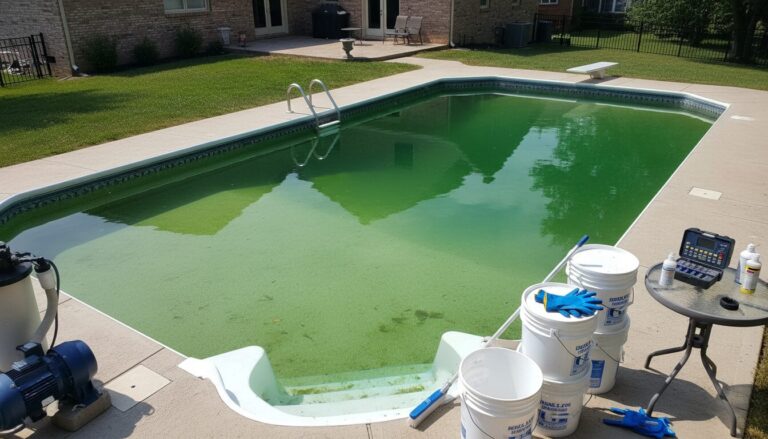
One thing worth doing before the cover goes on: make sure it’s actually clean enough to be worth putting down. A filthy cover traps organic matter against the water all winter, which makes spring opening harder. The real cost of a dirty winter cover is something most pool owners underestimate until they pull it off in April. For above-ground pool owners, the above-ground pool winter maintenance cost guide from Clearwater Pools is a solid resource for what to budget beyond just the closing service itself.
Frequently Asked Questions
How much does it cost to have a pool professionally winterized?
Most homeowners pay between $150 and $600 for a full professional winterization, including blowing out lines, adding chemicals, and installing a winter cover. The exact price depends on your region, pool size, and what’s included in the service. The national average for a standard inground pool is roughly $250 to $350.
What does a pool blow-out cost in the Northeast?
In the Northeast (New England, New York, New Jersey, Pennsylvania), expect to pay $250 to $500 for a full blow-out and winterization on a standard inground pool. Harsh winters mean contractors here are thorough, which adds to labor time and total cost. Pools with attached spas or water features push toward or past the $500 mark.
Is it cheaper to winterize an above-ground pool than an inground pool?
Yes, above-ground pool winterization typically runs $100 to $300, compared to $200 to $600 for inground pools. Above-ground systems have simpler plumbing, fewer return lines, and generally require less compressed-air work, all of which cuts labor time significantly.
What does pool winterization include for the price?
A standard professional winterization usually includes blowing out all plumbing lines with a compressor, adding winterizing chemicals (algaecide, shock, and often a slow-dissolve floater), plugging returns and skimmers, draining equipment, and installing or checking a winter cover. Antifreeze and chemical supplies are sometimes bundled, sometimes billed separately at $30 to $75 extra.
Do pool closing costs differ by pool size?
Yes, pool size directly affects both labor time and chemical volume. A small 10,000-gallon pool might cost $175 to $250 to close professionally, while a large 30,000-gallon inground pool can run $400 to $600 or more, especially in cold-climate regions where thoroughness matters most.
Professional pool winterization costs $150 to $600 for most residential pools, with your region, pool complexity, and what’s bundled into the quote accounting for most of that spread. In cold climates, paying for thoroughness is always cheaper than paying for burst pipe repairs in the spring.