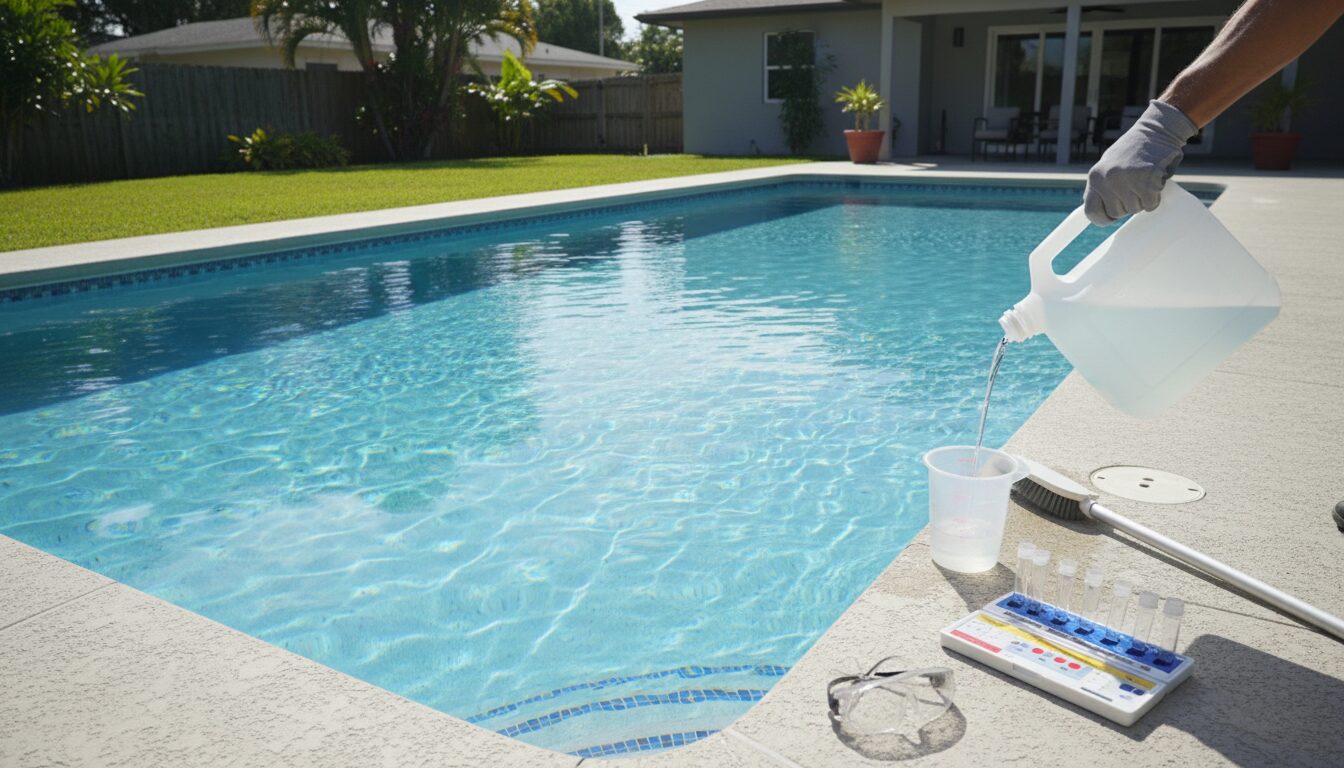

You test the water, the pH reads 7.9, and you know it needs to come down – but you’re staring at a painted concrete pool and wondering whether the same muriatic acid dose that works for a plaster pool is going to peel your finish right off the walls. It’s a fair concern, and a lot of generic dosing charts don’t even mention surface type.
The short answer: for a 20,000-gallon painted concrete pool, you’ll use roughly 1 quart (32 oz) of 31.45% muriatic acid to drop pH by about 0.3 units, or about 26 oz to lower total alkalinity by 10 ppm. The doses are similar to other concrete pools, but the application method matters more here because concentrated acid sitting on painted surfaces can blister or lift the finish. This article walks through the exact doses by starting pH and alkalinity level, how to add acid safely to a painted surface, and the common mistakes that cost people a repaint.
Why Painted Concrete Needs a Slightly Different Approach
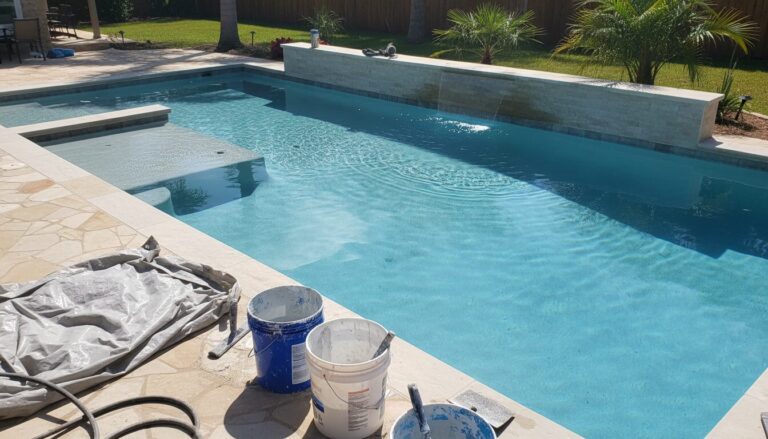
Painted concrete pools – typically coated with epoxy, rubber-based, or acrylic pool paint – have a layer of finish sitting on top of porous concrete. That paint layer is chemically inert once cured, but it has a real vulnerability: concentrated acid pooling against it. With bare plaster or pebble surfaces, a direct pour of muriatic acid stings the finish but doesn’t lift it. With paint, a puddle of undiluted acid can soften the binder, creating bubbles or peeling patches that turn a chemistry correction into a $1,500 repaint job.
The other thing painted pools do is absorb and release acid slightly faster than dense plaster. Because the underlying concrete is often older and more porous in painted pools (many painted pools were replastered or converted decades ago), pH can rebound a bit after treatment. Plan to retest 4 to 6 hours after any acid addition, not 1 to 2 hours. As a reference point, muriatic acid chemistry for pools follows the same principles regardless of surface, but surface type changes how and where you add it.
Muriatic Acid Dose Chart for a 20,000-Gallon Pool
The numbers below assume 31.45% full-strength muriatic acid (the standard jug you buy at a pool supply store or hardware store). If you’re using a diluted version (20% strength is sometimes sold as “safer” acid), multiply these amounts by about 1.6.
| Current pH | Target pH | pH Drop | Muriatic Acid Needed (31.45%) |
|---|---|---|---|
| 7.8 | 7.6 | 0.2 | ~22 oz (about 2.75 cups) |
| 7.8 | 7.4 | 0.4 | ~44 oz (about 5.5 cups) |
| 8.0 | 7.6 | 0.4 | ~50 oz (about 6 cups) |
| 8.2 | 7.6 | 0.6 | ~75 oz (about 9.5 cups) |
These figures align closely with published muriatic acid dose charts for pools and assume average alkalinity around 100 ppm. Higher alkalinity buffers the pH and means you’ll need more acid for the same pH drop – which is why alkalinity and pH are always addressed together.
Why These Numbers Vary by Starting Alkalinity
Total alkalinity acts as a buffer for pH. A pool sitting at 150 ppm alkalinity and pH 7.9 will resist acid treatment harder than one at 80 ppm alkalinity and pH 7.9. In practical terms, if your alkalinity is above 120 ppm, add 15 to 20% more acid than the chart above suggests, then retest. If alkalinity is already below 80 ppm, work slowly – small doses of 10 to 15 oz at a time – because pH can drop fast and overshoot 7.2, which risks etching the concrete under the paint at thin spots.
Worked Example: pH 8.0 in a 20,000-Gallon Painted Pool
Say your 20,000-gallon painted concrete pool reads pH 8.0 and total alkalinity at 110 ppm. Your target is pH 7.5 and alkalinity 90 ppm. Here’s how to work through it:
- Calculate the pH correction first. A 0.5 pH drop from 8.0 to 7.5 in 20,000 gallons requires roughly 60 oz of 31.45% muriatic acid.
- Factor in the alkalinity drop. Dropping alkalinity from 110 to 90 ppm (20 ppm reduction) in 20,000 gallons takes about 52 oz of acid. However, these corrections overlap – acid added for pH also pulls alkalinity down. You do not add both amounts separately.
- Start with the pH target amount. Add 60 oz, diluted in a 5-gallon bucket of pool water, poured slowly into the deep end with the pump running.
- Wait and retest. After 4 to 6 hours, test both pH and alkalinity. If alkalinity is still above 90 ppm, add a second small dose of 15 to 20 oz at that point.
- Confirm before closing the loop. Once pH is between 7.4 and 7.6 and alkalinity is between 80 and 120 ppm, you’re done. For guidance on how pool volume itself shapes every chemical decision, see how pool gallons drive chemical dosing across different pool sizes.
How to Add Muriatic Acid to a Painted Concrete Pool Safely
The method matters as much as the amount. Follow these steps every time, not just the first time.
- Pre-dilute the acid. Pour the measured amount of acid into a 5-gallon bucket half-filled with pool water first (acid into water, never the reverse). This drops the concentration before it ever touches your pool surface.
- Pour into the deep end while walking. With the pump running, walk along the edge of the deep end and pour in a slow, sweeping arc. Never dump it all in one spot – that’s the fastest way to blister painted floors.
- Run the pump for at least 4 hours. Painted concrete benefits from longer circulation to fully mix the acid before you retest.
- Never add acid near steps or shallow areas. Paint in shallow zones is usually older and thinner because UV and foot traffic degrade it first. Avoid pouring near painted steps or benches.
- Wear acid-rated gloves and eye protection. Muriatic acid produces fumes even at pool-use concentrations. Work upwind, and if you’re working on a still day, consider a respirator.
For a deeper look at how muriatic acid interacts with different pool chemistry parameters, this breakdown of muriatic acid for pools covers what’s happening chemically when you add it.
When You Need to Lower Alkalinity Specifically
Sometimes pH is fine but alkalinity is running high – say 140 to 160 ppm – and you need to bring it down without tanking the pH. This requires a specific technique: add acid with the pump OFF, let it sit in the deep end for 30 to 60 minutes to react with the water column directly, then brush the floor gently and turn the pump on to mix. This method targets alkalinity more aggressively than pH. For a 20,000-gallon pool, dropping alkalinity from 150 to 100 ppm (50 ppm reduction) takes approximately 130 oz of 31.45% acid added in two or three separate doses over 24 to 48 hours. Lowering pool alkalinity with muriatic acid follows a specific aeration and dose cycle that prevents pH from overcorrecting downward.
AquaDoc’s pH Down is a muriatic acid-based product that some pool owners use when they want a pre-measured, labeled dose format rather than pouring directly from a hardware store jug – useful if you’re not comfortable estimating ounces from a large container.
Common Mistakes With Painted Concrete Pools
- Pouring undiluted acid directly on the floor. Even a short contact time before circulation reaches it can leave a bleached or lifted patch on epoxy and rubber paint.
- Retesting too soon. Testing after 1 hour and thinking the dose didn’t work leads to over-dosing. Painted concrete pools need 4 to 6 hours for the water to fully equalize.
- Ignoring alkalinity before correcting pH. If alkalinity is above 130 ppm, any pH correction you make will bounce back within a day or two. Fix alkalinity first, pH follows.
- Using acid when the pool paint is already failing. If the surface is already flaking or bubbling in spots, acid – even properly diluted – accelerates that damage. Spot-prime and repaint before doing major chemistry corrections.
- Not accounting for weather. Hot sun and high evaporation can concentrate chemicals between treatments. Check pH every 3 to 4 days in summer, not once a week.
Frequently Asked Questions
How much muriatic acid do I add to a 20,000-gallon pool to lower pH by 0.3?
For a 20,000-gallon pool starting around pH 7.8, add approximately 1 quart (32 oz) of 31.45% muriatic acid to drop pH by about 0.3 units. Always pre-dilute in a bucket of pool water before adding, and retest after 4 to 6 hours rather than 1 to 2 hours, especially with a painted surface that can cause slight rebound.
How much muriatic acid lowers alkalinity by 10 ppm in a 20,000-gallon pool?
Dropping total alkalinity by 10 ppm in a 20,000-gallon pool takes roughly 26 oz (about 3 cups) of 31.45% muriatic acid. Add it with the pump off, let it sit in the deep end for 30 to 60 minutes, then run the pump and retest before deciding whether a second dose is needed.
Will muriatic acid damage a painted concrete pool?
It can if applied incorrectly. Undiluted acid poured in a single spot on a painted surface can blister or lift the coating. Pre-dilute every dose in a 5-gallon bucket, pour slowly in a moving arc over the deep end, and keep the pump running. Properly diluted and distributed acid will not harm intact pool paint.
What pH should a painted concrete pool run at?
Keep a painted concrete pool between 7.4 and 7.6 pH. Above 7.8, scale formation accelerates and can bond to paint, trapping algae underneath. Below 7.2, you risk etching the concrete substrate in any area where paint has thinned from UV exposure or foot traffic, which usually means the shallow end and steps first.
Can I add muriatic acid and shock at the same time to a 20,000-gallon pool?
No. Always adjust pH with muriatic acid first, run the pump for at least 4 hours, confirm pH is between 7.2 and 7.6, and then add shock. Adding acid and chlorine shock together – or within an hour of each other – can produce chlorine gas fumes and also destroys the shock’s sanitizing effectiveness before it has a chance to work.
For a 20,000-gallon painted concrete pool, the right muriatic acid dose runs between 22 oz and 75 oz depending on how far your pH needs to drop, with alkalinity correction requiring its own separate calculation. Get the application method right – pre-dilute, pour moving, run the pump long – and you’ll correct your chemistry without touching your finish.