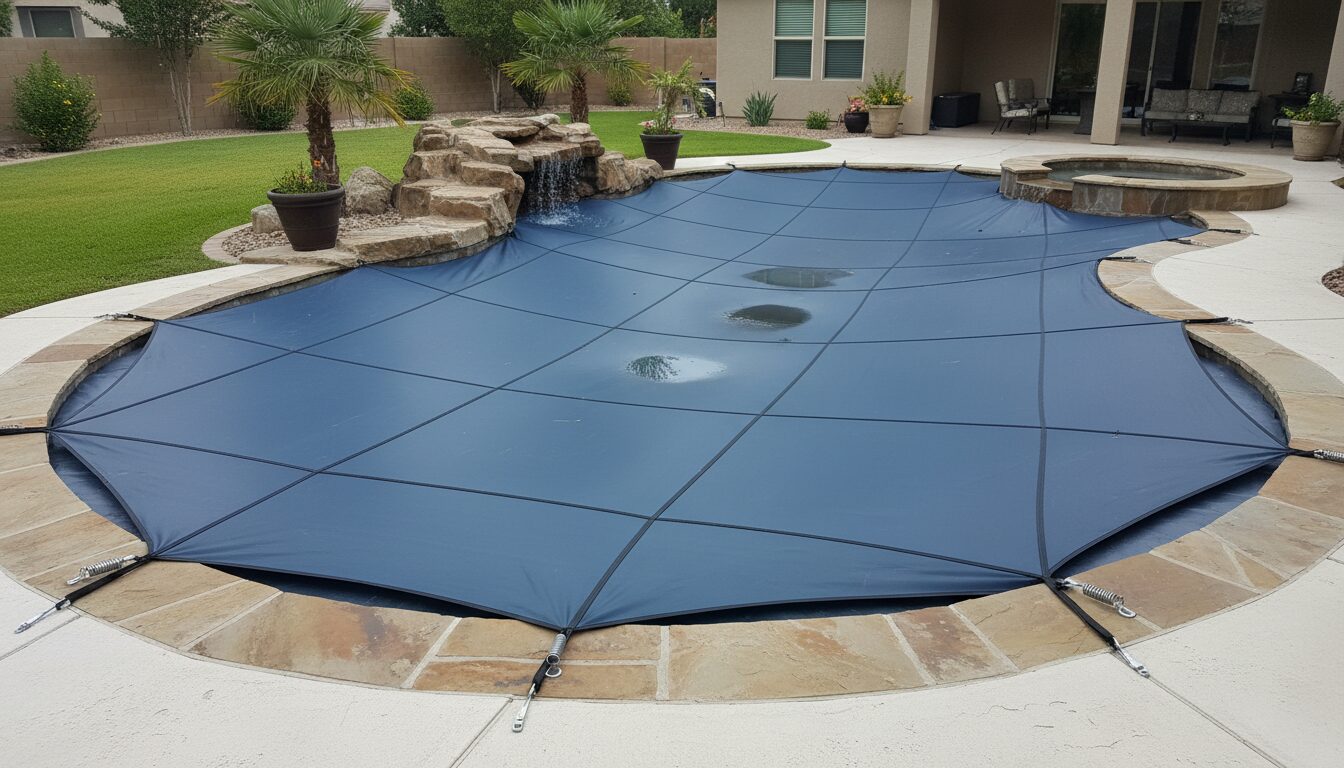

If you’ve got a kidney-shaped or freeform inground pool and you’re trying to price out a safety cover, you’ve probably already discovered that most of the numbers online assume a nice, rectangular pool. That’s a frustrating place to start when your pool looks more like an amoeba than a rectangle.
A custom safety cover for an irregularly shaped inground pool typically costs between $1,800 and $6,500 installed, with most freeform pool owners landing somewhere in the $2,500 to $4,000 range. The shape itself adds cost because the cover must be fabricated to a physical template of your pool’s exact outline, but the bigger price drivers are cover material, pool size, and how many anchors the deck requires. This article walks through all of those factors with real numbers, covers the difference between mesh and solid options, and explains what questions to ask before you sign a quote.
Why Irregular Pools Cost More to Cover
A rectangular pool cover is cut from a standard pattern and adjusted to length. A freeform cover cannot be cut that way. The manufacturer needs an exact outline of your pool, which means someone has to come out and create a template, either by tracing the pool’s edge on a large paper or fabric sheet, or by using a digital measuring system that records GPS coordinates of the perimeter. That templating service typically costs $75 to $200 and is sometimes included in the installation quote, sometimes billed separately.
Once the template is complete, the cover is custom fabricated to match. Because the perimeter of a freeform pool is longer than a rectangular pool of the same surface area, you get more material, more binding, and more anchors. Those anchors must be drilled into the surrounding deck at 3 to 4 foot intervals around the entire perimeter, and curves require closer spacing than straight runs. The result is a higher anchor count, which adds both hardware cost and labor time.
According to installer cost data from Longhorn Pools, safety covers across all pool types range from $1,200 to $25,000, with custom freeform pools sitting well above the low end of that range. The process of covering a freeform or kidney-shaped pool specifically requires this template-first approach, which is worth confirming with any company you quote.
Mesh vs Solid Safety Covers: Which Makes More Sense for an Irregular Pool?
Both mesh and solid safety covers can be fabricated for irregular shapes, but they behave differently and cost differently. Here is how they compare:
| Feature | Mesh Safety Cover | Solid Safety Cover |
|---|---|---|
| Typical material cost (custom, irregular) | $900 to $2,200 | $1,400 to $3,500 |
| Installed total (with anchors and labor) | $1,800 to $3,500 | $2,800 to $6,500 |
| Water management | Rain drains through | Requires drain panel or pump |
| Light and algae risk | Some UV passes through | Blocks light, reduces spring algae |
| Typical lifespan | 10 to 15 years | 7 to 12 years |
| Weight when wet | Light | Heavy without active drainage |
Why These Differences Matter for Freeform Pools
On an irregularly shaped pool, a solid cover with a poor drainage setup becomes a real problem because water pools in the low spots created by the cover’s curves. If your pool has a lazy-L shape or deep concave curves, a solid cover without a properly placed center drain panel will hold hundreds of gallons of rainwater over winter, adding stress to the anchor system and the cover material itself. A mesh cover sidesteps that problem entirely, which is why many freeform pool owners choose mesh even though it means more algae work in spring. For a deeper look at what ends up on a winter cover by spring, the honest breakdown of winter cover buildup is worth reading before you decide.
Real Cost Example: A 600 Square Foot Kidney-Shaped Pool
Say your kidney-shaped pool has a surface area of about 600 square feet, which is roughly equivalent to a 20×30 rectangular pool but with a concave side and rounded ends. Here is how the numbers typically break down for a mesh safety cover in this scenario:
- Templating visit: $100 to $175
- Custom mesh cover fabrication: $1,200 to $1,800
- Anchor hardware (approximately 40 to 50 anchors): $200 to $350
- Drilling and installation labor: $300 to $500
- Total installed: roughly $1,800 to $2,825
Upgrade to a solid cover with a drain panel on that same pool and the fabrication cost alone jumps to $1,800 to $2,600, pushing the all-in total to $2,600 to $3,800. Add a pool with more complex geometry (a lagoon shape with multiple curves, integrated steps, or a raised spa spillway) and you can reach $5,000 to $6,500 without unusual circumstances. Florida-specific installer pricing shows similar patterns, with labor costs slightly lower than the national average but material costs essentially unchanged because the covers are fabricated regionally regardless of where they are installed.
What Raises the Price Beyond the Basic Quote
Several factors push irregular pool cover costs toward the high end of the range, and knowing them before you call for quotes means you can give more accurate information and get more accurate estimates back.
- Integrated steps or tanning ledges: Steps that protrude into the pool’s outline require relief cuts or step panels in the cover, each adding $150 to $400 depending on the step configuration. If you’re curious how those costs compare on a rectangular pool with the same challenge, the safety cover installation cost breakdown for a 16×32 pool with irregular steps gives a useful baseline.
- Raised spa or water feature: A raised beam or attached spa changes the cover’s anchor layout significantly, sometimes requiring a separate cover panel for the spa section, which adds $300 to $700.
- Concrete vs paver deck: Drilling into pavers costs more and takes longer than concrete. Budget an extra $75 to $150 for paver deck installation.
- Pool perimeter over 120 linear feet: More perimeter means more anchors. At roughly $6 to $9 per anchor installed, an extra 20 feet of perimeter adds $30 to $60 in anchors alone, plus proportional labor.
- Geographic location: Labor rates vary significantly. Expect to pay 20 to 30 percent more in the Northeast and West Coast compared to the Midwest or Southeast.
Sizing and Installation Tips for Irregular Pool Covers
A safety cover must overlap the deck by at least 2 feet on all sides to meet ASTM safety standards, and most manufacturers build in 3 feet to allow for proper anchor placement. On a freeform pool, this means the cover’s footprint on the deck is significantly larger than the pool itself, which matters if you have landscaping, equipment, or a narrow deck section close to the water’s edge.
Before the installer comes out, walk your deck and identify any obstacles within 3 feet of the pool edge: light fixtures, returns above the waterline, handrails, or drains. These can interfere with anchor placement and will need to be accounted for in the template. Some cover manufacturers offer specialty cover options for irregular shaped pools that include hybrid anchor systems for tight deck situations.
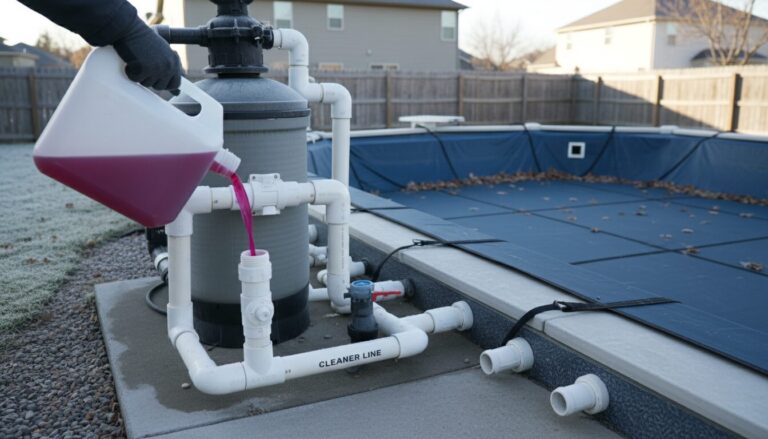
Water chemistry also matters before you put on any winter cover. A cover going over unbalanced water accelerates liner staining and corrosion at the waterline. Products like AquaDoc’s pool closing kit are something pool owners use specifically to get pH, alkalinity, and sanitizer dialed in before the cover goes on, which protects both the pool surface and the cover material from chemical degradation over winter.
For getting quotes, contact at least three installers and ask each one whether they do their own templating or outsource it, how they handle anchor placement near obstacles, and what their warranty covers on the fabric versus the hardware. Fabric warranties from quality manufacturers typically run 12 to 15 years on mesh and 10 to 12 years on solid covers. Hardware (springs, straps, brass anchors) usually carries a 3 to 5 year warranty separately.
You can also find a clear overview of pool cover types, costs, and fit considerations if you want to compare safety covers against alternative options before committing to a quote.
Frequently Asked Questions
How much does a safety pool cover cost for an irregularly shaped inground pool?
A custom safety cover for an irregularly shaped inground pool typically runs $1,800 to $6,500 installed. Simple freeform pools with gentle curves land closer to $1,800 to $2,800, while complex kidney, lagoon, or L-shaped pools with raised features can push past $4,500. Mesh covers sit at the low end and solid covers with a drain panel cost more.
Can you put a safety cover on a kidney-shaped pool?
Yes, safety covers can be made for kidney-shaped pools, but they must be custom fabricated from a physical template or a digital survey of the pool’s exact outline. Standard rectangular covers will not fit. Expect to pay a $300 to $600 premium over a comparable rectangular pool cover because of the extra material and anchor layout work involved.
How much does it cost to install anchors for a custom safety cover?
Anchor drilling typically adds $150 to $400 to the total cost, depending on how many anchors the cover requires. An irregularly shaped pool often needs more anchor points than a rectangular one of the same square footage, because the perimeter is longer and curves require closer anchor spacing to hold the cover taut.
What size safety cover do I need for a freeform pool?
There is no standard size for a freeform pool cover. A cover company will either send a technician to trace the pool’s outline on a template kit or use a digital measurement system. The fabricated cover overlaps the deck by 2 to 3 feet on all sides, which is required for proper anchor placement and safety certification compliance.
How long does a custom safety pool cover last?
A quality mesh safety cover lasts 10 to 15 years with proper care. Solid covers with drain panels typically last 7 to 12 years. Either type will degrade faster if left on during the swim season, stored improperly, or subjected to standing water and debris. Cleaning the cover before storage and inspecting anchors each spring extends the lifespan significantly.
For an irregularly shaped inground pool, budget $1,800 to $6,500 for a properly installed custom safety cover, with most pools landing between $2,500 and $4,000. Get the template done right, get three quotes, and choose a cover material that matches how you plan to manage water and algae over winter.