
You blew out your lines, plugged the returns, and now you’re staring at a jug of pool antifreeze wondering how much actually goes where. The math is easy for a simple two-return pool, but throw in a dedicated cleaner line and a third return jet and suddenly the standard “one gallon total” advice starts to feel a little thin.
A pool with a separate cleaner line and three return jets typically needs 4 to 6 quarts (1 to 1.5 gallons) of propylene glycol pool antifreeze to protect every line from a hard freeze – roughly 1 quart per return jet and 1 quart for the cleaner line, plus a small buffer for shared header pipe. The rest of this post walks through the volume math for each line type, how pipe diameter changes the numbers, the order in which you add antifreeze, and the mistakes that leave you with a cracked fitting in March.
Why a Cleaner Line Changes the Equation
Most winterizing guides treat the pool as suction lines plus return lines and stop there. A dedicated cleaner line – usually a 1.5-inch line running from its own port on the pool wall to a valve on the equipment pad – is a separate pipe run that holds its own volume of water. That line does not share a return header with your jets, so antifreeze poured into the skimmer or pushed through the return ports never touches it. If you skip it, even a single hard freeze night can split the wall fitting or crack the pipe at a low point underground.
How to Calculate the Antifreeze You Actually Need
The volume of any pipe run is straightforward geometry: pipe cross-section area times length. You do not need a calculator for this – the table below gives you ready-to-use numbers for the two pipe sizes found in almost every residential inground pool.
| Line Type | Pipe Diameter | Line Length (ft) | Water Volume | Antifreeze Needed |
|---|---|---|---|---|
| Return jet (each) | 1.5 inch | 15 | ~0.6 qt | 1 qt |
| Return jet (each) | 1.5 inch | 25 | ~1.0 qt | 1 qt |
| Return jet (each) | 2 inch | 25 | ~1.7 qt | 2 qt |
| Cleaner line | 1.5 inch | 20 | ~0.8 qt | 1 qt |
| Cleaner line | 1.5 inch | 35 | ~1.4 qt | 1.5 qt |
| Shared return header | 2 inch | 10 | ~0.7 qt | 1 qt |
Why These Numbers Matter for Your Decision
Notice that the antifreeze amounts are always rounded up past the actual water volume. That is intentional. Pool antifreeze protects by displacing residual water, not by filling bone-dry pipe. Even after a good compressor blow-out, low points and wall fittings trap moisture, so you want enough antifreeze to push through the full run and pool a bit at the plug. Rounding up by one-third is the right margin. Going over by an extra quart does not hurt the pool; going under by a quart can cost you a fitting repair in spring.
Worked Example: 18,000-Gallon Pool, Three Returns, One Cleaner Port
Say you have a typical 18,000-gallon inground pool with 1.5-inch return lines, each running about 20 feet from the equipment pad to the pool wall. You have three return jets and one dedicated cleaner port, also on 1.5-inch pipe at roughly 25 feet. Here is how the math stacks up:
- Return 1 (20 ft, 1.5 in): 0.8 qt actual volume – pour 1 qt.
- Return 2 (20 ft, 1.5 in): 0.8 qt actual volume – pour 1 qt.
- Return 3 (20 ft, 1.5 in): 0.8 qt actual volume – pour 1 qt.
- Cleaner line (25 ft, 1.5 in): 1.0 qt actual volume – pour 1.5 qt to account for fittings and any slight low-point sag in the run.
- Shared return header (short 2-in run at the pad): 1 qt.
Total: 5.5 quarts, so buy two gallons (8 quarts) and you will have a comfortable buffer. Most pool antifreeze is sold in 1-gallon jugs, and two gallons covers this configuration with enough left over to re-dose a fitting if you have to pull and replace a plug in spring.
The Right Order for Adding Antifreeze
Sequence matters here. Getting the order wrong either wastes antifreeze or leaves a line exposed. Follow these steps after the compressor blow-out is complete and every line port is accessible at the equipment pad:
- Blow out each line completely with a shop compressor or a Cyclone blower before touching the antifreeze. Antifreeze that has to push through a standing column of water loses its effectiveness at the far end of the run.
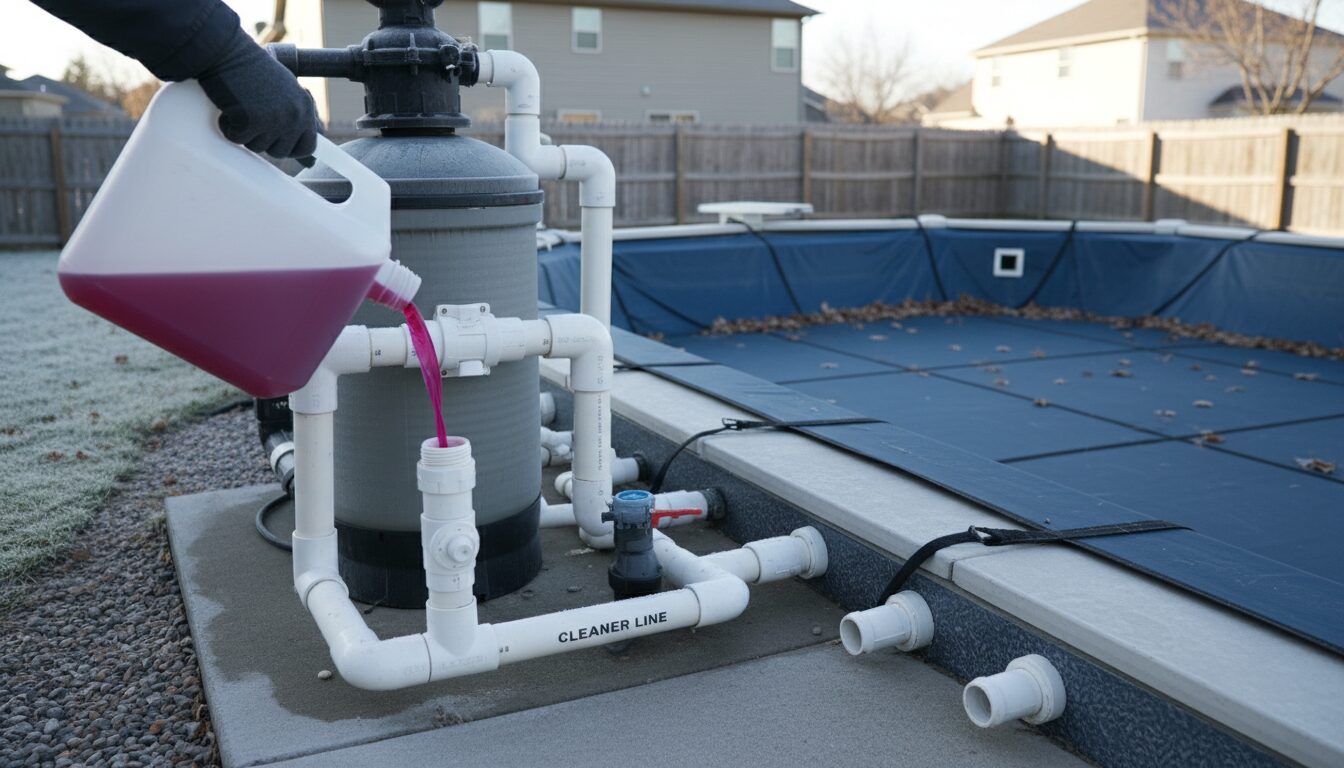
- Start with the cleaner line. Close or cap the cleaner valve at the pad, pour 1 to 1.5 quarts of propylene glycol antifreeze into the open port, then plug the cleaner fitting at the pool wall. The antifreeze sits in the line and protects the wall fitting, which is the part most exposed to frost heave.
- Move to each return line individually. Do not open all three return valves at once. Work one at a time: pour 1 quart into the return port at the pad while the valve to the other two returns is closed, then plug that wall fitting before moving to the next return.
- Protect the return header last. If your setup has a short 2-inch manifold header shared by all three returns between the pad and the individual branch valves, pour antifreeze into the header access point (often the drain plug on the manifold) after plugging the individual returns.
- Plug every port at the pool wall first, then at the pad. The antifreeze needs somewhere to stop; if you forget to plug the wall fitting before pouring, the antifreeze drains straight into the pool.
Common Mistakes That Lead to Spring Repair Bills
A few patterns show up again and again when homeowners call a pool tech in March with a cracked fitting:
- Treating the cleaner line as optional: Because the cleaner port is sometimes on the suction side of the system, some owners assume blowing out the skimmer line covers it. It does not. The cleaner port is an independent stub-out, and it needs antifreeze just like every return.
- Using automotive antifreeze: Ethylene glycol, the kind sold for cars and trucks, is toxic and will contaminate pool water. Only propylene glycol labeled as pool-safe or potable-water-safe belongs in pool plumbing. AquaDoc’s pool antifreeze, used by service techs for this exact reason, is a propylene glycol concentrate rated to -50 degrees Fahrenheit.
- Skipping the compressor step and relying only on antifreeze: Pool antifreeze is not a substitute for blowing out the lines – it is a second layer of protection for what the compressor leaves behind. If you pour antifreeze into a line that still holds several quarts of standing water, you dilute it to the point where it may not protect below 20 degrees Fahrenheit.
- Under-estimating line length: If you do not know your actual line lengths, measure from the pool wall port to the nearest valve at the pad along the pipe run, not as the crow flies. Underground runs almost always curve, and a 15-foot straight-line measurement can be a 22-foot pipe run.
If you are closing a pool that has had any recent work done underground – say, a replaster that included drain replacement – it is worth double-checking that all new pipe connections are fully blown out before adding antifreeze. Projects like a 12×24 inground pool replaster with main drain and two skimmers often add or reposition pipe runs that change your effective line lengths.
What If Your Third Return Is a Spa or Floor Return?
Some pools route one of the three returns to an attached spa spillover or to a floor return fitting in the deep end. Both of those configurations add pipe volume beyond a standard wall jet. A floor return on 2-inch pipe running 30 feet from the pad holds roughly 2.0 quarts of water, so budget 2 to 2.5 quarts of antifreeze for that line alone. The process is the same – blow it out, pour antifreeze in at the pad, plug the fitting – but do not shortchange it just because it is on the floor of the pool where you cannot easily see frost damage from the deck. Cracked floor fittings are expensive to access and repair.
Frequently Asked Questions
How much antifreeze does a pool with three return jets need?
A pool with three return jets typically needs 1 to 3 quarts of propylene glycol antifreeze total for the return lines, assuming standard 1.5-inch pipe and line runs of 15 to 25 feet each. Each return line holds roughly 0.6 to 1.0 quarts at that diameter, so three lines add up to 2 to 3 quarts before accounting for any shared header pipe. Always round up to ensure the antifreeze reaches and pools at the wall plug.
Does a pool cleaner line need antifreeze if it’s already been blown out?
Yes, even after a thorough blow-out, a separate cleaner line should receive at least 1 quart of pool-grade propylene glycol antifreeze. Residual water trapped at low points or inside the wall fitting will freeze and can crack the pipe or fitting, and a quart of antifreeze provides reliable protection down to roughly -50 degrees Fahrenheit.
What type of antifreeze is safe for pool plumbing?
Only propylene glycol-based antifreeze rated for potable water or pool use is safe for pool plumbing. Never use ethylene glycol automotive antifreeze – it is toxic and will contaminate pool water. Most pool antifreeze is sold as a concentrate that protects to -50 degrees Fahrenheit when used at full strength without dilution.
How much antifreeze for a pool with a heater and cleaner line?
If your pool also has a heater in-line, add another 1 to 2 quarts to cover the heater bypass or heat exchanger passages not fully drained by blowing out. The post on pool liner and plumbing issues after winter touches on what freeze damage to internal fittings looks like when antifreeze amounts fall short.
Can I pour antifreeze directly into the skimmer instead of each line?
Pouring antifreeze into the skimmer only protects the skimmer throat and the suction line running back to the pump – it does not travel through the equipment pad and into your return lines or cleaner line. You must introduce antifreeze at each individual port, ideally after blowing out each line with a compressor, to ensure full coverage across every run.
A pool with a cleaner line and three returns is not dramatically harder to winterize than a simpler setup – it just has more lines to account for. Buy two gallons of propylene glycol pool antifreeze, work through each line one at a time in the order above, and every fitting will be protected when the ground freezes.