
You’ve blown out the lines, the equipment pad is quiet, and now you’re standing in the pool supply aisle squinting at jugs of antifreeze, trying to figure out whether you need two gallons or six. It’s a surprisingly frustrating moment for something that should have a clear answer.
A pool with a main drain, two skimmers, and four returns typically needs 3 to 4 gallons of propylene glycol pool antifreeze, assuming standard 1.5-inch plumbing and equipment runs of 20 to 50 feet. The exact number depends on pipe diameter and line length, not pool size. This article walks you through the math line by line so you buy the right amount on the first trip.
Why Pool Size Doesn’t Drive the Antifreeze Number
This is the mistake most people make: they assume a bigger pool needs more antifreeze. It doesn’t. Antifreeze goes into the plumbing lines, not the pool itself. What matters is how much water volume is sitting inside each pipe run between the pool fittings and the equipment pad. A 40,000-gallon pool with short pipe runs may need less antifreeze than a 15,000-gallon pool where the equipment pad is 60 feet away from the skimmers.
The relevant variables are pipe diameter (usually 1.5-inch or 2-inch for residential pools) and linear run length. A 1.5-inch pipe holds about 0.092 gallons per linear foot. A 2-inch pipe holds about 0.163 gallons per linear foot. Once you know those two things for each line, the rest is arithmetic.
Line-by-Line Antifreeze Breakdown
Main Drain Line
The main drain line runs from the deepest point of the pool up to the equipment pad. On most residential pools, this is a single 1.5-inch or 2-inch run. If you’ve already blown this line out completely with a compressor, very little water remains, but a small amount of standing water can settle back toward the low point of the pipe. Pour 1 quart of propylene glycol antifreeze into the main drain port after blowing, then cap it. If your run is longer than 50 feet or uses 2-inch pipe, use 2 quarts.
Two Skimmer Lines
Skimmer lines are where antifreeze earns its keep. Even after a good blow-out, skimmer throats and the horizontal pipe segment near the pool wall can hold residual water. The standard approach: pour antifreeze directly into each skimmer basket well, where it will settle into the throat and the line below. Use 1 quart per skimmer for runs up to 30 feet of 1.5-inch pipe. Two skimmers means 2 quarts minimum. If your skimmer lines run more than 30 feet or are plumbed in 2-inch pipe, plan on 1.5 quarts per skimmer, so 3 quarts total for both. For a detailed look at the full closing process, Accurate Pool and Landscape’s inground pool closing guide covers the sequence of steps from water level to plugging.
Four Return Lines
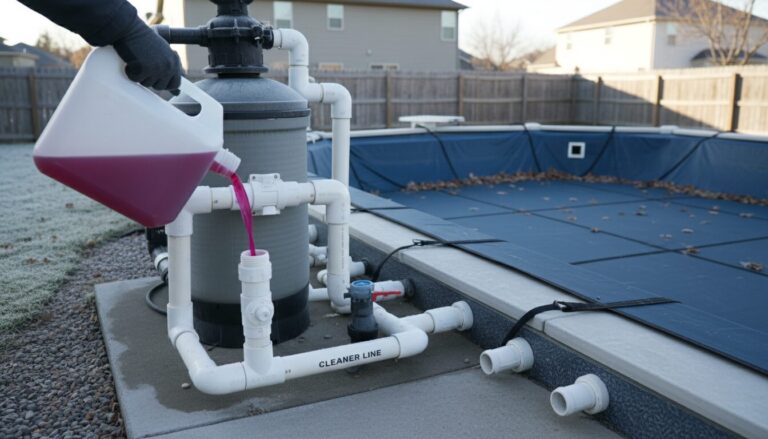
Return lines run from the equipment pad back to the pool wall fittings. Four returns is a common configuration for pools in the 15,000 to 25,000-gallon range, and each one needs its own protection. The antifreeze for returns is typically added at the equipment pad side (pumped or poured in before plugging the return fittings from inside the pool). Budget 1 quart per return line for runs up to 40 feet of 1.5-inch pipe. Four returns means 4 quarts, or exactly 1 gallon, for this portion of the plumbing. Returns longer than 50 feet or plumbed in 2-inch pipe get 1.5 quarts each.
Worked Example: A Typical 20,000-Gallon Inground Pool
Say you have a 20,000-gallon rectangular pool. The equipment pad sits 35 feet from the pool edge. All plumbing is 1.5-inch pipe. Here’s how the antifreeze adds up:
- Main Drain Line (35-foot run, 1.5-inch pipe): 35 feet x 0.092 gallons per foot = 3.2 quarts of pipe volume. One quart of antifreeze displaces and mixes with that residual water adequately. Use 1 quart.
- Skimmer Line 1 (35-foot run): Same math. Use 1 quart.
- Skimmer Line 2 (35-foot run): Use 1 quart.
- Return Lines 1 through 4 (35 feet each): 1 quart per line x 4 lines = 4 quarts, or 1 gallon.
Total: 7 quarts, which rounds to just under 2 gallons. But most pros add a safety buffer of one extra quart per skimmer and one extra quart for the main drain given how common it is for blow-outs to leave small pockets of standing water. With the buffer, you land at about 3 gallons for this configuration. That matches the common rule of thumb you’ll see on The Pool and Lawn’s antifreeze volume guide, which recommends 1 to 3 gallons for most residential setups depending on line complexity.
Now scale up: if any of those runs were 60 feet and plumbed in 2-inch pipe, you’d recalculate at 0.163 gallons per foot. A 60-foot 2-inch run holds about 9.8 quarts of water. In that case, you’d want 2 to 2.5 quarts per line, and your total for the same pool could jump to 5 or 6 gallons. Longer lines change everything.
Comparison Table: Antifreeze by Line Type and Pipe Size
| Line Type | Pipe Diameter | Run Length | Antifreeze Needed |
|---|---|---|---|
| Main Drain | 1.5-inch | Up to 50 ft | 1 quart |
| Main Drain | 2-inch | Up to 50 ft | 2 quarts |
| Skimmer Line (each) | 1.5-inch | Up to 30 ft | 1 quart |
| Skimmer Line (each) | 1.5-inch | 30 to 60 ft | 1.5 quarts |
| Skimmer Line (each) | 2-inch | Up to 60 ft | 2 quarts |
| Return Line (each) | 1.5-inch | Up to 40 ft | 1 quart |
| Return Line (each) | 1.5-inch | 40 to 60 ft | 1.5 quarts |
| Return Line (each) | 2-inch | Up to 60 ft | 2 quarts |
Why These Numbers Matter for Your Purchase
The table above shows why a flat “buy two gallons” recommendation can go wrong in either direction. A compact pool with a 20-foot equipment pad distance and all 1.5-inch pipe might genuinely only need 1.5 to 2 gallons. A pool on a large lot where the equipment pad is 70 feet from the water edge, with upgraded 2-inch plumbing, could need 5 to 6 gallons for the same number of lines. Measure your runs before you shop, or walk off the approximate distance from your equipment pad to the pool edge so you have a realistic number.
Common Mistakes to Avoid
- Using automotive antifreeze: Ethylene glycol products are toxic to animals and plants and will contaminate your pool water. Only use propylene glycol antifreeze labeled specifically for pool and spa use.
- Skipping the main drain: Many owners blow out the main drain and assume they’re done. If the check valve or main drain fitting isn’t perfectly sealed, water can migrate back. A quart of antifreeze into the port takes 30 seconds and eliminates the risk.
- Forgetting the equipment pad side of the returns: The pipe segment between the pump and the pool wall freezes just as readily as the in-ground portion. Make sure antifreeze is introduced at the pad end, not just poured into the pool-side fitting.
- Pouring antifreeze before blowing the lines: Blow first, antifreeze second. Adding antifreeze to a line still full of water just dilutes it and reduces its freeze protection. The goal is to replace most of the standing water, not mix with it.
AquaDoc’s propylene glycol pool antifreeze is one option pool owners use for this step, formulated to work in lines down to negative 40 degrees Fahrenheit so it covers even the coldest closing season. Whatever brand you reach for, confirm the label says propylene glycol and check the freeze protection temperature on the jug before you buy.
What to Do If You’re Unsure About Your Line Lengths
If you genuinely don’t know how long your pipe runs are, use 1.5 quarts as the default per line on a standard residential pool. For a setup with a main drain, two skimmers, and four returns, that puts you at 10.5 quarts total, which is just under 3 gallons. Buy 3 gallons. If you have leftover antifreeze, it stores fine sealed for next season. Buying short and leaving a line unprotected is the mistake that costs real money in the spring when a cracked pipe needs replacing. And if your pool ever needs plumbing-level work after winter, the cost context in the 12×24 inground pool replaster cost breakdown gives you a realistic sense of what a damaged main drain repair fits into budget-wise.
Frequently Asked Questions
How much antifreeze does an inground pool need for winterizing?
Most inground pools with a main drain, two skimmers, and four returns need between 2 and 4 gallons of propylene glycol antifreeze total. The exact amount depends on pipe diameter and the distance from the equipment pad to each fitting, but 3 gallons covers the majority of standard residential setups with 1.5-inch plumbing and runs under 50 feet.
How many quarts of antifreeze go in each skimmer line?
Plan on 1 quart of antifreeze per skimmer line for runs up to about 30 feet of 1.5-inch pipe. If your skimmer lines are longer than 30 feet or use 2-inch pipe, use 1.5 to 2 quarts per line to make sure the full run is protected through a hard freeze.
Do you put antifreeze in the main drain line?
Yes. Even after blowing out the main drain, pour 1 quart of pool-grade propylene glycol antifreeze into the main drain port before plugging it. If the run exceeds 50 feet or uses 2-inch pipe, use 2 quarts. Never use automotive antifreeze, which contains ethylene glycol and is toxic to animals and plants.
How much antifreeze do four return lines need?
Four return lines at standard 1.5-inch diameter and 20 to 40 feet of run each typically need 1 quart per line, so 4 quarts total for all four returns. Add an extra half quart per line if any run exceeds 50 feet or if the pipe steps up to 2-inch diameter.
Can you use too much antifreeze in pool lines?
Excess antifreeze won’t crack your plumbing, but it will flush into the pool water in spring and raise the pH slightly, requiring extra balancing before you open. Staying close to the calculated amount, usually 3 to 4 gallons for a main drain, two skimmer, four return setup, keeps your spring startup cleaner and saves you money on product you didn’t need.
For a pool with a main drain, two skimmers, and four returns, buy 3 gallons if your plumbing is 1.5-inch and your equipment pad sits within 50 feet of the pool. Scale up toward 5 to 6 gallons if you have 2-inch pipe or longer runs. Measure once, buy right, and your lines will make it through winter without a crack.