
You knew the plaster was going, but you kept putting it off. Then last spring you ran your hand along the shallow end wall and felt it: rough, pitted, chalky patches that tell you the surface is done. Now you are trying to figure out what this project actually costs, and the fact that you have a wading pool attached makes every generic estimate you find online feel useless.
Replastering a 16×32 inground pool with an attached wading pool typically costs $6,500 to $14,000, and the wading pool alone adds $1,500 to $3,500 on top of what the main pool would cost by itself. The exact number depends on your finish choice, the condition of the existing shell, and your region. This article walks through every cost line item, explains how the wading pool is priced, shows you a worked example with real numbers, and helps you figure out where you can save and where cutting corners will cost you more later.
Why the Wading Pool Changes the Math
Most replaster cost guides price pools by surface area, usually in square feet of wetted surface (walls plus floor). A standard 16×32 pool with a 4-to-6-foot depth range has roughly 1,050 to 1,150 square feet of plaster surface once you account for the walls curving down to the floor. Add an attached wading pool, typically 6×10 to 10×12 feet with a depth of 12 to 18 inches, and you add another 200 to 400 square feet of surface depending on shape. Freeform wading pools with curved walls cost more per square foot to finish because the applicators need more time to work around edges and transitions.
There is also a transition seam where the wading pool meets the main pool. That joint requires extra prep work and careful blending so the new finish does not crack or separate at the connection point. Most contractors charge a small premium for this, typically $150 to $400, that shows up as a line item called “transition prep” or “bond beam work” on the quote.
Finish Options and What Each Costs Per Square Foot
The finish you choose is the single biggest variable in your total bill. Here is how the three main options break down for a combined surface area of roughly 1,300 to 1,500 square feet (main pool plus wading pool):
| Finish Type | Cost Per Sq Ft | Estimated Total (1,400 sq ft) | Expected Lifespan |
|---|---|---|---|
| Standard White Plaster | $4 to $6 | $5,600 to $8,400 | 7 to 12 years |
| Quartz Aggregate | $6 to $9 | $8,400 to $12,600 | 12 to 18 years |
| Pebble / Exposed Aggregate | $8 to $12 | $11,200 to $16,800 | 15 to 25 years |
Why These Differences Matter
White plaster is the most affordable entry point, but it stains easily from metals and algae, and it can craze (develop a network of fine cracks) within a few years in aggressive water. If your water chemistry runs acidic or you have high calcium, you will be back here sooner than you want. Quartz aggregate mixes colored quartz crystals into the plaster base, giving you a harder, more stain-resistant surface at a moderate price jump. Pebble finishes (small rounded pebbles exposed at the surface) are the most durable and the most visually striking, but they are also the roughest underfoot in a wading pool where young kids are likely to be standing and walking. That is worth considering before you commit. As detailed in this line-by-line replaster cost breakdown, material choice and surface area together drive the final number more than any other factor.
Full Cost Breakdown: Every Line Item
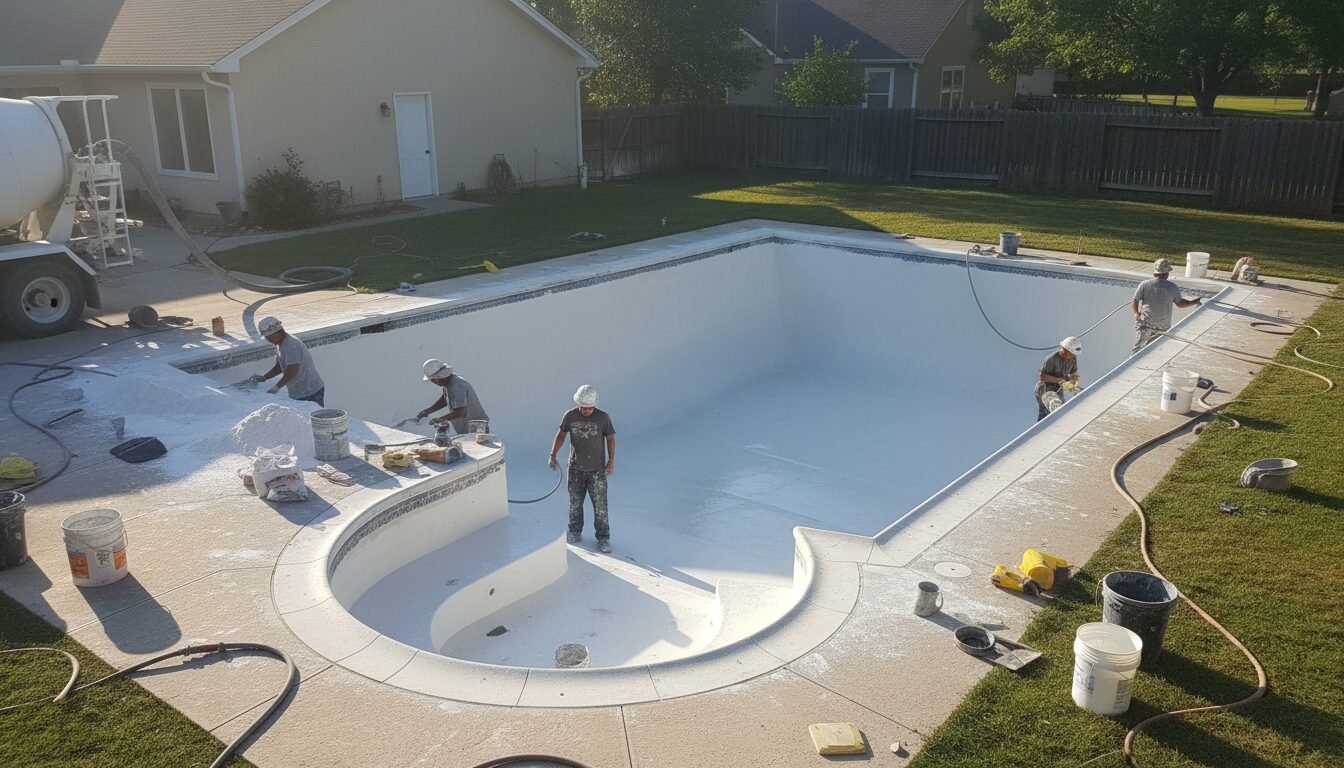
A replaster job is not just plastering. Here is what a complete project invoice for a 16×32 pool with an attached wading pool typically includes:
- Draining: Pumping down the pool costs $150 to $350 depending on your location and whether the contractor handles water discharge compliance.
- Surface Prep (Acid Wash or Sandblast): Removing the old plaster and etching the shell runs $500 to $1,500. A pool with heavy scaling or spalling may need chipping, which adds $300 to $800.
- Transition Prep: The seam between the main pool and wading pool needs special treatment to prevent cracking at the joint: budget $150 to $400.
- Plaster Application (Main Pool): Labor and materials for 1,050 to 1,150 square feet at the per-square-foot rate for your chosen finish.
- Plaster Application (Wading Pool): Labor and materials for 200 to 400 square feet, often priced at a slight premium per square foot because of the smaller working area.
- Startup Chemicals: After replastering, the pool needs a careful chemical startup sequence to cure the plaster without etching or staining it. Contractors typically charge $150 to $300 for this service, though some include it.
- Waterline Tile (Optional): If you replace or add tile at the waterline, add $500 to $2,000 depending on tile type and linear footage.
- Refilling: Water costs vary by region but budget $50 to $200 for a combined 24,000 to 30,000-gallon fill on a pool this size.
Worked Example: Standard White Plaster on a 16×32 With a 8×10 Wading Pool
Say your main pool is 16×32 with an average depth of 5 feet, giving you roughly 1,100 square feet of plaster surface. Your attached wading pool is 8×10 with 18-inch walls, adding about 250 square feet. Total plaster surface: 1,350 square feet. At $5 per square foot for white plaster, the material and labor for the plaster itself comes to $6,750. Add $250 for draining, $800 for surface prep (light acid wash, good condition), $200 for transition prep, and $200 for startup chemicals. That puts your total at roughly $8,200. If you swap white plaster for quartz at $7.50 per square foot, the plaster line alone jumps to $10,125 and your total lands around $11,500. Both numbers are before any waterline tile work or unexpected repairs.
What Drives the Cost Up (and Down)
A few things can push your quote well above or below those ranges. On the high side, old plaster that has delaminated from the shell requires chipping and a bonding coat before new plaster goes on, adding $800 to $2,000. Structural cracks need to be routed and filled before any finish goes over them: figure $300 to $600 per crack depending on length. Geographic location matters too: contractors in the Southeast and Southwest tend to charge less per square foot than those in the Northeast or Pacific Northwest where labor costs are higher. For a broader sense of regional ranges, this guide to inground pool resurfacing costs breaks down how location shifts the numbers.
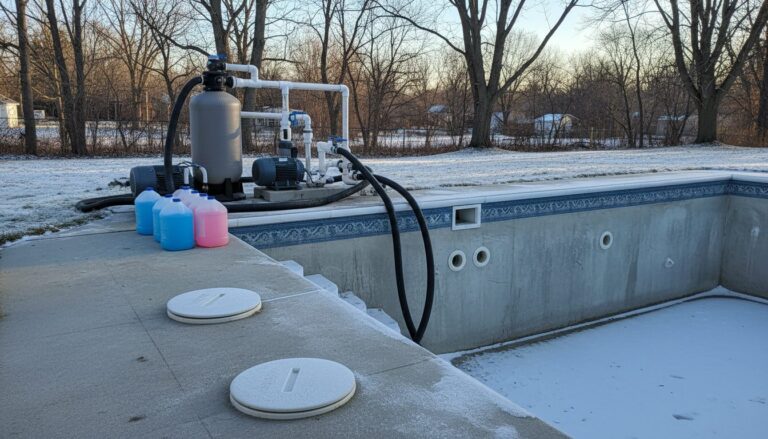
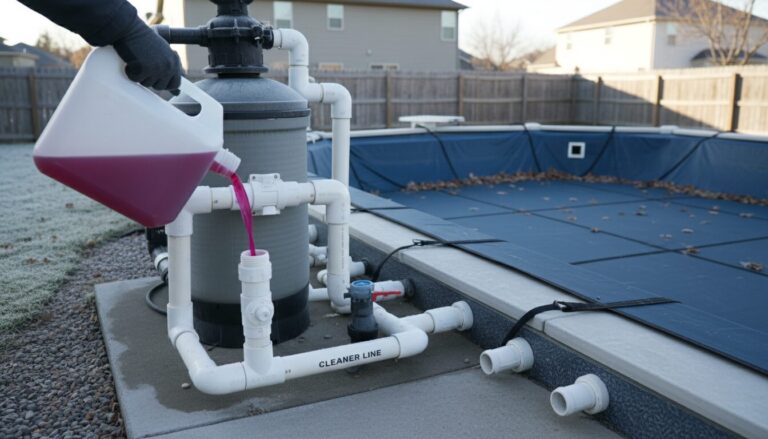
On the low side, you can trim costs by scheduling in the off-season (October through February in most markets), getting at least three quotes, and doing your own water hauling if local ordinances allow a garden hose fill. One thing you should not skip: the startup chemical sequence. Rushing or skipping the first 28-day brushing and chemistry schedule after replastering is one of the most common reasons new plaster fails early. AquaDoc makes a plaster startup kit specifically for this curing window, and it is one of those products that actually earns back its cost by protecting a $7,000 to $12,000 surface. Keep your pH between 7.2 and 7.6 and your calcium hardness between 200 and 400 ppm for the first month, and your finish will cure correctly.
Should You Replaster Both Pools at Once?
Always yes. Replastering the main pool without touching the wading pool means two different surface textures, two different ages, and two different curing schedules. Contractors also charge a mobilization fee (typically $300 to $600) to show up, set up equipment, and drain the pool. Doing both at once means you pay that fee once. If you have any doubt about timing, this overview of inground pool renovation expenses makes a strong case for bundling related work into a single project to reduce total mobilization and labor costs.
If your 16×32 is similar in layout to a 12×24 but scaled up, the pricing logic is the same: surface area drives cost more than footprint. You can see how the math works for a smaller pool with a different configuration in this breakdown of 12×24 inground pool replaster costs covering main drain and skimmer work.
Frequently Asked Questions
How much does it cost to replaster a 16×32 inground pool with a wading pool?
The typical range is $6,500 to $14,000 for a 16×32 inground pool with an attached wading pool. Standard white plaster brings you in at the lower end ($6,500 to $8,500), while pebble or quartz finishes push the total to $10,000 to $14,000 or more. Condition of the existing shell and your region will move the number within that range.
How much does the wading pool add to the replaster cost?
An attached wading pool typically adds $1,500 to $3,500 to the total bill depending on its size and shape. Contractors price by surface area, so a 6×10 shallow wading pool adds less than a 10×12 freeform design. The transition seam where the two pools meet also adds $150 to $400 in prep labor.
How often does a gunite pool need to be replastered?
Standard white plaster on a gunite pool lasts 7 to 12 years before staining, crazing, or roughness becomes a real problem. Quartz aggregate finishes last 12 to 18 years, and pebble finishes can reach 15 to 25 years. Water chemistry plays a big role: pools with chronically low pH or high calcium hardness tend to eat through plaster faster than pools with balanced water year-round.
What is the cheapest finish option for replastering an inground pool?
Standard white plaster is the most affordable at $4 to $6 per square foot installed. It works perfectly well, but it stains more easily and has a shorter lifespan than quartz or pebble options. If budget is tight, white plaster on the main pool with quartz on the wading pool (where wear is concentrated) is a reasonable compromise some contractors will accommodate.
Does replastering a pool include draining and acid washing?
Most full replaster quotes include draining and surface prep (acid wash or sandblast) as part of the job. Surface prep typically runs $500 to $1,500 depending on the pool’s condition. If the old plaster has delaminated or there are structural cracks, expect additional chipping and repair charges of $800 to $2,000 before the new finish goes on.
For a 16×32 inground pool with an attached wading pool, plan on $6,500 to $14,000 depending on finish and shell condition, get at least three quotes, bundle both pools into one project, and do not skip the startup chemistry sequence that protects your new surface during the first four weeks after application.