
You blow out the main returns, cap the skimmers, and feel pretty good about the job until you realize your pressure cleaner booster pump and its dedicated suction line are just sitting there full of water. Most winterizing guides treat a booster pump like an afterthought, and that oversight can cost you a cracked pump housing or a split pipe come February.
A pool with a booster pump and a separate cleaner line needs antifreeze in three distinct plumbing runs: the main system lines, the booster pump supply and return, and the dedicated cleaner port line. For a typical setup, that adds up to 5 to 8 quarts of non-toxic propylene glycol pool antifreeze beyond what a standard four-return pool would use. The sections below walk through how to measure each run, calculate the right volume, and apply the antifreeze in the correct order so nothing gets missed.
Why a Booster Pump Setup Changes Your Antifreeze Math
A standard inground pool might have a skimmer line, a main drain line, and three or four return jets. A booster pump system adds an independent pressurized water circuit that runs from a dedicated tee off the filter output, through the booster pump, and out to a cleaner port in the pool wall. That separate loop can hold anywhere from 2 to 5 quarts of water depending on pipe diameter and how far the equipment pad sits from the pool. Ignore it, and you have standing water in a sealed loop with no expansion room when it freezes.
The cleaner port line is a second concern. Many pools with pressure cleaners have a dedicated 1.5-inch line that runs from the booster pump discharge straight to a fitting in the pool wall or floor. This line is separate from the return jets, so blowing out the returns does not clear it. It needs its own blow-out and its own antifreeze charge.
Measuring Your Pipe Volumes: The Math That Actually Matters
Antifreeze volume is driven by pipe length and diameter, not pool size. Use these reference numbers for standard pool plumbing:
- 1.5-inch pipe: holds approximately 0.106 gallons (about 0.42 quarts) per 10 feet of run.
- 2-inch pipe: holds approximately 0.163 gallons (about 0.65 quarts) per 10 feet of run.
Walk each line and estimate the footage from the equipment pad to where it enters the pool shell. Include any vertical drops, because low spots are exactly where water collects after a blow-out.
Here is a worked example. Say your equipment pad is 25 feet from the pool wall. Your booster pump feed line is 1.5-inch pipe running 25 feet from the main plumbing tee to the pump inlet: that is 0.42 quarts per 10 feet, so 25 feet holds about 1.05 quarts. The booster pump discharge line runs another 30 feet of 1.5-inch pipe to the cleaner port in the wall: 30 feet holds about 1.26 quarts. Round both up for safety and you need roughly 1.5 quarts for the feed side and 1.5 quarts for the discharge side, for a booster pump sub-total of 3 quarts. Add that to whatever your main return and skimmer lines require, and you can see how fast a full system antifreeze job climbs to 6 or 7 quarts total.
Step-by-Step: Winterizing the Booster Pump and Cleaner Line
- Step 1: Shut down and drain the booster pump. Turn off the pump and close the isolation valve on its feed line. Open the drain plug on the pump housing and let all water drain out completely. The pump volute must be empty before you cap anything.
- Step 2: Blow out the booster pump feed line. Connect your blow-out plug to the feed line at the equipment end and run compressed air at 30 to 50 PSI until you see a steady stream of bubbles at the pool end. This pushes standing water back toward the pool.
- Step 3: Blow out the cleaner line. Move your blow-out plug to the booster pump discharge port and repeat the same process. Air should exit at the cleaner port fitting in the pool wall or floor. Keep the air running until bubbles are consistent, not sputtering, for at least 30 seconds.
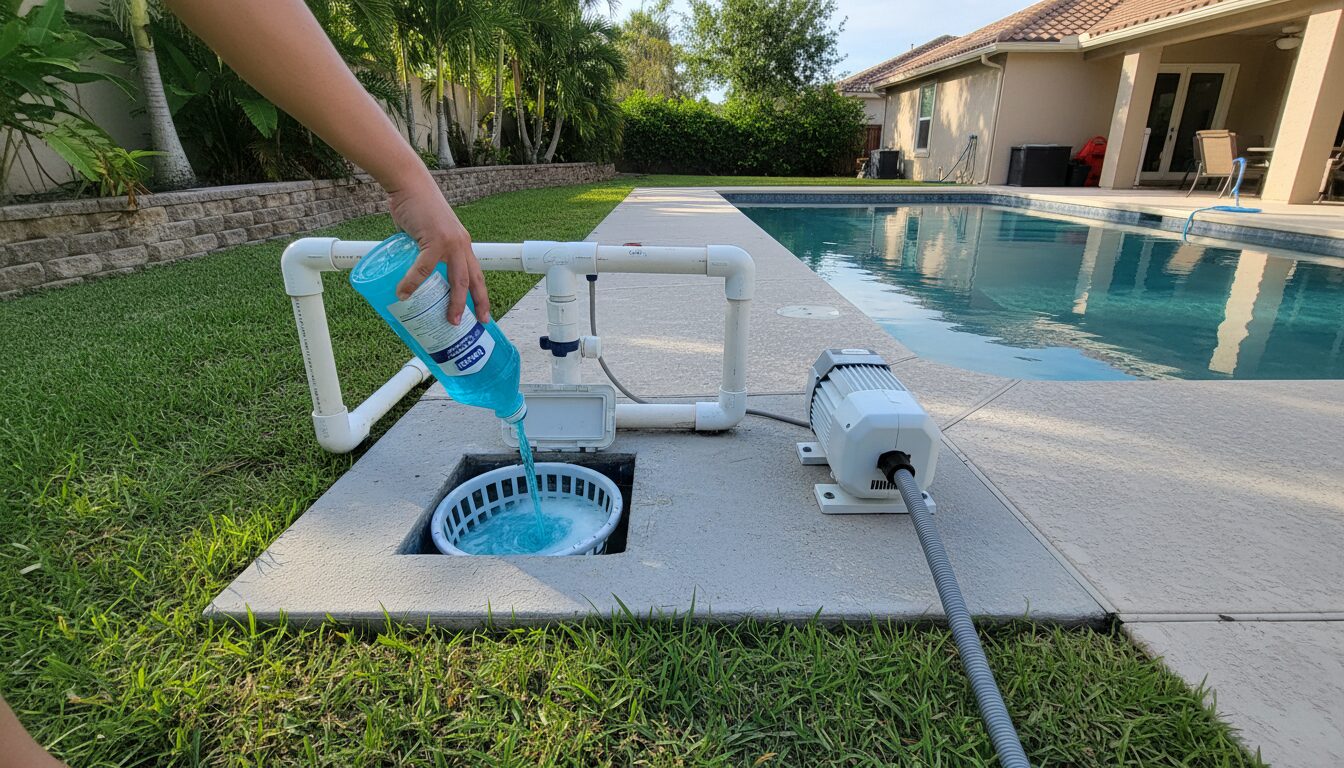
- Step 4: Pour antifreeze into the booster feed line. With the pool-side end still open (or the fitting loosened), pour 1.5 quarts of non-toxic propylene glycol pool antifreeze into the equipment-end opening. The liquid fills the low spots the air missed. Cap the equipment end securely.
- Step 5: Pour antifreeze into the cleaner line. Same process: pour 1.5 quarts into the discharge side at the equipment end, then cap. If your cleaner port has a winterizing plug, install it now so the antifreeze stays in the line rather than draining back into the pool.
- Step 6: Cap and protect the booster pump ports. Install threaded plugs or rubber expansion plugs on every open port of the booster pump body. Some owners wrap the pump body with foam pipe insulation as a backup layer of protection against temperature swings.
Antifreeze Amounts by System Size: Quick Reference
| Plumbing Run | Typical Length | Pipe Size | Antifreeze Needed |
|---|---|---|---|
| Booster pump feed line | 15 to 30 ft | 1.5 in | 1 to 1.5 qt |
| Booster pump discharge / cleaner line | 20 to 40 ft | 1.5 in | 1 to 2 qt |
| Standard return lines (3 to 4 jets) | 15 to 25 ft each | 1.5 in | 1 qt per line |
| Skimmer line(s) | 15 to 25 ft each | 1.5 in | 1 qt per line |
| Main drain line | 20 to 35 ft | 2 in | 1.5 to 2 qt |
Why These Numbers Matter for Your Decision
The table makes clear that a booster pump and cleaner line add one and a half to three and a half quarts to your total antifreeze purchase. If you budgeted a single gallon (4 quarts) for a straightforward four-return pool, add at least one more gallon when a booster pump system is in the picture. Running short mid-job and leaving a line half-treated is worse than using none at all, because diluted antifreeze can still freeze at a higher temperature than pure water would.
AquaDoc makes a propylene glycol pool antifreeze that pool owners use specifically because the formula is non-toxic and rated down to minus 40°F, which gives real margin in cold climates. Pour it undiluted for lines you could not fully clear with air.
Common Mistakes to Avoid
- Skipping the booster pump drain plug: The pump housing is the lowest point in its circuit. If you only blow out the pipes and skip the drain plug, water sits in the volute and freezes. Always open the drain plug before blowing out the lines.
- Assuming the cleaner line shares a return: It does not. The cleaner port is a dedicated fitting with its own pipe run back to the booster pump. Blowing out your return jets will not touch it.
- Using too little antifreeze: A quart poured into a 40-foot line barely coats the bottom. Use the pipe volume math above and add 10 percent as a buffer for lines with multiple bends.
- Using automotive antifreeze: Ethylene glycol is toxic. Every drop that migrates back into the pool is a contamination problem in spring. Use only propylene glycol-based pool antifreeze.
- Forgetting the booster pump isolation valve: If your booster pump feed has an isolation ball valve, leave it in the open position after winterizing. A closed valve traps antifreeze on one side and an untreated water pocket on the other.
If your pool has ever given you plumbing surprises (and a booster pump setup usually means you have invested in more than just the basics), protecting that equipment at closing is worth the extra few quarts of antifreeze. Pools with more complex equipment pads are also the ones where deferred maintenance becomes expensive fast. If you are thinking through other long-term costs, the breakdown of a 12×24 inground pool replaster with a main drain and two skimmers shows how quickly an equipment-heavy pool can stack up repair bills when winterization gets skipped. And if your booster pump has been making noise lately, it may be worth reading about what those pump sounds actually mean before you button everything up for winter.
Frequently Asked Questions
How much antifreeze do you need for a pool with a booster pump?
Budget at least 1 quart of non-toxic pool antifreeze per 10 feet of 1.5-inch pipe, and treat the booster pump supply and return lines as two separate runs. A typical booster pump installation with 20 feet of feed line and 15 feet of return adds roughly 2 quarts on top of your main system total, bringing most complete pool closing jobs to 6 to 8 quarts overall.
Do you put antifreeze in the booster pump itself?
No. The booster pump housing must be fully drained and blown out with compressed air before you cap the lines. Antifreeze goes into the pipes leading to and from the pump, not the pump body itself. Leaving water trapped in the pump volute will crack it when temperatures drop below 32°F, and pump housings are not cheap to replace.
How much antifreeze goes in a dedicated cleaner line?
A dedicated cleaner line typically runs 20 to 40 feet of 1.5-inch pipe from the equipment pad to the cleaner port in the wall. That range holds roughly 1 to 2 quarts of fluid, so pour in 2 quarts to ensure the liquid reaches all the low spots the blow-out air missed. Install a winterizing plug at the cleaner port fitting to keep the antifreeze in the line.
Can you use automotive antifreeze in pool plumbing lines?
No. Automotive antifreeze contains ethylene glycol, which is toxic and will contaminate your pool water in spring. Use only propylene glycol-based pool and spa antifreeze, which is rated non-toxic and is safe for plumbing that contacts pool water. The two products look similar on the shelf, so check the label before you buy.
Do you need to blow out the cleaner line before adding antifreeze?
Yes. Blow out the cleaner line with compressed air at 30 to 50 PSI first to push the bulk of standing water back toward the pool. Then pour antifreeze into the line from the equipment end so it fills the residual low spots the air missed. Skipping the blow-out leaves too much water in the pipe, which dilutes the antifreeze and raises its freeze point significantly.
A booster pump and separate cleaner line add roughly 2 to 4 quarts of antifreeze to your total closing job. Measure each line, blow it out first, then pour in enough propylene glycol antifreeze to cover the residual low spots, and your plumbing will come through winter intact.