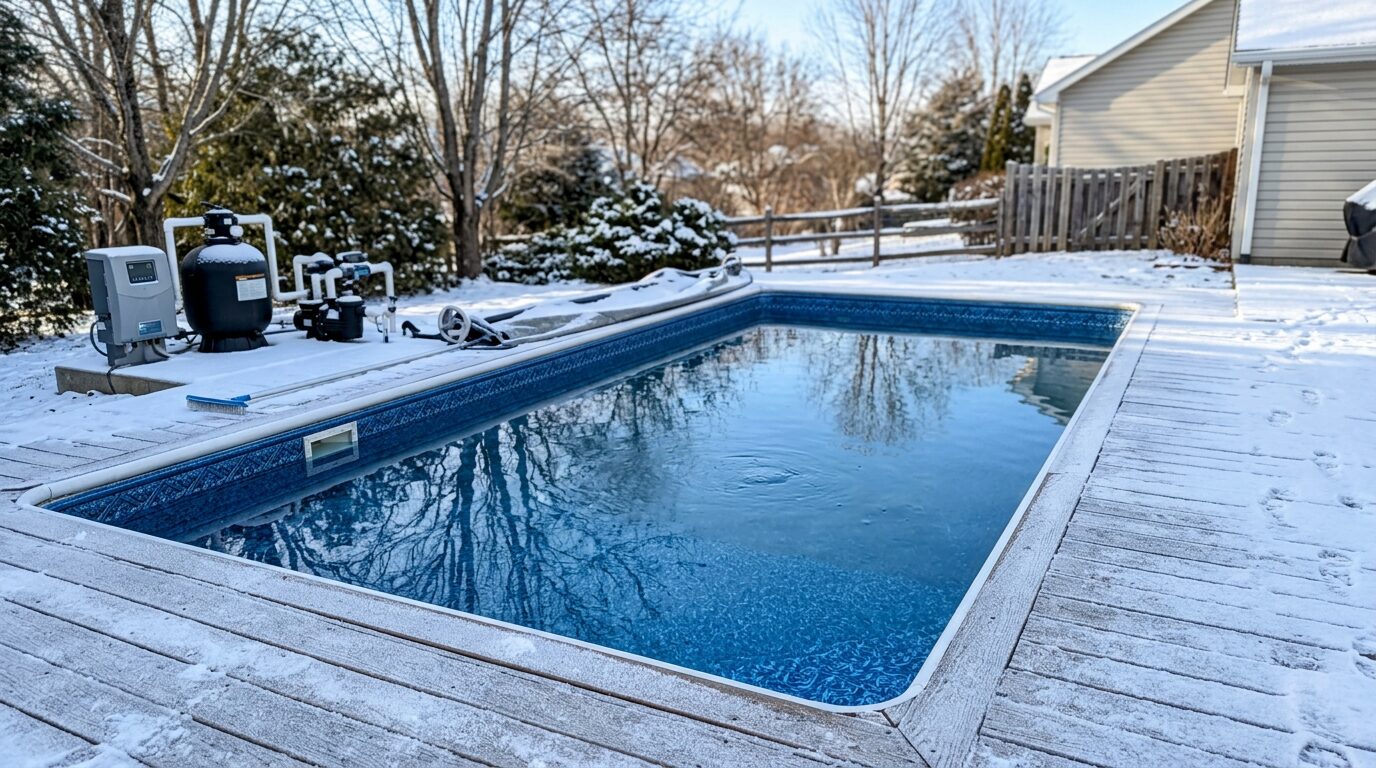

You spent real money on that liner and now you’re staring at a bead that’s starting to pull away from the track, wondering whether the salt system or the Michigan winters are the culprit, or whether both have been quietly working against you all along. It’s a fair question, and the answer changes depending on how well the chemistry has been managed over the years.
A vinyl pool liner in a cold climate with a saltwater system typically lasts 8 to 12 years. That’s shorter than the 12 to 15 years you might get in a warmer region with a conventional chlorine setup, but it’s not inevitable. The gap closes significantly when pH is kept tight and the pool is closed correctly each fall. This article covers what actually shortens liner life in cold climates, what the salt system adds to the picture, and the specific steps you can take to push replacement as far out as possible.
Why Cold Climates Are Hard on Vinyl Liners
The core problem in freeze country is thermal stress. Vinyl expands and contracts with temperature swings, and over many years of hard winters, that cycling fatigues the material at its weakest points: seams, corner welds, and the cutouts around fittings. A liner that might flex comfortably in a Georgia winter is working much harder when temperatures drop to 10°F in January.
Ice is the more immediate danger. If water freezes against an unsupported section of liner, the expanding ice can crack or tear the vinyl outright. The risk is highest when the pool is drained too low at closing. Keeping the water level within the normal operating range at winterization (most cold-climate pool pros recommend no more than 12 to 18 inches below the skimmer) gives the liner the support it needs and lets any ice sheet float on the surface rather than pressing hard against the walls.
Improper closing also accelerates liner aging through chemistry. A pool closed with high chlorine and low pH will continue attacking the vinyl under the cover all winter. The liner doesn’t get a break just because nobody’s swimming in it.
What the Saltwater System Actually Does to the Liner
Salt at the right concentration (2,700 to 3,200 ppm) is not inherently more damaging to vinyl than traditionally chlorinated water. The concern is real but it’s more specific than most people realize: the risk comes from chlorine output, not the salt itself.
Salt cells generate chlorine continuously, and if the cell’s output percentage is set too high or if the pump runs many hours a day, free chlorine can spike above 5 to 6 ppm for extended periods. Sustained high chlorine levels bleach and embrittle vinyl faster than anything else in the system. A liner that’s been running at 4 to 6 ppm free chlorine for three summers will show its age much sooner than one kept consistently at 1 to 3 ppm.
pH drift is the second salt-specific issue. Saltwater systems naturally push pH upward over time, and if you’re not testing and correcting weekly, pH can creep above 7.8. High pH doesn’t hurt the liner the same way high chlorine does, but it reduces chlorine effectiveness, which tempts owners to crank the cell output higher, and that creates the high-chlorine problem described above. Keeping pH in the 7.2 to 7.6 range keeps the whole system in balance. AquaDoc’s pH Down is formulated specifically for saltwater pools where pH drift is a recurring issue rather than an occasional correction.
The Combined Effect: Cold Climate Plus Salt System
When you stack a cold climate on top of a saltwater system, the two stressors compound. Here’s how the typical damage pattern plays out:
- Years 1 to 4: The liner looks nearly new. Minor fading is possible if pH has been running high, but the vinyl is still pliable and seams are intact.
- Years 5 to 8: Fading accelerates. Small repairs (patch kits for punctures or minor tears near fittings) become more common. If the liner has been closed incorrectly even once or twice, bead separation can begin.
- Years 9 to 12: The liner becomes brittle enough that patches don’t hold well. Seams in corners and deep-end transitions are most vulnerable. This is the typical replacement window in a cold-climate saltwater pool managed with average care.
- Years 13 and beyond: Possible if chemistry has been managed carefully and the pool was closed correctly every year, but the liner is on borrowed time. A single hard winter or a season of chemistry neglect can end it quickly at this stage.
What Shortens Liner Life the Most
Not all damage is equal. These are the factors that cut years off a liner’s lifespan fastest:
- Chronic high chlorine: Running free chlorine above 4 ppm for weeks at a time bleaches and stiffens vinyl. Keep it at 1 to 3 ppm for a saltwater pool.
- Low pH over time: pH below 7.0 causes vinyl to become brittle and lose plasticizers. This is less common with salt systems (which tend to push pH up), but it happens after aggressive acid additions without retesting.
- Draining too low for winter: Pulling the water level down past 18 inches below the skimmer removes the support the liner needs to survive freeze-thaw cycles without cracking.
- Algae and aggressive chemical treatments: Repeated super-shocking to clear algae, especially with calcium hypochlorite granules dropped directly onto the liner, creates concentrated bleach contact that leaves permanent bleached spots and accelerates aging.
- UV exposure from an uncovered pool: A pool left open during the off-season in a region with strong sun (even cold regions get intense fall UV) degrades the vinyl surface faster than chemistry alone.
How to Get the Full 12 Years Out of a Cold-Climate Saltwater Liner
The difference between an 8-year liner and a 12-year liner usually comes down to consistency on about four things:
- Test and adjust pH weekly during the season. Salt systems drift. Weekly testing is not excessive; it’s what keeps everything else in range. Target 7.2 to 7.6, correct with acid before pH climbs above 7.8.
- Set the salt cell output conservatively. Most residential cells are set higher than necessary. If your free chlorine is consistently above 3 ppm, dial the output back. You want 1 to 3 ppm, not 4 to 6.
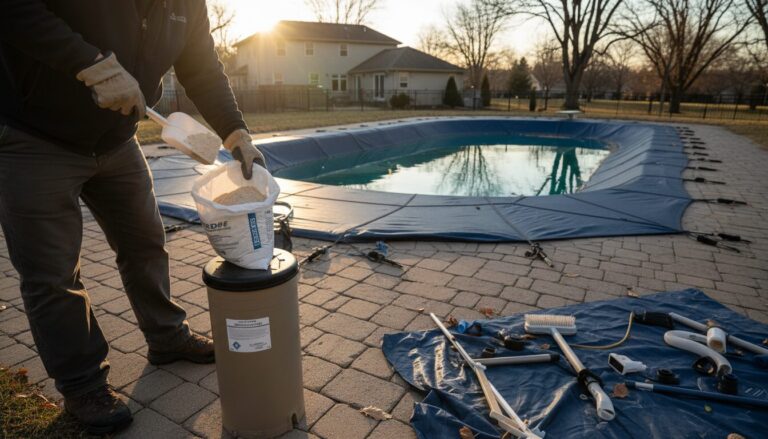
- Close the pool correctly every fall. This means bringing chemistry into balance before you cover it, keeping the water level at the right depth, winterizing the lines properly, and using a solid or mesh safety cover that blocks UV. If you need a reference on what a thorough winterization looks like for an inground liner pool, the 12×24 inground pool replaster cost breakdown on this site touches on what deferred maintenance actually costs when chemistry damage compounds over seasons.
- Never add granular shock directly to the liner. Always pre-dissolve granular products in a bucket of water first. For liquid shock or sodium hypochlorite, pour it slowly into the deep end with the pump running. Direct contact between concentrated chlorine and vinyl leaves permanent bleached marks and weakens that spot.
Liner Thickness and Material Quality Matter Too
A 20-mil liner will outlast a 20-mil competitor in the same pool if the underlying vinyl formulation includes better UV stabilizers and plasticizers. In cold climates, ask your liner supplier specifically about plasticizer retention at low temperatures. Thicker isn’t always better if the material is cheap; a quality 20-mil liner often outperforms a bargain 28-mil option. When you’re budgeting for replacement, the liner itself is usually not where you want to cut costs. Installation labor runs $1,000 to $2,500 for a standard inground pool regardless of which liner you choose, so putting an extra $200 to $400 into better material is almost always worth it. If you’re curious how other pool renovation expenses stack up, it’s worth reviewing what full replastering projects run on this site, since liner and plaster timelines often align when a pool is reaching the end of a renovation cycle.
Frequently Asked Questions
How long does a pool liner last in a cold climate with a saltwater system?
Expect 8 to 12 years in a cold climate with a saltwater system. Without the freeze-thaw stress and with careful salt chemistry, the same liner might last 12 to 15 years in a warmer region. Keeping pH between 7.2 and 7.6 and salt levels at the lower end of your cell’s range (around 2,700 to 3,000 ppm) makes the biggest difference.
Does a saltwater pool damage vinyl liners faster than chlorine?
Not on its own. Saltwater at the correct concentration (2,700 to 3,200 ppm) is no harsher on vinyl than traditionally chlorinated water. The risk comes from chlorine spikes when the salt cell is set too high or pH drifts above 7.8, which causes accelerated bleaching and brittleness in the liner over time.
What happens to a pool liner during a cold winter freeze?
Freeze-thaw cycling causes the vinyl to contract and expand repeatedly, stressing the seams and fitting cutouts over time. If the water level is too low and ice forms against unsupported sections of liner, that area can crack or tear. Keeping the water level up at closing and using a proper winter cover reduces this risk significantly.
How do I know when my vinyl liner needs to be replaced?
The clearest signs are persistent leaks that can’t be patched, fading and brittleness that makes the vinyl crack when you press it, and liner bead pulling out of the track along the waterline. Surface staining alone doesn’t mean the liner is done, but if you’re patching more than once a season, replacement is almost certainly cheaper than ongoing repairs at that point.
Does draining a pool for winter hurt the liner in a cold climate?
Yes. Draining a vinyl liner pool completely for winter is one of the fastest ways to destroy the liner. Without water weight holding it in place, the liner shrinks in the cold and pulls away from fittings and the bead track. The correct approach for a cold-climate inground liner pool is to lower the water level only slightly (12 to 18 inches below the skimmer) and use antifreeze in the lines.
In a cold climate with a saltwater system, a vinyl liner that’s managed well lands between 10 and 12 years. Let chemistry drift or close the pool sloppily a few winters in a row, and you’ll be back at 8. Tight pH control and a correct fall closing are the two things that matter most.