
You’ve drained the filter, bagged the skimmer, and you’re staring at the plumbing loop that runs through your above-ground pool heater, wondering whether the same antifreeze rules apply or if there’s a whole separate calculation hiding in there. There is, and most winterizing guides skip right past it.
The short answer: add 1 quart of non-toxic propylene glycol pool antifreeze per 10 linear feet of 1.5-inch pipe, or 1 quart per 7 to 8 feet of 2-inch pipe, for every line in the system, including the heater inlet and outlet runs. A heater in the plumbing loop typically adds 10 to 20 feet of pipe beyond what a basic filter system uses, so budget 2 to 3 extra quarts on top of your base amount. This article walks through how to measure each line, how the heater changes the math, and exactly how to get antifreeze into the right places without wasting a drop.
Why the Heater Loop Changes the Calculation
A standard above-ground pool filter system runs water from the skimmer out to the pump, through the filter, and back to the return. Add a heater and you’ve inserted another appliance into that loop, which means the water travels extra pipe before returning to the pool. That extra pipe freezes just as readily as everything else, and the heater’s own internal heat exchanger can hold residual water that cracks the unit if it freezes solid.
The pipe runs between the filter and the heater inlet, and between the heater outlet and the pool return, are the sections most people forget to account for. In a typical backyard setup, those two runs together add 10 to 20 linear feet to your total pipe count. At the standard 1-quart-per-10-feet rate for 1.5-inch pipe, that’s 1 to 2 additional quarts you’d be leaving out of the calculation entirely if you only used the generic “above-ground pool filter system” instructions on the bottle.
Step 1: Measure Every Line in Your Plumbing Loop
Grab a tape measure and walk the perimeter of your equipment pad. You’re counting four sections: the suction line from the skimmer to the pump, the line from the pump to the filter, the line from the filter to the heater inlet, and the line from the heater outlet back to the pool return. Write each measurement down. If your system has a bypass valve around the heater, measure that branch too, because antifreeze needs to reach any line that can hold standing water.
Here’s a worked example. Say your measurements look like this:
- Skimmer to pump: 8 feet of 1.5-inch pipe
- Pump to filter: 4 feet of 1.5-inch pipe
- Filter to heater inlet: 10 feet of 1.5-inch pipe
- Heater outlet to pool return: 12 feet of 1.5-inch pipe
Total: 34 linear feet of 1.5-inch pipe. Divide by 10 and you get 3.4 quarts. Round up to 4 quarts (1 gallon) to account for fittings and low spots. That’s your antifreeze purchase for the plumbing alone. Without the heater runs you’d have had 12 feet, or just 1 to 2 quarts. The heater loop nearly tripled the amount needed in this example.
How to Handle the Heater Itself
Do not pour antifreeze into the heater body. Most heat pump and gas heater manufacturers specify that the unit must be fully drained before winterizing, and they do not want antifreeze sitting inside the heat exchanger or burner section. If antifreeze contacts certain internal components it can degrade seals or leave deposits. For guidance specific to heat pumps, Zagers Pool and Spa’s winterizing guide walks through the proper drainage steps before you ever touch the antifreeze.
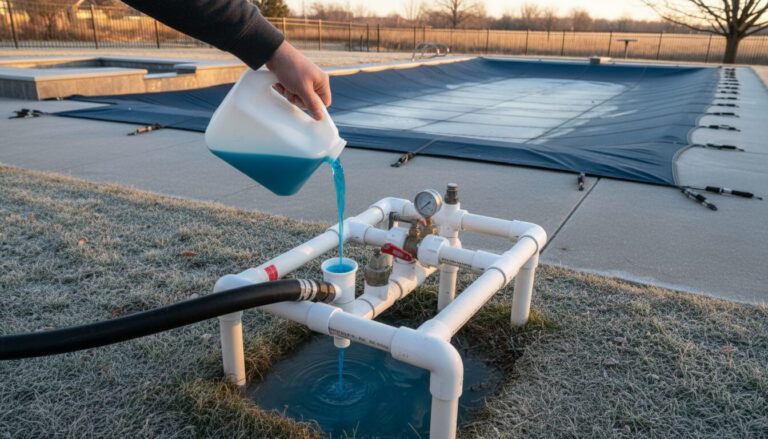
What you do instead is this: drain the heater completely using the drain plug (usually at the lowest point on the unit), then blow out the inlet and outlet pipes with a shop vac or compressor set to no more than 30 PSI. Once the pipes are clear, pour antifreeze into each pipe opening until it flows through. Cap or plug both the inlet and outlet once antifreeze appears at the far end. The antifreeze is protecting the pipes and fittings adjacent to the heater, not the heater itself.
Which Antifreeze to Buy (and What to Avoid)
Only propylene glycol-based antifreeze rated for pool, spa, or potable water systems belongs in pool plumbing. It’s typically pink or clear, labeled “non-toxic,” and sold in quart or gallon jugs at pool supply stores. Ethylene glycol – the green or orange stuff in automotive antifreeze – is toxic to people, pets, and the environment. Never use it in pool plumbing, ever. The two products are not interchangeable.
Propylene glycol antifreeze is rated to protect pipes down to -50°F in full concentration, though most pool applications dilute it somewhat with residual water in the lines. That’s still more than enough protection in all but the most extreme climates. This breakdown of pool antifreeze quantities goes into more detail on how dilution affects freeze protection if you want to dig into the chemistry. AquaDoc makes a propylene glycol pool antifreeze specifically formulated for residential pool and spa plumbing, and it’s one of the brands pool owners reach for because the formula is clearly labeled for this application.
Step 2: Get the Antifreeze Into the Right Places
Follow these steps in order after you’ve drained and blown out the lines:
- Remove the drain plug from the pump and filter and allow them to drain completely.
- Drain the heater via its drain plug, then reinstall the plug loosely so water can’t pool inside.
- Blow out the skimmer line from the skimmer basket opening until no water sprays from the pump end.
- Pour antifreeze directly into the skimmer line at the skimmer basket opening: 1 quart per 10 feet of 1.5-inch pipe, rounding up.
- Plug the skimmer outlet fitting at the pump with a winterizing plug.
- Blow out and add antifreeze to the filter-to-heater inlet line, pouring in at the filter end and plugging once antifreeze appears at the heater inlet port.
- Blow out and add antifreeze to the heater outlet-to-return line, pouring at the heater outlet side and plugging the return fitting at the pool wall.
- Install a Gizzmo or expansion plug in the skimmer body to absorb ice expansion in any residual water.
One mistake people make: they add antifreeze to the skimmer and forget the return line entirely, assuming blowing it out was enough. Any line that has a low spot where water can collect needs antifreeze as a backup. If you had a cold snap sneak up on you in the past and want the full story on what that looks like for a heater, this account of a heater that survived right up until an unexpected storm is a good reminder of why proper winterizing matters even in mild climates.
Typical Antifreeze Quantities by Pool and Heater Setup
| Pool Size | Base Filter System (no heater) | Added for Heater Loop | Total Estimate |
|---|---|---|---|
| 12-ft round (small) | 1-2 quarts | 1-2 quarts | 2-4 quarts |
| 18-ft round (medium) | 2-3 quarts | 2-3 quarts | 4-6 quarts (1-1.5 gal) |
| 24-ft round (large) | 3-4 quarts | 2-3 quarts | 5-7 quarts (~1.5 gal) |
| 15×30 oval (large) | 3-4 quarts | 2-3 quarts | 5-7 quarts (~1.5 gal) |
These are estimates based on typical equipment pad layouts. Your actual pipe runs may be shorter or longer depending on where your equipment sits relative to the pool. Measure first; the table is a sanity check, not a substitute for a tape measure.
What Happens to the Heater in Spring
When you open the pool, flush the lines before starting the heater. Run fresh water through the plumbing to clear the antifreeze before firing up the heat exchanger. Propylene glycol is non-toxic, but concentrated residue in the lines can foam slightly and affect water chemistry until it’s diluted out. Most pool openers run the pump for a full turnover cycle before adding opening chemicals, and that’s usually enough to flush any residual antifreeze through the system. For a full primer on what can go wrong with a heater at startup after winter storage, this heat pump pool heater winterizing guide covers the reconnection checklist in detail.
Frequently Asked Questions
How much antifreeze does an above-ground pool with a heater need?
Plan on 1 quart of non-toxic pool antifreeze per 10 linear feet of 1.5-inch pipe, and 1 quart per 7 to 8 linear feet of 2-inch pipe, for every line in the system. A heater in the plumbing loop typically adds 10 to 20 extra feet, which means 2 to 3 additional quarts beyond the base filter-system amount. Most setups end up using 1 to 1.5 gallons total.
Do you put antifreeze in a pool heater or just the pipes?
You put antifreeze in the pipes leading to and from the heater, not inside the heater itself. Drain the heater completely through its drain plug, then blow out and add antifreeze to the inlet and outlet pipe runs. Most heater manufacturers explicitly state the unit should be fully drained for winter storage, not filled with antifreeze.
What kind of antifreeze is safe for pool plumbing?
Only propylene glycol-based antifreeze labeled for pool, spa, or potable water systems is safe. Automotive antifreeze (ethylene glycol) is toxic and must never be used in pool plumbing. Propylene glycol is rated to protect down to -50°F in full concentration, which is more than sufficient for most residential pools.
How much antifreeze do you need for a 24-foot round above-ground pool with a heater?
Expect to use roughly 5 to 7 quarts (about 1.5 gallons) total. The base filter system on a 24-foot pool typically needs 3 to 4 quarts for 30 or so feet of pipe, and the heater loop adds another 2 to 3 quarts. Measure your actual pipe runs to confirm before you buy.
Can you skip antifreeze if you blow out the lines?
You can skip it if you are absolutely certain every line and low spot is completely dry and all fittings are plugged. In practice, most winterizing pros add at least 1 quart per line as insurance against residual water in an elbow or fitting that a blower didn’t fully clear. The cost of a gallon of antifreeze is far less than a cracked PVC fitting or a damaged heater port.
Bottom Line
An above-ground pool with a heater in the plumbing loop needs 2 to 3 quarts more non-toxic pool antifreeze than a basic filter system – measure your heater inlet and outlet runs, add them to your total pipe footage, and calculate at 1 quart per 10 feet of 1.5-inch pipe. Drain the heater itself completely, protect the pipes on either side, and you’re covered.