
Keeping an above-ground pool clean comes down to five chemicals: chlorine, shock, pH adjusters, alkalinity increaser, and cyanuric acid (stabilizer). Get those five dialed in and you’ll have clear water all season. The trick is learning the right order and the right amounts – most beginners struggle not because pool chemistry is hard, but because the instructions on product labels assume you already know what you’re doing. This guide fills that gap.
Why Above-Ground Pool Chemistry Feels Harder Than It Is
Above-ground pools are actually simpler to maintain than in-ground pools in most ways. Smaller volume means chemicals take effect faster, costs are lower, and problems are easier to catch early. The confusion usually starts at the pool store when someone hands you a bag of six different products without explaining how they relate to each other. Once you understand that all pool chemistry is just about keeping chlorine working efficiently, the whole system clicks.
Chlorine is your primary sanitizer. Everything else – pH, alkalinity, stabilizer – exists to make chlorine do its job. When your pH is off or your alkalinity is unstable, chlorine either burns through too fast or becomes almost useless. That’s why the order you add chemicals matters as much as the chemicals themselves. For a deeper look at sequencing, Above-Ground Pool Chemicals: What to Add First and Why walks through the logic in detail.
What Are the Five Essential Pool Chemicals?
1. Chlorine tablets or granules. This is your week-to-week sanitizer. Most above-ground pool owners use 3-inch tablets in a floating dispenser or skimmer basket. For a 10,000-gallon pool, one tablet every 5-7 days keeps free chlorine in the 2-4 ppm target range. Never toss tablets directly on the liner – they’re concentrated enough to bleach or degrade it on contact.
2. Pool shock. Shock is a high-dose chlorine treatment (usually calcium hypochlorite or dichloroisocyanurate) that burns off chloramines, kills algae, and resets your water after heavy use. Shock weekly during summer, after any rainstorm that adds significant water, or after a large pool party. The standard dose is 1 lb of granular shock per 10,000 gallons of water. Always shock at dusk or after dark – UV sunlight degrades unstabilized shock quickly.
3. pH adjusters (increaser and decreaser). Target a pH of 7.2 to 7.6. Above 7.8, chlorine loses most of its killing power. Below 7.2, you’ll get eye irritation and your liner deteriorates faster. pH Up is sodium carbonate (soda ash); pH Down is sodium bisulfate or muriatic acid. Add in small increments – 6 oz of pH Down per 10,000 gallons moves pH down by roughly 0.2 points.
4. Alkalinity increaser. Total alkalinity (TA) is the buffer that keeps pH stable. Target 80-120 ppm. If TA is too low, your pH will bounce around daily no matter how often you adjust it. Raise TA with sodium bicarbonate (plain baking soda works): 1.5 lbs per 10,000 gallons raises TA by about 10 ppm. Always fix alkalinity before you try to fix pH – trying to chase pH with unstable TA is the most common beginner mistake.
5. Cyanuric acid (stabilizer/conditioner). CYA protects chlorine from UV degradation. Without it, summer sun can destroy your free chlorine in 2-3 hours. Keep CYA at 30-50 ppm for an outdoor above-ground pool. If you’re using stabilized chlorine tablets (most 3-inch tablets contain CYA), your levels will build up over the season on their own – test every few weeks and stop adding dedicated stabilizer if you’re already in range. Above 80 ppm, CYA actually starts suppressing chlorine effectiveness.
What Order Should You Add Pool Chemicals?
- Test your water first. Know your starting numbers before adding anything. A basic test kit or strips should give you free chlorine, pH, alkalinity, and ideally CYA levels.
- Adjust total alkalinity. Get this to 80-120 ppm before touching pH.
- Adjust pH. Once alkalinity is stable, pH is easier to dial in and stays put.
- Add stabilizer if needed. If CYA is below 30 ppm and you’re using unstabilized chlorine, add it now.
- Add chlorine or shock last. Never add shock and pH adjusters at the same time – the reaction can produce irritating gases and wastes both chemicals. Space additions by at least 15-30 minutes and always run the pump.
Common Beginner Mistakes (and How to Avoid Them)
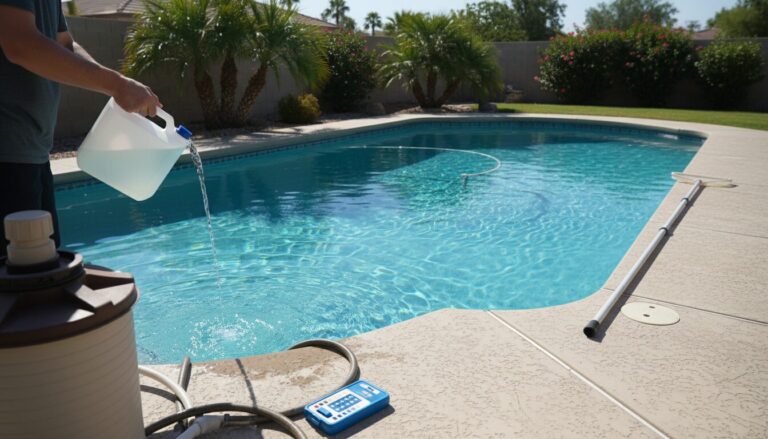
The biggest mistake new pool owners make is adding chemicals directly to the pool without the pump running. Always run your pump when adding chemicals – it distributes them evenly and prevents concentrated pockets from damaging your liner. Run the pump for at least 30 minutes after each addition, and wait an hour or two before retesting.
Another common error: over-correcting. If your pH tests at 7.9, the temptation is to dump in a bunch of pH Down and retest in 20 minutes. Resist that urge. Add the calculated dose, let the pump run for 4-6 hours, then test again. Pool chemistry moves slowly, and overcorrection creates a seesaw effect that’s harder to fix than the original problem.
Buying cheap test strips and trusting them completely is also a trap. Strips are fine for quick spot-checks, but a liquid drop test kit gives you more accurate readings for alkalinity and chlorine. Test 2-3 times per week during peak swim season. AquaDoc makes a 5-in-1 test kit that pool owners use for exactly this kind of routine monitoring – it covers chlorine, pH, alkalinity, CYA, and calcium hardness in one kit.
Putting Together a Simple Weekly Routine
A realistic weekly above-ground pool chemical routine takes about 10-15 minutes. Test on Monday and Thursday. Replace chlorine tablets as needed. Shock on Friday evening before the weekend if you’re expecting heavy use. Check and adjust pH and alkalinity only when they’re out of range, not on a fixed schedule. That’s it. You don’t need to add something every day to have a clean pool – you just need consistent testing and quick corrections when numbers drift.
For a full breakdown of how this fits into a broader maintenance schedule, the Above-Ground Pool Chemicals for Beginners: What You Actually Need guide covers equipment and chemical products side by side.
Frequently Asked Questions
What chemicals do I need for an above-ground pool?
You need chlorine (tablets or granules), pool shock, pH increaser or decreaser, alkalinity increaser, and cyanuric acid (stabilizer). That covers 95% of what a typical above-ground pool requires to stay clean and safe all season.
How much chlorine do I add to my above-ground pool?
Target a free chlorine level of 2-4 ppm. For a 10,000-gallon pool, one 3-inch chlorine tablet in a floater or skimmer basket typically maintains that range. Adjust based on your weekly test results and how much sun and swim traffic your pool gets.
What order should I add chemicals to a pool?
Adjust total alkalinity first, then pH, then add chlorine or shock last. Adding chlorine before your pH is balanced wastes money because chlorine becomes far less effective outside the 7.2-7.6 pH range.
How often should I add chemicals to an above-ground pool?
Test your water 2-3 times per week during swim season. Chlorine tablets need replacing every 5-7 days. Shock weekly or after heavy use, rain, or a large gathering. Alkalinity and pH adjustments happen only as needed based on test results – not on a fixed schedule.
What pH should my above-ground pool be?
Keep pH between 7.2 and 7.6. Below 7.2, the water irritates eyes and skin and accelerates liner wear. Above 7.8, chlorine becomes largely ineffective and you’ll start seeing cloudy water or early algae growth.
Pool chemistry gets easier every week you do it. The first season feels like guesswork; the second season feels like routine. Stick to the basics – test consistently, adjust alkalinity before pH, and shock regularly – and you’ll spend a lot more time in the water than chasing it.
For more on professional pool care approaches, the team at Poolwerx covers a range of water chemistry topics from a service technician’s perspective.